Computer Science · Ch 3 — Emerging Trends
Grid Computing
Grid Computing
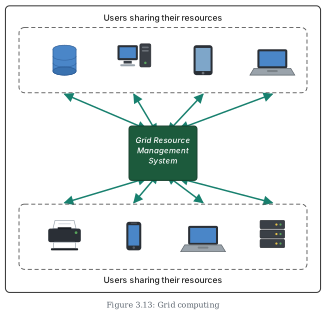
A grid is a computer network of geographically dispersed and heterogeneous computational resources (Figure 3.13) — machines of different kinds, in different places, pooled together. Unlike the cloud, whose primary focus is to provide services, a grid is more application-specific: it creates the sense of a virtual supercomputer with enormous processing power and storage.
Nodes and how a grid works
- The constituent resources of a grid are called nodes.
- Different nodes temporarily come together to solve a single large task and reach a common goal — the grid forms around the problem, then can dissolve.
Today, countless computational nodes — from hand-held mobile devices to personal computers and workstations — are connected to a LAN or to the Internet. It is therefore economically feasible to reuse their resources, such as memory and processing power, that would otherwise sit idle. The grid thus lets us solve computationally intense scientific and research problems without procuring costly hardware.
Two types of grid
- Data grid — used to manage large and distributed data that requires multi-user access.
- CPU (Processor) grid — where processing is moved from one PC to another as needed, or a large task is divided into subtasks that are distributed to various nodes for parallel processing.
Grid computing vs IaaS cloud
The two can look similar (both give you computing power you don't own), but the model is different:
| IaaS cloud | Grid computing |
|---|---|
| A service provider rents the required infrastructure to users | Multiple computing nodes join together to solve a common computational problem |
| Commercial, pay-per-use relationship | Cooperative pooling of resources |
Middleware: the software that builds a grid …
Drawn by us to help you understand the concept clearly, and verified to make sure it's accurate. For exams, practice from your NCERT textbook's own diagram.
This diagram shows the architecture of grid computing. At the centre is a dark-green box labelled "Grid Resource Management System". Double-headed arrows connect it to two dashed-outline groups, one above and one below, each captioned "Users sharing their resources":
- the top group contains database cylinders, a tower PC with monitor, a tablet and laptops;
- the bottom group contains a printer, a smartphone, a laptop and a server rack.
Every element of the drawing maps to an idea in the section:
- The varied devices — databases, PCs, tablets, laptops, phones, printers, server racks — depict the grid's defining trait: it is a network of heterogeneous computational resources. These are the grid's nodes, and they can be anything from hand-held mobile devices to workstations.
- The two separate dashed groups suggest the nodes are geographically dispersed — different users, in different places, contributing whatever resources (memory, processing power) they have.
- The central management system with double-headed arrows shows how such scattered, dissimilar resources become usable as one: a coordinating layer (implemented by middleware such as the open-source Globus Toolkit) manages the sharing in both directions, so the nodes can temporarily come together to solve a single large task. …