Physics · Ch 6 — System of Particles and Rotational Motion
Angular Momentum of a Particle
Angular Momentum of a Particle
Angular Momentum of a Particle
The idea of angular momentum is the rotational analogue of linear momentum. Just as linear momentum () tells us how much "oomph" a moving object has in a straight line, angular momentum tells us how much "rotational oomph" a particle has about a chosen point.
Consider a particle of mass moving with velocity . Its linear momentum is . Now pick a fixed point in space. Let be the position vector of the particle measured from . The angular momentum of the particle about the point is defined as the cross product of and :
Since , we can also write:
The SI unit of angular momentum is , and its dimensions are .
Angular momentum is always defined with respect to a specific point. If you change the reference point , the value of changes. Never speak of "the angular momentum of a particle" without stating the point about which it is measured.
The direction of is given by the right-hand rule for the cross product . If the particle moves in a straight line that does not pass through , is perpendicular to the plane containing and .
Relation Between Torque and Angular Momentum
Just as force causes a change in linear momentum (), torque causes a change in angular momentum. Differentiate with respect to time:
Now, and , so the first term becomes:
because the cross product of any vector with itself is zero. The second term uses Newton's second law: , where is the net force on the particle. So:
But is precisely the torque about the same point . Therefore:
The net torque acting on a particle equals the time rate of change of its angular momentum about the same point.
This is the rotational analogue of . It holds for any fixed point as long as both torque and angular momentum are measured about that same point.
Properties of Angular Momentum
The textbook lists three important properties that follow directly from the definition and the torque relation.
Property (I): Angular momentum about a point for motion along a straight line
If a particle moves in a straight line, its angular momentum about any point on that line is zero. About any other point, it is non-zero and constant in magnitude if the speed is constant.
Proof: Let the particle move along a straight line. Choose a point on that line. Then the position vector of the particle is always along the line of motion, and the velocity is also along that line. Hence and are parallel (or anti-parallel). The cross product , so .
If is not on the line, then and are not parallel. However, the magnitude , where is the angle between and . For uniform motion along a straight line, is the perpendicular distance from to the line, which is constant. So is constant. Since the direction of (perpendicular to the plane of and ) also remains fixed, is constant. Consequently, , implying , which is consistent because the net force on a particle moving with constant velocity is zero.
This property shows that a particle moving in a straight line with constant speed has constant angular momentum about any fixed point. The torque about that point is zero.
Property (II): Angular momentum in circular motion
For a particle moving in a circle of radius with constant speed , the angular momentum about the centre of the circle is constant in magnitude and direction.
Proof: Take the centre of the circle as the reference point . The position vector is always radial outward from , and the velocity is tangential. They are perpendicular: . The magnitude of angular momentum is:
Since and are constant, is constant. The direction of is perpendicular to the plane of the circle (by the right-hand rule, it points along the axis of rotation). As the particle moves, and rotate together, but their cross product always points in the same fixed direction (out of the plane for anticlockwise motion, into the plane for clockwise motion). Hence is constant. …
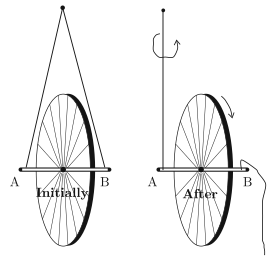
Drawn by us to help you understand the concept clearly, and verified to make sure it's accurate. For exams, practice from your NCERT textbook's own diagram.
This is the textbook's own hands-on activity, presented just before the "Properties of Angular Momentum" discussion: take a bicycle rim (or wheel) and extend its axle on both sides, then tie two strings to the two ends of the axle, A and B. Hold both strings together in one hand with the rim vertical -- the figure's left panel ("Initially") shows this state: the wheel is not spinning, and the two strings, held together at a single point above, form a narrow triangle down to the axle.
Now, keeping the rim vertical, spin the wheel fast around its axle with the other hand, and then let go of just one string, say B. The right panel ("After") shows what happens next: the axle rises to become nearly vertical, supported now only by string A, and instead of falling, the spinning wheel's axis sweeps slowly around string A -- shown by the small curved arrow near the top of the string. The wheel keeps spinning fast in its own (now tilted) plane the whole time, shown by the curved arrow beside the rim, while string B hangs loose. …