Q.The function given by is (A) continuous as well as differentiable at (B) not continuous but differentiable at (C) continuous but not differentiable at (D) neither continuous nor differentiable at
You're viewing a preview — the full solution, concept, methods & PYQ mapping are locked.
Start your 14-day free trial to unlock the full solution →The absolute value function creates a sharp corner (a cusp) at , so is continuous there but not differentiable — the left and right slopes don't match. The correct option is (C).
Why This Problem Tests a Core Idea
The absolute value function is the classic example of a function that is continuous everywhere but fails to be differentiable at the point where its "kink" occurs — here, at . The negative sign in front just flips the V-shape upside down; it doesn't change the nature of the corner.
Continuity asks: Does the graph have a break? Differentiability asks: Does the graph have a unique tangent line? At a sharp corner, the answer to the first is "no" and to the second is "no" — that's exactly what we'll verify.
Step-by-Step Reasoning
1. Rewrite the function without the absolute value
The expression behaves differently depending on whether is positive or negative:
- If , then , so .
- If , then , so .
Therefore, becomes:
So the function is two straight lines meeting at : for it's the line (slope ), and for it's the line (slope ).
You can also think of as the graph of reflected across the x-axis. The V-shape becomes an inverted V — still a sharp point at .
2. Check continuity at
A function is continuous at if:
- exists,
- exists,
- They are equal.
Left-hand limit ():
For , . As approaches 1 from the left, . So:
Right-hand limit ():
For , . As approaches 1 from the right, . So:
Function value:
At , using the piece: .
Since both one-sided limits equal , the function is continuous at .
A common mistake is to think that because the graph has a sharp point, it must be discontinuous. That's false — continuity only cares about the value and the limit matching, not about smoothness.
3. Check differentiability at …
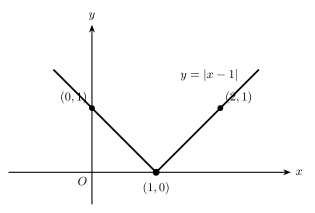 Statement 1 : Left hand derivative of
 Unlock everything free for 14 days
- Full step-by-step solutions
- Concept-first explanations
- Methods, shortcuts & mistakes
- PYQ mapping + timed mock tests
Full access for 14 days. No credit card required.