Q.(a)
🔒You're viewing a preview — the full solution, concept, methods & PYQ mapping are locked.
🔒 Start your 14-day free trial to unlock the full solution →Part (a)Concept understanding — Frequency Invariance
Frequency Invariance
When a light wave crosses from one medium into another — on reflection or on refraction — one property never changes: its frequency. Everything else about the wave (its speed, its wavelength) can change, but the frequency is fixed the moment the wave leaves its source.
Why frequency is set by the source, not the medium
A wave's frequency is the rate at which its source oscillates. Think of shaking one end of a rope: if you shake it 5 times a second, exactly 5 crests leave your hand every second. If that rope changes into a heavier rope partway along, the wave travels slower in the heavier section, but the number of crests arriving per second at the join must still equal 5 — a crest cannot be created or destroyed at the boundary. The same logic applies to light: whatever surface it meets, the boundary condition (continuity of the oscillating electric and magnetic fields) forces the reflected and refracted waves to oscillate at exactly the incident frequency.
A common mistake is to think that because wavelength changes across a boundary, frequency must change too. It's the reverse: frequency is fixed by the source, so when speed changes, wavelength (λ=v/f) adjusts to compensate.
What changes instead: speed and wavelength
In a medium of refractive index n, light slows to v=c/n. Since frequency f is unchanged and v=fλ, the wavelength inside the medium must shrink:
fmedium=fvacuum,v=nc,λmedium=nλvacuum
For reflection, the ray stays in the original medium, so speed, wavelength, and frequency are all unchanged. For refraction, the frequency still matches the incident wave, but speed and wavelength both scale by 1/n.
Does slowing down mean losing energy?
No. The energy of light is carried by its photons, each of energy E=hf — a quantity that depends only on frequency. Since frequency doesn't change on entering a denser medium, the energy per photon is unchanged too; only the wave's speed and wavelength are affected. (The wave's amplitude does adjust at the boundary so that energy is properly split between the reflected and transmitted beams — but frequency, and hence photon energy, is untouched.)
Worked example
Light of λ0=589 nm in air strikes water (n=1.33). The frequency is …
Why this formula?
Frequency Invariance
When light (or any wave) crosses from one medium into another, one property refuses to change: its frequency. Understanding why is the key to Snell's law and to how colour is preserved through glass, water and lenses.
On refraction the frequency f stays the same; the speed v and wavelength λ change together so that v=fλ still holds.
Why Frequency Is Conserved
A wave is driven at the boundary by the incoming oscillation. The electric field of the light wave forces the electrons in the second medium to oscillate, and they can only oscillate at the same rate at which they are driven. If the frequency changed, wave crests would either pile up at or vanish from the interface — the boundary would not stay continuous. So the number of crests arriving per second must equal the number leaving per second:
f1=f2=f
What Does Change
Inside a denser medium light slows to v=c/n. Since f is fixed and v=fλ, the wavelength must shrink in the same proportion:
λmedium=fv=fc/n=nλvacuum …
Part (b)Concept understanding — Dispersion by a Prism
Dispersion by a Prism – First Principles
Imagine a glass prism — a triangular block. You shine a narrow beam of white light into one face. What comes out the other side is not white. It is a beautiful band of colours: red, orange, yellow, green, blue, indigo, violet — the rainbow. That is dispersion.
Why does this happen? The short answer: different colours of light bend by different amounts when they enter and leave the prism. But the real question is why they bend differently.
The core idea: refractive index depends on colour
When light passes from air into glass, it slows down. The ratio of the speed of light in vacuum to its speed in the material is called the refractive index (n). For a given material, n is not a single number — it changes with the colour (wavelength) of light.
Violet light has the shortest wavelength. It interacts more strongly with the glass molecules, so it slows down the most. That means violet has the highest refractive index in glass. Red light has the longest wavelength, slows down the least, and has the lowest refractive index.
nviolet>nred(for ordinary glass)
Now, when light enters a prism at an angle, it bends according to Snell's law:
n1sinθ1=n2sinθ2
A larger n2 (for violet) means a smaller sinθ2 — so violet bends more toward the normal inside the prism. Red bends less. The same thing happens again when the light exits the other face. The net effect: each colour emerges at a slightly different angle.
The precise statement
Dispersion is the phenomenon in which the refractive index of a medium depends on the wavelength of light, causing different colours to deviate by different amounts when passing through a prism. White light, being a mixture of all visible wavelengths, is thus separated into its constituent colours.
The angle of deviation δ for a colour is given (for a thin prism of small angle A) by:
δ=(n−1)A
Since n is different for each colour, δ is different. Violet deviates the most, red the least.
Dispersion is not the same as refraction. Refraction is the bending of light when it changes medium. Dispersion is the spreading of light into colours because the amount of bending depends on colour. Refraction is the cause; dispersion is the consequence.
A mental picture
Think of a prism as a colour-sorting machine. White light enters as a single beam. Inside the glass, each colour travels at its own speed. Violet, the slowest, takes the sharpest turn. Red, the fastest, takes the gentlest turn. When they exit, they are no longer overlapping — they spread out into a fan of colours. …
Part (a)
(i) The frequency of a light wave is set by its source — the oscillating charges that emit it — not by the medium. When the wave crosses a boundary, the number of crests arriving per second at the interface must equal the number leaving, otherwise crests would pile up or vanish. So f is invariant. What does change is the speed, v=c/n. Since v=fλ and f is fixed, the wavelength adjusts:
λmed=fv=nλvac. …
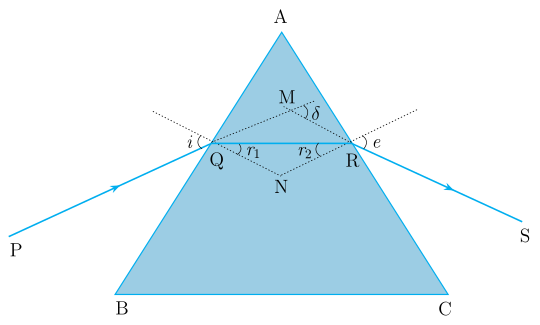
Part (a): frequency is fixed by the source, so it is unchanged across a boundary; the wavelength changes as λ=λvac/n because the speed changes. 1011 Hz is microwave (radar, ovens). Part (b): the prism deviation is δ=i+e−A from the two refractions, and the minimum deviation for symmetric passage is δm=2i−A.
Part (a)
(i) Why frequency stays fixed but wavelength changes
The frequency of light is determined by the oscillating charges in the source. When the light enters a new medium the source has not changed, so the rate at which wave crests cross the interface cannot change — f is invariant. The speed, however, drops to v=c/n in a medium of refractive index n. Since v=fλ with f constant,
λmed=fv=nfc=nλvac.
So the wavelength shrinks by the factor n while the frequency is untouched.
Do not say "frequency changes because light slows down." Slowing down changes the wavelength, not the frequency — the crests still arrive at the same rate.
(ii) Identifying the radiation
For f=1.0×10¹¹ Hz, the EM spectrum places this in the microwave band (roughly 109–1012 Hz).
Two uses:
- RADAR — aircraft detection, weather and speed monitoring. …
Showing the 12 most recent of 46 on this concept.
- CBSE 2026Set 55/1/11 markMCQQ.An electromagnetic wave passes from vacuum into a dielectric medium with relative electrical permittivity (23) and relative magnetic permeability (38). Then, its (A) wavelength is doubled and frequency remains unchanged. (B) wavelength is doubled and frequency is halved. (C) wavelength is halved and frequency remains unchanged. (D) wavelength and frequency both will remain unchanged.
›Reveal solutionSolution
The key idea is that frequency is determined by the source and never changes when a wave enters a new medium, while wavelength scales with the wave speed. Here the speed reduces by a factor of 2, so the wavelength is halved — making option (C) correct.
When a wave crosses from one medium into another, the frequency never changes — it is set by the source and cannot be altered by the medium. What does change is the wave speed, and with it the wavelength, because v=fλ must hold in every medium.
The question gives us the relative permittivity εr=23 and relative permeability μr=38. These determine the refractive index of the dielectric, which tells us how much the speed changes.
- Find the refractive index. For any medium, the refractive index is n=εrμr (for a non-magnetic medium μr≈1 and this reduces to n=εr; here μr=38, so we keep both factors).
n=23×38=28=4=2.
So the dielectric has refractive index n=2.
- Relate speed to wavelength. In vacuum, speed is c, wavelength is λ0, and c=fλ0. In the medium, speed is v=nc=2c, and v=fλ. Since f is unchanged,
2c=fλ⇒λ=2fc=2λ0.
The wavelength is halved.
- Check the options.
- (A) says wavelength doubled — wrong. …
- CBSE 2026Set ANNUAL1 markMCQQ.[FIGURE: Ray diagram at a plane interface between medium n1 (rarer) and medium n2 (denser), n2>n1, showing an incident ray, a reflected ray and a refracted ray.] When monochromatic light is incident on a surface separating two transparent media (first medium is rarer and second medium is denser) then some light is reflected back into first medium and remaining light is refracted in second medium. In this case -(i) Frequency of incident, refracted and reflected light is same.(ii) Frequency of incident and reflected light is same but frequency of refracted wave is decreased.(iii) Frequency of incident and reflected light is same but frequency of refracted light is increased.(iv) Frequency of incident light and refracted light is same but frequency of reflected light is changed.
›Reveal solutionSolution
Frequency of light is fixed by the source and never changes on reflection or refraction.
The frequency of a light wave is determined by the source that produces it, not by the medium it travels through. On reflection and refraction only the wavelength and speed change (since v=fλ and v depends on the medium); the frequency …
- CBSE 2026Set A1 markMCQQ.The ratio of the refractive index of red light to blue light in air is (A) less than unity (B) greater than unity (C) equal to unity (D) none of these
›Reveal solutionSolution
Because refractive index rises from red to blue (dispersion), n_red < n_blue, so their ratio is less than 1.
Dispersion arises because the refractive index of a medium depends on wavelength: it is larger for shorter wavelengths (blue) and smaller for longer wavelengths (red). Thus nred<nblue, and their ratio is
…
- CBSE 2026Set ANNUAL1 markMCQQ.The focal length of a lens is minimum for which colour?(a) Red(b) Yellow(c) Violet(d) Blue
›Reveal solutionSolution
Since refractive index decreases from violet to red (dispersion), and f∝1/(μ−1), the colour with the highest μ — violet — bends most and has the smallest focal length.
For a thin lens, the lens-maker's formula gives f1=(μ−1)(R11−R21), so f∝μ−11: a larger refractive index means a smaller focal length. Because the refractive index of ordinary glass is greater for shorter wavelengths, the order from lowest to highest μ across the visible spectrum is red < orange < yellow < green < blue < …
- CBSE 2026Set ANNUAL1 markMCQQ.If a wave gets refracted into a denser medium, then which of the following is true?(a) wavelength, speed and frequency decrease.(b) wavelength increases, speed decreases and frequency remain constant.(c) wavelength and speed decrease but frequency remains constant.(d) wavelength, speed and frequency increase.
›Reveal solutionSolution
Frequency is fixed by the source and never changes on refraction; since v=fλ and v decreases in a denser medium, λ must decrease too.
When a wave crosses from a rarer to a denser medium:
- Frequency is determined only by the source that generates the wave and stays the same in every medium — this is why frequency is used to define colour of light, unlike wavelength.
- Speed decreases in a denser medium because the refractive index n=c/v is larger there, so v=c/n is smaller. …
- CBSE 2026Set ANNUAL1 markMCQQ.The speed of light in an isotropic medium depends on :(a) the nature of propagation(b) its intensity(c) the motion of the source with respect to medium(d) its wavelength
›Reveal solutionSolution
A medium's refractive index (and hence the speed of light within it) varies with wavelength -- the phenomenon of dispersion.
Working
The speed of light in a medium is v=c/n. For any real (non-vacuum) isotropic medium, the refractive index n is not fixed but depends on the wavelength of the light (e.g., violet light travels slightly slower than red light in glass) -- this dependence is the cause of dispersion (splitting of white light by a prism).
…
- CBSE 2025Set ANNUAL1 markMCQQ.In glass, the velocity of the light is minimum for :(a) red(b) violet(c) yellow(d) green
›Reveal solutionSolution
Violet light bends the most and travels slowest in glass because glass has its highest refractive index for violet light.
Speed of light in a medium is v=c/n. Due to dispersion, the refractive index of glass is different for different colours and increases from red to violet (violet has the shortest wavelength and is refracted most). Since nviolet is the largest …
- CBSE 2025Set ANNUAL1 markMCQQ.If red light and violet rays are of focal lengths f_r and f_v, then which one of the following is true ?(a) lambda_r <= lambda_v(b) lambda_r = lambda_v(c) mu_r > mu_v(d) mu_r < mu_v
›Reveal solutionSolution
Violet light has a shorter wavelength and is refracted more, so its refractive index is higher than red light's.
By Cauchy's dispersion relation, the refractive index of a medium decreases as wavelength increases: μ=A+λ2B (approximately). Since red light has a longer wavelength than violet light (λr>λv), red light is refracted less and has a smaller refractive index than violet light.
…
- CBSE 2025Set ANNUAL1 markMCQQ.If the refractive index of a material of equilateral prism is sqrt(3), then the angle of minimum deviation is(i) 30 degrees(ii) 45 degrees(iii) 60 degrees(iv) 75 degrees
›Reveal solutionSolution
Dm = 60 degrees for an equilateral prism with mu = sqrt(3).
The prism formula is μ=sin(2A)sin(2A+Dm). For an equilateral prism A=60∘, so sin(A/2)=sin30∘=0.5. Then …
- CBSE 2024Set IMPROVEMENT1 markMCQQ.When light enters from one medium to other medium then its —(a) Frequency is changed, wavelength remains unchanged.(b) Frequency remains unchanged, wavelength is changed.(c) Frequency and wavelength both are changed.(d) Frequency and wavelength both remain unchanged.
›Reveal solutionSolution
On crossing a boundary between media, frequency (fixed by the source) stays the same; wavelength changes because speed changes.
When light passes from one medium to another, its frequency ν is determined by the source and does not change. However, its speed v changes because it depends on the refractive index of the medium (v=c/n). Since v=νλ, a change in speed at constant frequency means the wavelength …
- CBSE 2024Set FS1 markMCQQ.The maximum focal length of convex lens is for:(i) blue light(ii) green light(iii) red light(iv) yellow light
›Reveal solutionSolution
f1∝(n−1); red light has the least refractive index in glass, so it gives the greatest focal length — option (iii).
Concept. For a lens, f1=(n−1)(R11−R21), so f is largest when the refractive index n is smallest.
…
- CBSE 2024Set A1 markMCQQ.The wavelength of which colour is minimum? (A) Violet (B) Yellow (C) Blue (D) Red
›Reveal solutionSolution
Violet has the minimum wavelength in the visible spectrum.
In the visible spectrum (VIBGYOR), wavelength increases steadily from violet to red:
Violet(∼400nm)<Blue<Yellow<Red(∼700nm).
…
🎓Unlock everything free for 14 days
- ✓Full step-by-step solutions
- ✓Concept-first explanations
- ✓Methods, shortcuts & mistakes
- ✓PYQ mapping + timed mock tests
Full access for 14 days. No credit card required.