Q.(a) Draw the graph showing the variation of the number of scattered alpha particles with scattering angle in Geiger-Marsden experiment. Infer two conclusions from the graph.
Concept understanding — Rutherford Scattering Distance
Rutherford Scattering Distance – From Intuition to Precision
Imagine you are firing a tiny, fast bullet at a large, heavy cannonball hidden inside a big cloud of cotton. Most bullets zip right through the cotton, barely slowing down. But a few bullets come very close to the cannonball itself. Those bullets get deflected sharply, sometimes even bouncing back.
The Rutherford scattering distance is the answer to this question: How close did that bullet get to the cannonball before it turned around?
In the real experiment, the "bullet" is an alpha particle (a helium nucleus, positively charged), the "cannonball" is the gold nucleus (also positively charged, and very heavy), and the "cotton" is the mostly empty space inside the gold atom. The alpha particle and the gold nucleus repel each other because both are positive. The closer the alpha particle gets, the stronger the repulsion.
The Intuitive Picture
Think of a ball rolling up a steep hill. The ball starts with some speed (kinetic energy). As it climbs, it slows down because gravity is pulling it back. At the very top of its climb, it stops for an instant — all its kinetic energy has been converted into gravitational potential energy. Then it rolls back down.
The alpha particle does the same thing, but with electric repulsion instead of gravity. It approaches the nucleus, slows down, stops at the closest possible point, and then flies back the way it came.
That closest point — the distance of closest approach — is the Rutherford scattering distance. It is the distance at which the alpha particle's initial kinetic energy is completely converted into electrostatic potential energy.
This distance is not the radius of the nucleus. It is the distance at which the alpha particle would just touch the nucleus if the nucleus were a point charge. In reality, the alpha particle never actually reaches the nucleus — it turns around before that.
The Precise Statement
Let an alpha particle with charge and mass approach a gold nucleus with charge (where for gold). The alpha particle starts from very far away with initial kinetic energy .
At the distance of closest approach, call it , the alpha particle's speed becomes zero. All its kinetic energy has become electrostatic potential energy:
Solving for :
This is the Rutherford scattering distance (also called the distance of closest approach in a head-on collision).
What It Tells Us
- If the alpha particle hits the nucleus head-on, it comes exactly this close before reversing direction.
- If it misses slightly, it comes closer than ? No — it comes less close. The head-on collision gives the minimum possible distance of closest approach for a given initial energy. Any sideways motion means the particle never gets as close.
- If the initial kinetic energy is larger, becomes smaller — the alpha particle can punch closer to the nucleus before being stopped.
Do not confuse this with the impact parameter (the perpendicular distance from the nucleus to the initial line of motion). The impact parameter is a different quantity — it tells you how "off-center" the collision is. The Rutherford scattering distance is the actual closest distance achieved during the collision, which depends on both the impact parameter and the initial energy.
A Quick Numerical Feel
For a typical alpha particle from radioactive decay (kinetic energy about ) and a gold nucleus ():
That's about 45 femtometers — roughly 10,000 times smaller than the atom itself. This tiny number was the first direct evidence that the positive charge in an atom is concentrated in an incredibly small nucleus.
The Key Takeaway
Rutherford scattering distance is the distance at which an alpha particle, approaching a nucleus head-on, comes to a complete stop and reverses direction. It is given by:
It is the minimum possible distance of closest approach for a given initial kinetic energy, and it revealed that the atom's positive charge is packed into a volume far smaller than the atom itself.
The distance of closest approach in Rutherford scattering is a classic numerical from the NCERT Class 12 Physics chapter on Atoms, regularly appearing in "Rutherford scattering distance of closest approach formula" searches and in JEE Main/NEET important-questions compilations on atomic structure. Mastering this derivation also builds the groundwork for later problems on nuclear size and the scale of the atom covered in the same chapter.
Why this formula?
Rutherford Scattering: Why the Distance of Closest Approach Formula Works
The distance of closest approach — often denoted or — is the minimum separation between an alpha particle and the nucleus in a head-on collision. It's a beautiful example of energy conservation doing all the heavy lifting.
The Physical Picture
Imagine an alpha particle (charge ) fired straight at a gold nucleus (charge ). As it approaches, the Coulomb repulsion slows it down. At the point of closest approach, the alpha particle's radial velocity becomes zero — it stops moving toward the nucleus, and is about to turn around and fly back.
At that instant, all the kinetic energy it had at infinity has been converted into electrostatic potential energy. No other forces are at play (gravity is negligible, and we're far from the nuclear force range).
The Derivation in One Step
Let the alpha particle have initial kinetic energy at a large distance (where potential energy is zero). At the distance of closest approach , its speed is zero, so kinetic energy is zero. Energy conservation gives:
That's it. The formula is a direct consequence of energy conservation in a pure Coulomb field.
Why This Makes Physical Sense
- Higher kinetic energy → the alpha particle can push closer before being stopped → is smaller.
- Higher nuclear charge → stronger repulsion → the alpha stops farther away → is larger.
- The factor comes from the product of charges: .
This is the head-on distance. For non-head-on collisions (nonzero impact parameter), the distance of closest approach is larger because some energy remains in the perpendicular component of motion. The general formula involves the impact parameter and scattering angle , but the head-on case gives the absolute minimum possible approach.
A Common Misconception
Students sometimes think the alpha particle "hits" the nucleus at . It doesn't — it's turned around purely by the electric field. The fact that Rutherford's experiment did see some alpha particles bounce back at large angles (implying they got very close) is what told him the nucleus must be extremely small — smaller than for those particles. If the nucleus were larger, the alpha would have hit it and the scattering pattern would have been different.
The formula assumes the nucleus is point-like and stationary. In reality, the nucleus recoils slightly, so the reduced mass should technically be used. But for gold () vs alpha (), the correction is tiny — less than 2%.
The Deeper Insight
Rutherford didn't just measure — he used it to set an upper limit on nuclear size. By observing that alpha particles with kinetic energy were still being scattered (not absorbed), he knew the nucleus must be smaller than the corresponding . This gave the first experimental evidence that the atom's positive charge is concentrated in a region less than m across — a thousand times smaller than the atom itself.
That's why this simple energy-conservation formula is historically monumental: it opened the door to the nuclear age.
Part (a): The – graph in Rutherford scattering drops steeply with angle, proving the atom is mostly empty with a tiny, dense, positively charged nucleus.
Part (b): Photocurrent–voltage graphs show that stopping potential depends only on frequency (same saturation current for fixed intensity) and saturation current depends only on intensity (same stopping potential for fixed frequency).
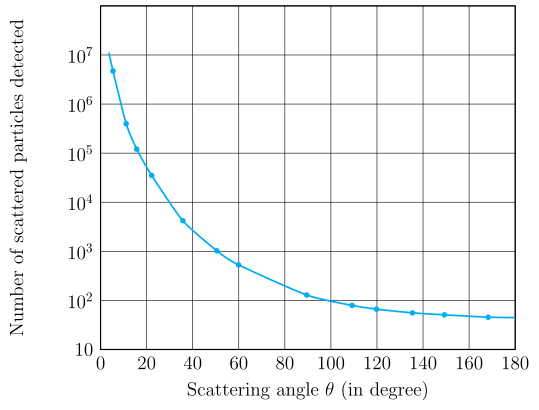
Rutherford fired -particles at a thin gold foil. If charge were spread out (Thomson model) only small deflections would occur, but a tiny fraction (~1 in 8000) scattered beyond .
- Graph shape: plot (number scattered) against scattering angle . is very large near and falls off extremely rapidly, following ; beyond it is tiny but non-zero. It is a steep, monotonic drop — not a straight line or bell curve.
Two conclusions:
- The atom is mostly empty space — since almost all -particles pass with little or no deflection, the scattering centre occupies a very small fraction of the atomic volume.
- A tiny, dense, positively charged nucleus — the few -particles repelled through large angles must have met a concentrated positive charge (the nucleus, ), holding nearly all the atom's mass.
The -vs- graph falls sharply from a maximum near to nearly zero beyond , implying (i) the atom is mostly empty space and (ii) its positive charge and mass are concentrated in a tiny nucleus.
Concept understanding — Photoelectric Effect
The Photoelectric Effect: When Light Knocks Electrons Loose
Imagine you're throwing tennis balls at a wall covered in loose pebbles. If you throw hard enough, a pebble might get knocked off. That's the basic picture — but the photoelectric effect is the quantum version of this, and it completely shattered classical physics.
The Intuition
Light is made of tiny packets of energy called photons. Each photon carries a specific amount of energy, determined by its colour (frequency). When a photon hits a metal surface, it can transfer its energy to an electron inside the metal. If that energy is enough, the electron breaks free and flies out.
Think of electrons in a metal like people in a room with a high window. To escape, they need enough energy to reach the window sill. A photon is like a boost — but only if it gives enough energy in one shot. No amount of weak boosts (dim light) will work if each individual boost is too small.
The Precise Statement
Where:
- is the energy of a photon (Planck's constant , is frequency)
- is the work function — the minimum energy needed to remove an electron from that metal
- is the maximum kinetic energy of the ejected electron
What Classical Physics Got Wrong
Before Einstein (1905), physicists thought light was a continuous wave. They expected:
- Brighter light → more energy per electron → faster electrons
- Any colour would eventually eject electrons if you waited long enough
But experiments showed the opposite:
| Observation | Classical Prediction | Actual Result |
|---|---|---|
| Effect of intensity | Brighter light → faster electrons | Brighter light → more electrons, same speed |
| Threshold frequency | None — any light works eventually | Below a certain frequency, no electrons no matter how bright |
| Time delay | Electrons need time to absorb energy | Electrons appear instantly (within s) |
The Key Insight
Einstein said: light behaves like a stream of particles (photons), each with energy . One photon interacts with one electron. If , the electron cannot escape — period. If , the excess energy becomes kinetic energy:
This is why:
- Increasing intensity (more photons) ejects more electrons, but each electron still gets the same energy per photon — so their speed doesn't change.
- Below threshold frequency, even a trillion photons per second can't help — each one is too weak individually.
The photoelectric effect proved that light is quantized — it comes in discrete packets. This was the birth of quantum mechanics. Einstein won the 1921 Nobel Prize for this, not for relativity.
A Worked Example
Problem: A metal has work function . Light of frequency shines on it. Find the maximum kinetic energy of ejected electrons. ()
Step 1: Photon energy
Step 2: Subtract work function
Step 3: Convert to joules if needed
The electron escapes with this much kinetic energy.
Common Mistake to Avoid
Students often think "more intense light means more energy per electron." Wrong. Intensity = number of photons per second. Each photon still has the same . More photons = more electrons, but each electron gets the same energy kick.
The Big Picture
The photoelectric effect is your first encounter with wave-particle duality. Light, which we model as a wave for interference and diffraction, behaves as a particle when transferring energy to matter. This duality is central to all of quantum mechanics.
Final takeaway: Light ejects electrons only if each photon carries enough energy individually. The colour (frequency) determines whether ejection happens; the brightness (intensity) determines how many electrons get ejected.
"Photoelectric effect formula and Einstein equation" is among the most-searched Class 12 physics topics, and it is a core result of the Dual Nature of Radiation and Matter chapter in the NCERT/CBSE Class 12 Physics curriculum. Work function and threshold frequency questions built on this concept appear in nearly every JEE Main and NEET physics paper.
Why this formula?
Photoelectric Effect: Why the Key Formulas Hold
The photoelectric effect is a cornerstone of quantum physics. It showed that light behaves as particles (photons) , not just waves. Let's build the reasoning step-by-step.
1. The Core Idea: Energy Conservation
When a photon hits a metal surface, it transfers all its energy to a single electron inside the metal.
- The photon's energy is , where is Planck's constant and is the frequency of light.
- The electron needs a minimum energy to escape the metal — this is called the work function, .
Why only one electron?
Einstein proposed that light is quantized into discrete packets (photons). A single photon cannot split its energy among multiple electrons — it interacts with one electron at a time.
2. The Photoelectric Equation
If the photon's energy is greater than the work function, the excess energy becomes the electron's kinetic energy after escape:
Where:
- = energy of incident photon
- = work function (minimum energy to remove electron)
- = maximum kinetic energy of ejected electron
Why "maximum" kinetic energy?
- Electrons inside the metal have different binding energies.
- Some electrons are near the surface (loosely bound) → get maximum .
- Others are deeper → lose energy in collisions before escaping → lower .
3. The Stopping Potential Connection
We measure using a stopping potential :
Where is the electron charge. This is because:
- An electric field opposing the electron's motion does work to stop it.
- At the stopping potential, the electron's kinetic energy is exactly balanced by the electric potential energy.
Combining:
This is the Einstein photoelectric equation in its most testable form.
4. Why the Threshold Frequency Exists
From the equation:
If is too low, . Then:
- The photon cannot supply enough energy to overcome the work function.
- No electron is ejected, regardless of light intensity.
The threshold frequency is when :
Why intensity doesn't matter for ejection?
- Intensity = number of photons per second.
- Each photon still has energy . If , even a billion photons won't eject an electron — each photon is individually too weak.
5. Why Kinetic Energy Depends on Frequency, Not Intensity
From :
- Frequency directly determines .
- Intensity only affects the number of electrons ejected (more photons → more electrons), not their individual energy.
This was the key experimental contradiction with classical wave theory:
- Classical: Higher intensity = bigger wave amplitude = more energy to electrons.
- Reality: Higher frequency = more energy per electron; intensity only changes current.
6. Summary of Key Relationships
| Quantity | Formula | Why it holds |
|---|---|---|
| Photon energy | Light is quantized (Planck-Einstein) | |
| Work function | Minimum energy to escape at threshold | |
| Max kinetic energy | Energy conservation per photon-electron | |
| Stopping potential | Electric work balances kinetic energy | |
| Threshold frequency | Below this, no ejection possible |
7. The Deeper "Why" — Particle Nature of Light
The photoelectric effect cannot be explained by classical wave theory because:
- Waves spread energy over the whole wavefront — an electron would take time to absorb enough energy.
- But experiments show instantaneous ejection (within s).
- Wave theory predicts kinetic energy should increase with intensity — it doesn't.
Einstein's photon model resolves all three:
- Instantaneous — one photon, one interaction.
- Frequency-dependent — photon energy is .
- Intensity-independent — more photons = more electrons, not more energy per electron.
Key takeaway: The photoelectric effect is a direct consequence of energy quantization — both light and electron binding energy are quantized. The formulas are simply conservation laws applied to this quantum world.
Part (a): The – graph in Rutherford scattering drops steeply with angle, proving the atom is mostly empty with a tiny, dense, positively charged nucleus.
Part (b): Photocurrent–voltage graphs show that stopping potential depends only on frequency (same saturation current for fixed intensity) and saturation current depends only on intensity (same stopping potential for fixed frequency).
In the photoelectric effect the current depends on the number of emitted electrons (set by intensity) and their energy (set by frequency), with .
(i) Same intensity, . Same number of photons same saturation current for all three. Higher frequency larger larger (more negative) stopping potential. Graph: three curves rising to one common saturation level, cutting the voltage axis at that is most negative for and least for .
(ii) Same frequency, . Fixed frequency same same stopping potential for all three. Higher intensity more photons larger saturation current. Graph: three curves meeting the axis at the same but saturating at different levels ( highest).
| Condition | Stopping potential | Saturation current |
|---|---|---|
| Same intensity, higher frequency | More negative | Same |
| Same frequency, higher intensity | Same | Higher |
- Curves reach the same saturation current but have a more negative stopping potential for higher frequency;
- curves share the same stopping potential but reach a higher saturation current for greater intensity.
Unlock everything free for 14 days
- Full step-by-step solutions
- Concept-first explanations
- Methods, shortcuts & mistakes
- PYQ mapping + timed mock tests
Full access for 14 days. No credit card required.