Q.Draw the plot of potential energy of a pair of nucleons as a function of their separation. Write two important conclusions that can be drawn from this plot.
You're viewing a preview — the full solution, concept, methods & PYQ mapping are locked.
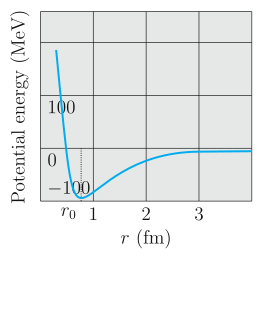
Start your 14-day free trial to unlock the full solution →The potential energy of a nucleon pair has a deep minimum at a separation fm. From the plot: the nuclear force is attractive for and strongly repulsive for , and it is short-range — negligible once the separation exceeds a few femtometres.
Constructing the plot
Take the separation between the two nucleons (in fm, where ) on the horizontal axis and their potential energy (in MeV) on the vertical axis, with negative values below the axis.
- Large separations ( more than a few fm): the curve runs along the -axis, — the nucleons barely interact at all.
- As decreases towards fm: the curve dips below the axis and falls smoothly to a deep minimum at . Since the force is , the falling potential energy in this region corresponds to an attractive force pulling the nucleons together.
- For : the curve turns and rises extremely steeply, shooting up to large positive values as . Here the force is strongly repulsive, preventing the nucleons from being squeezed into one another.
So the sketch is: a flat tail hugging zero at large , a smooth dip to a deep minimum at fm, and a nearly vertical rise to the left of the minimum. At itself the slope is zero, so the force vanishes — this is the equilibrium separation of the pair.
The two important conclusions
Conclusion 1 — attractive beyond , strongly repulsive within it.
The minimum of the curve divides the behaviour of the nuclear force: for separations greater than fm the force is attractive (this is what binds nucleons into a nucleus), while for separations less than it is strongly repulsive (this is what stops the nucleus from collapsing to a point and gives it a finite size and roughly constant density).
Conclusion 2 — the nuclear force is short-range. …
Unlock everything free for 14 days
- Full step-by-step solutions
- Concept-first explanations
- Methods, shortcuts & mistakes
- PYQ mapping + timed mock tests
Full access for 14 days. No credit card required.