Q.(a) Using the relation for refraction at a curved spherical surface, derive the expression for lens maker's formula.
🔒You're viewing a preview — the full solution, concept, methods & PYQ mapping are locked.
🔒 Start your 14-day free trial to unlock the full solution →Part (a)Concept understanding — Lens Maker's Formula
The Intuition: Why a Lens Bends Light
A lens works because light slows down when it enters glass. When a wavefront hits a curved surface at an angle, different parts of it slow down at different moments, and the wavefront bends. The stronger the curvature, the more it bends.
A lens has two surfaces. Each surface bends light by an amount that depends on its radius of curvature R and the refractive index n of the glass. The net bending — the focal length f — is the combined effect of both surfaces.
If you had a single spherical surface separating air from glass, its contribution to bending power is Rn−1. A lens has two such surfaces: light goes from air into glass at the first surface, then from glass back into air at the second. Because the two surfaces face opposite directions relative to the travelling light, their radii typically carry opposite signs.
This uses the New Cartesian Sign Convention (the one used in NCERT and CBSE): all distances are measured from the optical centre, and the direction the incident light travels in is taken as positive. So R is positive if the centre of curvature lies on the side the light is travelling towards (the outgoing side), and negative if it lies on the side the light is travelling from (the incident side).
The Precise Statement
For a thin lens (thickness negligible compared to the radii), the Lens Maker's Formula is:
f1=(n−1)(R11−R21)
where:
- f is the focal length of the lens (positive for converging, negative for diverging)
- n is the refractive index of the lens material relative to the surrounding medium (usually air)
- R1 is the radius of curvature of the first surface (the one light reaches first)
- R2 is the radius of curvature of the second surface
f1=(n−1)(R11−R21)
How to Apply It: A Worked Example
Take a biconvex lens made of glass (n=1.5) with both surfaces having the same radius of curvature magnitude, 20 cm.
Light travels left to right. The first surface bulges toward the incoming light, so its centre of curvature lies to the right of the surface — on the side the light is travelling towards. By the rule above, R1=+20 cm.
The second surface also bulges outward (away from the lens), so its centre of curvature lies to the left of that surface — on the side the light is travelling from. So R2=−20 cm.
Plug in:
f1=(1.5−1)(201−−201)=0.5×(201+201)=0.5×202=201
So f=+20 cm. Positive means converging — correct for a biconvex lens.
The most common mistake is getting the sign of R2 wrong. For a biconvex lens, R1 is positive and R2 is negative. For a biconcave lens, it's the reverse: R1 negative, R2 positive. Always sketch the lens and mark where each surface's centre of curvature actually sits.
Why the Formula Works (Brief Derivation) …
Part (b)Concept understanding — Spherical Mirror Equation
The Spherical Mirror Equation: From Intuition to Formula
Imagine you're standing in front of a concave mirror — the kind that makes your face look bigger when you're close, but flips everything upside down when you step far back. That change isn't magic; it's geometry. The spherical mirror equation is the single relationship that predicts exactly where an image will form, and whether it's real or virtual, for any spherical mirror.
The Core Idea
Every point on an object sends out light rays in all directions. A mirror redirects those rays. The mirror equation tells you: given the mirror's curvature and the object's distance, where will those rays meet again (or appear to meet)?
There are only three quantities you need:
- u — object distance (from the mirror's pole)
- v — image distance (from the mirror's pole)
- f — focal length (a property of the mirror's curvature)
The equation is:
v1+u1=f1
The power is in the sign convention, because every distance can point in one of two directions.
The Sign Convention (New Cartesian Sign Convention)
This is where most students slip. The equation works for all spherical mirrors — concave and convex — only if you follow the convention used throughout NCERT and CBSE:
- All distances are measured from the mirror's pole.
- The incident light is taken to travel left to right, so distances measured in that same direction (to the right) are positive, and distances measured against it (to the left) are negative.
- Heights above the principal axis are positive; heights below are negative.
Because a real object is always placed in front of the mirror (to the left, where the incident light originates), its distance u is always negative.
Under this convention, the focal length of a concave mirror is negative (its focus F sits in front of the mirror, on the same side as the object), and the focal length of a convex mirror is positive (its focus lies behind the mirror). This is one of the most frequently tested facts in CBSE board exams.
A very common mistake is writing f as positive for a concave mirror because "it converges light." Convergence tells you the type of mirror, not the sign — the sign comes purely from where the focus physically sits relative to the pole, under the convention above.
Where Does the Formula Come From?
For a concave mirror, parallel rays from a distant object converge at the focus, a point at (signed) distance f from the mirror. The derivation uses similar triangles from a ray diagram.
›Proof
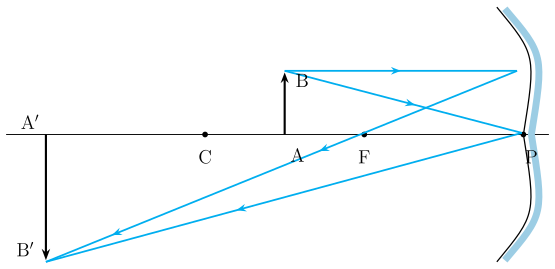
Consider an object of height ho in front of a concave mirror. Draw the ray parallel to the axis: it reflects through the focus F. Draw the ray through the centre of curvature C: it strikes the mirror normally and reflects straight back on itself. These two reflected rays cross to form the image, of height hi.
From similar triangles formed by the ray through C:
hiho=R−vu−R
where R=2f is the radius of curvature (with the same sign convention as f).
From similar triangles formed by the ray through F:
hiho=fu−f
Equating the two ratios and simplifying (using R=2f) gives:
v1+u1=f1
What the Equation Tells You
Rearranging for v:
v=u−fuf
Because u is negative for a real object, and v takes the sign the geometry dictates:
- v negative → the image forms in front of the mirror → real image (can be projected on a screen).
- v positive → the image forms behind the mirror → virtual image.
For a concave mirror (f negative), using the magnitude of the object distance ∣u∣ measured from the pole:
- ∣u∣>2∣f∣ → real, inverted, diminished image between f and 2f
- ∣u∣=2∣f∣ → real, inverted, same-size image at 2f
- ∣f∣<∣u∣<2∣f∣ → real, inverted, magnified image beyond 2f
- ∣u∣=∣f∣ → image at infinity …
Why this formula?
Spherical Mirror Equation: Why the Formula Holds
The spherical mirror equation — also called the mirror formula — relates the object distance (u), image distance (v), and focal length (f) of a spherical mirror. Let's build the reasoning step by step.
1. The Key Formula
For a spherical mirror (concave or convex):
f1=u1+v1
Where:
- f = focal length (positive for concave, negative for convex)
- u = object distance from pole (always negative by sign convention)
- v = image distance from pole (sign depends on image location)
2. Why This Formula Holds — The Derivation
Step 1: Start with a ray diagram
Consider a concave mirror with:
- Pole P
- Centre of curvature C (radius R)
- Focus F (midpoint of PC, so f=R/2)
Take an object placed beyond C. Draw two rays from the object's tip:
- A ray parallel to the principal axis → reflects through F
- A ray through C → reflects back along itself
These rays meet at the image point.
Step 2: Use similar triangles
Let the object height be ho and image height be hi.
From the geometry of the ray through C:
- Triangle formed by object, C, and axis is similar to triangle formed by image, C, and axis.
This gives:
hiho=R−vu−R
(Here u and v are distances from P, with sign conventions applied later.)
Step 3: Use the parallel ray
From the ray parallel to the axis:
- Triangle formed by object, F, and axis is similar to triangle formed by image, F, and axis.
This gives:
hiho=fu−f
Step 4: Equate the two ratios
Since both ratios equal ho/hi:
R−vu−R=fu−f
Step 5: Substitute R=2f
For a spherical mirror, the focal length is half the radius of curvature:
R=2f
Substitute:
2f−vu−2f=fu−f
Step 6: Cross-multiply and simplify
Cross-multiply:
f(u−2f)=(u−f)(2f−v)
Expand:
fu−2f2=2fu−uv−2f2+fv
Cancel −2f2 on both sides:
fu=2fu−uv+fv
Bring all terms to one side:
0=fu−uv+fv
Rearrange:
uv=fu+fv
Step 7: Divide by uvf
Divide both sides by uvf:
f1=v1+u1
This is the mirror formula.
3. Why the Sign Convention Matters
The derivation above used distances as positive magnitudes. In actual problem-solving, we use the Cartesian sign convention:
- Distances measured against incident light are negative
- Distances measured along incident light are positive
For a concave mirror:
- u is negative (object in front)
- f is negative (focus in front)
- v is negative for real images (in front) …
Part (a)
(a) Lens maker's formula. Apply the single-surface relation twice (air→glass at R1, glass→air at R2):
v1n−u1=R1n−1,v1−v1n=R21−n.
Adding cancels n/v1; for u→∞, v=f:
f1=(n−1)(R11−R21).
(b) Three lenses (f=40 cm each).
- L1: u=−80⇒v11=401−801=801, v1=+80 cm.
- L2 (120 cm from L1): u2=−(120−80)=−40⇒v21=401−401=0, v2=∞ (parallel rays).
- L3 (20 cm from L2): u3=∞⇒v3=+40 cm. …
Part (a): applying the single-surface refraction relation twice gives f1=(n−1)(R11−R21); for the three-lens system the final image is 40 cm right of L3, i.e. 260 cm from the object. Part (b): the mirror formula v1+u1=f1 gives f=−20 cm (focal length 20 cm) for a concave mirror forming a 2× virtual image at u=−10 cm.
Part (a) — Lens maker's formula and a three-lens system
(a) Derivation
Single-surface refraction: vn2−un1=Rn2−n1.
- First surface (air→glass, R1), image at v1: v1n−u1=R1n−1.
- Second surface (glass→air, R2), the first image acting as object (thin lens): v1−v1n=R21−n.
- Add; the v1n terms cancel: v1−u1=(n−1)(R11−R21).
- For u→∞, v=f:
f1=(n−1)(R11−R21).
(b) Three lenses in a row
Each f=40 cm; use v1−u1=f1.
- L1: u=−80: v11=401−801=801⇒v1=+80 cm (right of L1).
- L2 is 120 cm right of L1, so the image is 120−80=40 cm to its left, u2=−40: v21=401−401=0⇒v2=∞ (parallel beam).
- L3 receives parallel rays, u3=∞: v3=+40 cm (right of L3).
- Distance from object: object 80 cm left of L1; L1→L3=120+20=140 cm; image 40 cm right of L3: …
Showing the 12 most recent of 33 on this concept.
- CBSE 2026Set 55/1/11 markMCQQ.A concave lens of focal length 10 cm is cut into two identical plano-concave lenses. The focal length of each lens will be (A) 20 cm (B) 30 cm (C) 40 cm (D) 5 cm
›Reveal solutionSolution
Cutting a symmetric concave lens through its middle (perpendicular to the principal axis) leaves each piece with only one curved surface, so each plano-concave piece has half the power — and therefore double the focal length: 20 cm, option (A).
Concept and Intuition
The lens maker's formula relates a thin lens's focal length to its two radii of curvature and the refractive index of the material:
f1=(μ−1)(R11−R21)
A symmetric biconcave lens has two curved surfaces, and each contributes equally to the total power. When the lens is cut through its middle by a plane perpendicular to the principal axis, each piece keeps one original curved surface and gains a flat face. A flat surface has an infinite radius of curvature, so it contributes nothing to the power — each piece is left with only half the original bending power.
Step-by-Step Solution
1. Apply the formula to the original biconcave lens.
Use the New Cartesian sign convention with light travelling left to right. For a biconcave lens of equal radii of magnitude R: the first surface's centre of curvature lies on the incident (left) side, so R1=−R; the second surface's centre of curvature lies on the outgoing (right) side, so R2=+R. Then
f1=(μ−1)(−R1−+R1)=−R2(μ−1)
The negative sign confirms a diverging lens. With f=−10 cm:
Rμ−1=201 cm−1
2. Apply it to one plano-concave piece.
Each piece keeps one curved surface (R1=−R) and gains a flat cut face (R2=∞):
f′1=(μ−1)(−R1−∞1)=−Rμ−1=−201 cm−1
3. Read off the result.
f′=−20 cm …
- CBSE 2026Set 55/3/11 markMCQQ.A thin plano-convex lens and a thin equi-concave lens are kept coaxially in contact as shown in the figure. Assuming both the lenses are made of glass of refractive index μ, and R is the radius of curvature of each curved surface, the focal length of the combination is : (A) μ−1R (B) −μ−1R (C) μ−12R (D) −μ−12R
›Reveal solutionSolution
We calculate the focal lengths of the plano-convex and equi-concave lenses separately using the lens maker's formula, applying the correct sign conventions for radii of curvature. Then, we combine these focal lengths to find the equivalent focal length of the system. The focal length of the combination is −μ−1R.
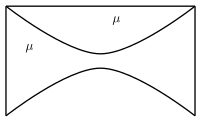
Figure — plano-convex and equi-concave lens combination Concept and Intuition
To find the focal length of a combination of thin lenses kept in contact, we first need to determine the focal length of each individual lens. The fundamental tool for this is the Lens Maker's Formula.
Lens Maker's Formula
The focal length f of a thin lens made of a material with refractive index μ (relative to the surrounding medium, usually air, for which μair=1) is given by:
f1=(μ−1)(R11−R21)
Here, R1 is the radius of curvature of the first surface encountered by light, and R2 is the radius of curvature of the second surface. The signs of R1 and R2 are crucial and follow a specific convention.
Sign Convention for Radii of Curvature
We will use the following convention for R1 and R2 in the lens maker's formula, assuming light travels from left to right:
- R1 (First Surface):
- If the first surface is convex (bulges towards the right), R1 is positive (+R).
- If the first surface is concave (bulges towards the left), R1 is negative (−R).
- If the first surface is flat (plano), R1 is infinite (∞).
- R2 (Second Surface):
- If the second surface is convex (bulges towards the left), R2 is negative (−R).
- If the second surface is concave (bulges towards the right), R2 is positive (+R).
- If the second surface is flat (plano), R2 is infinite (∞).
Watch outThe sign convention for R1 and R2 is a common source of error. Always be consistent with the convention you choose. The one outlined above ensures that converging lenses have positive focal lengths and diverging lenses have negative focal lengths when μ>1.
Combination of Thin Lenses in Contact
When two thin lenses with focal lengths f1 and f2 are placed coaxially in contact, the focal length F of the combination is given by:
F1=f11+f21
Step-by-step Solution
-
Identify the properties of the plano-convex lens (Lens 1).
- Refractive index: μ
- First surface: Flat. According to our sign convention, R1=∞.
- Second surface: Convex. It bulges towards the left (as seen from the second surface, or its center of curvature is to the left). According to our sign convention, R2=−R.
-
Calculate the focal length of the plano-convex lens (f1).
Using the lens maker's formula:
f11=(μ−1)(R11−R21)
Substitute the values for $R_1$ and $R_2$:f11=(μ−1)(∞1−−R1)
f11=(μ−1)(0+R1)
f11=Rμ−1
Therefore, the focal length of the plano-convex lens is:f1=μ−1R
This is a positive focal length, as expected for a converging lens.3. Identify the properties of the equi-concave lens (Lens 2).
* Refractive index: μ …
- R1 (First Surface):
- CBSE 2026Set DS1 markQ.In which the power of a lens will be large — in air or water?
›Reveal solutionSolution
Power is larger in air, because the glass–water relative refractive index is smaller than the glass–air one.
Concept. By the lens-maker's formula the power of a lens depends on the refractive index of the lens relative to its surroundings:
P=f1=(mng−1)(R11−R21),
where mng=ng/nm is the index of glass with respect to the medium.
- In air (nm≈1): ang≈1.5, so (ang−1)≈0.5.
- In water (nm≈1.33): wng=1.5/1.33≈1.13, so (wng−1)≈0.13. …
- CBSE 2026Set ANNUAL1 markMCQQ.A 4.5 cm needle is placed 12 cm away from a convex mirror of focal length 15 cm. The location of the image is(a) formed at 6.67 cm behind the mirror.(b) formed at 67 cm behind the mirror.(c) formed at 70 cm same side of the mirror.(d) formed at 5.57 cm same side of the mirror.
›Reveal solutionSolution
Using the mirror formula with the correct sign convention, the convex mirror forms a virtual image 6.67 cm behind the mirror.
Given: Needle height h=4.5 cm, object distance u=−12 cm (object in front, so negative by convention), convex mirror so focal length f=+15 cm (behind the mirror, positive).
Mirror formula:
v1+u1=f1
v1=f1−u1=151−−121=151+121
Taking LCM (60): v1=604+605=609=203
v=320=6.67 cm …
- CBSE 2025Set 55/4/11 markMCQQ.The magnification produced by a spherical mirror is −2.0. The mirror used and the nature of the image formed will be: (A) Convex and virtual (B) Concave and real (C) Concave and virtual (D) Convex and real
›Reveal solutionSolution
A magnification of −2.0 means the image is inverted (negative sign) and magnified (magnitude > 1). Only a concave mirror can produce an inverted, magnified image, and such an image is always real. So the mirror is concave and the image is real — option (B).
Concept and Intuition
The magnification m of a spherical mirror tells you two things at once: the sign tells you orientation, and the magnitude tells you size.
- If m is positive, the image is virtual and erect (upright).
- If m is negative, the image is real and inverted (upside down).
The magnitude ∣m∣ tells you relative size:
- ∣m∣>1 → image is magnified (larger than object)
- ∣m∣<1 → image is diminished (smaller)
- ∣m∣=1 → same size
Here m=−2.0 means the image is inverted (negative) and twice as large as the object (∣m∣=2).
Now, which mirror can produce an inverted, magnified image? A convex mirror always gives a virtual, erect, and diminished image — so it can never produce a negative magnification. A concave mirror, however, can produce both real (inverted) and virtual (erect) images depending on where the object is placed. The real image from a concave mirror is always inverted, and when the object is between the centre of curvature and the focus, that real image is also magnified.
So the only mirror that fits m=−2.0 is a concave mirror, and the image must be real.
Step-by-step reasoning
-
Interpret the sign of m
m=−2.0 is negative. For spherical mirrors, a negative magnification always means the image is inverted relative to the object. An inverted image formed by a single mirror is always real (it can be projected on a screen). So the image is real.
-
Interpret the magnitude of m
∣m∣=2.0>1, so the image is magnified — larger than the object.
-
Eliminate convex mirror
A convex mirror always produces a virtual, erect, and diminished image for any real object. That means m is always positive and ∣m∣<1. Since our m is negative and ∣m∣>1, a convex mirror is impossible. This eliminates options (A) and (D).
-
Check concave mirror possibilities
A concave mirror can produce:
- A real, inverted, magnified image when the object is placed between F and C (focus and centre of curvature).
- A virtual, erect, magnified image when the object is placed between P and F (pole and focus). In that case m is positive.
Since our m is negative, the image cannot be virtual. So the only possibility is the real, inverted, magnified case — which is exactly what a concave mirror gives for an object between F and C. …
- CBSE 2025Set IMPROVEMENT1 markMCQQ.Assertion (A): The radius of curvature of a concave mirror is 20 cm. If an object is placed in front of the mirror at a distance of 10 cm from its pole, its image is formed at infinity. Reason (R): The image of an object placed at the focus of a spherical mirror is formed at infinity. Select the correct option.(a) Both A and R are correct and R is the correct explanation of A.(b) Both A and R are correct but R is not the correct explanation of A.(c) A is correct but R is incorrect.(d) Both A and R are incorrect.
›Reveal solutionSolution
Both statements are true, and the reason correctly explains why the assertion is true.
For a concave mirror of radius of curvature R=20cm, the focal length is f=R/2=10cm. In Assertion (A), the object is placed at a distance of 10 cm from the pole — exactly at the focus. Using the mirror formula v1+u1=f1, when u=f, we get v1=f1−f1=0, so v→∞ — the image is indeed formed at infinity. This is exactly the general principle stated in Reason (R): rays from an object placed at the f …
- CBSE 2025Set D1 markMCQQ.A convex lens is dipped in a liquid, whose refractive index is equal to the refractive index of the material of the lens. Then its focal length will (A) become zero (B) become infinity (C) reduce (D) increase
›Reveal solutionSolution
Lensmaker's formula has a factor (n_lens/n_medium − 1); if the two indices are equal this factor is zero, so 1/f = 0 and f → ∞.
By the lensmaker's formula in a medium,
1/f = (n_lens/n_medium − 1)(1/R₁ − 1/R₂)
If the liquid's refractive index equals the lens material's index, then n_lens/n_medium = 1, so the factor (1 − 1) = 0.
…
- CBSE 2025Set ANNUAL1 markMCQQ.When monochromatic red light is used instead of blue light in a convex lens, its focal length(a) does not change(b) increases(c) decreases(d) remain same
›Reveal solutionSolution
Red light has a lower refractive index than blue (dispersion), and f∝1/(n−1), so lower n gives a larger f.
By the lens maker's formula, f1=(n−1)(R11−R21), so f∝(n−1)1 for fixed geometry. Due to dispersion, the refractive index of a material is slightly higher for blue light than for red light (nblue>nred, since blue light bends more). Using red …
- CBSE 2024Set ANNUAL1 markMCQQ.Focal length of a concave mirror in air is 25 cm. Its focal length in water will be -(a) 50 cm(b) 12.5 cm(c) ∞(d) 25 cm
›Reveal solutionSolution
A mirror's focal length depends only on its radius of curvature, not on the surrounding medium.
For a spherical mirror, f=R/2, where R is the radius of curvature -- a purely geometrical quantity. Since reflection (unlike refraction) does not depend on the refractive index of the surrounding medium, the focal length …
- CBSE 2024Set FS1 markQ.Find the ratio of focal length of lens in air and that of lens when it is immersed in liquid.
›Reveal solutionSolution
fliquidfair=nl(ng−1)ng−nl, where ng, nl are the refractive indices of glass and the liquid.
Concept. The lens maker's formula uses the index of the lens relative to its surroundings:
f1=(medng−1)(R11−R21).
In air (nair=1): fair1=(ng−1)(R11−R21).
In liquid: the glass index relative to the liquid is ng/nl, so …
- CBSE 2024Set A1 markMCQQ.The correct relationship between the radius of curvature (R) and focal length(f) of a spherical mirror is ______.(a) R = 2f(b) f = 2R(c) R = f/2(d) R = 1/f
›Reveal solutionSolution
For a spherical mirror, R = 2f because the focal point lies midway between the pole and the centre of curvature.
For a spherical mirror (concave or convex), a ray parallel to the principal axis, after reflection, passes through (or appears to diverge from) the focus F. Using the mirror geometry, for paraxial rays, the focal length f is related to the radius of curvature R by: …
- CBSE 2024Set ANNUAL1 markQ.The radius of curvature of a concave mirror is 24 cm. The value of its focal length will be __________ cm.
›Reveal solutionSolution
For a spherical mirror, f = R/2, a direct geometric consequence of paraxial ray reflection.
For any spherical mirror (concave or convex), the focal length is related to the radius of curvature by:
…
🎓Unlock everything free for 14 days
- ✓Full step-by-step solutions
- ✓Concept-first explanations
- ✓Methods, shortcuts & mistakes
- ✓PYQ mapping + timed mock tests
Full access for 14 days. No credit card required.