Q.An infinitely long straight wire lies in the plane of the paper and carries a current I(t) whose rate of change dI/dt = λ is constant. A rectangular loop ABCD of wire, of resistance R, lies in the same plane with its two sides AB and DC (each of length l) parallel to the long wire. The nearer side DC is at a perpendicular distance x₀ from the wire and the farther side AB at a perpendicular distance x₀ + r (so the loop's breadth measured away from the wire is r). Find the magnitude of the current induced in the loop.
🔒You're viewing a preview — the full solution, concept, methods & PYQ mapping are locked.
🔒 Start your 14-day free trial to unlock the full solution →Concept understanding — Electromagnetic Induction
Electromagnetic Induction
Electromagnetic induction is the phenomenon in which a changing magnetic flux through a circuit produces an electromotive force (emf) — and hence a current, if the circuit is closed. It is the single idea behind generators, transformers, inductors, and the entire AC power grid.
The Central Discovery
Michael Faraday found (1831) that a current is induced in a coil not when a magnet sits still near it, but only while the magnet moves — that is, only while the magnetic flux linked with the coil is changing. A steady magnet, however strong, induces nothing.
Magnetic Flux
The key quantity is magnetic flux ΦB through a surface of area A in a field B:
ΦB=B⋅A=BAcosθ
where θ is the angle between B and the area's normal. Its SI unit is the weber (Wb), where 1 Wb=1 T⋅m2.
Flux can change in three distinct ways, and any of them induces an emf:
- the field strength B changes,
- the area A of the loop changes,
- the orientation θ changes (a coil rotating in a field — the basis of the generator).
Faraday's Law
The induced emf equals the negative rate of change of flux. For a coil of N turns:
E=−NdtdΦB
The faster the flux changes, the larger the emf. This is why a magnet dropped quickly through a coil gives a bigger deflection than one moved slowly.
Lenz's Law — the Minus Sign
The negative sign expresses Lenz's law: the induced current flows in the direction that opposes the change producing it. Push a magnet's north pole toward a coil, and the coil's near face becomes a north pole to repel it; pull it away, and the face becomes a south pole to attract it. This is simply energy conservation — you must do work against this opposition, and that work becomes the electrical energy of the induced current.
Motional emf
A special, very useful case: a conducting rod of length l moving with speed v perpendicular to a field B sweeps out area and develops an emf
E=Blv
Here the emf arises because the free charges in the rod experience a magnetic force qv×B, which drives them along the rod. …
Why this formula?
Electromagnetic Induction
Electromagnetic induction is the effect discovered by Faraday: a changing magnetic flux through a circuit drives an induced EMF (and hence a current). The key word is changing — a steady field, however strong, induces nothing.
Magnetic flux
Flux measures how many field lines thread a surface bounded by the loop:
ΦB=∫B⋅dA=BAcosθ
It can change three ways: by changing B, by changing the area A, or by rotating the loop (changing θ).
Faraday's law
The induced EMF equals the rate of change of flux:
E=−dtdΦB
For a coil of N turns, E=−NdtdΦB. The EMF depends on how fast the flux changes, not on the flux itself — a slow change gives a small EMF, a rapid change a large one.
Lenz's law — the minus sign …
Integrate the 1/x field of the wire across the loop: ϕ=2πμ0Illnx0x0+r; with dI/dt=λ, the induced current is 2πRμ0lλlnx0x0+r. …
The long wire's field falls off as 1/x, so the flux through the loop is found by integrating across its breadth: ϕ=2πμ0Illnx0x0+r. Since dI/dt=λ is constant, the induced emf is constant and Iloop=2πRμ0lλlnx0x0+r.
Concept
The magnetic field of an infinitely long straight wire at perpendicular distance x is
B(x)=2πxμ0I,
directed perpendicular to the loop's plane. Because B varies across the loop, the flux must be obtained by integration.
Flux through the loop
Take a strip of width dx at distance x, parallel to the wire and of length l; its area is ldx. Integrating from the near side x0 to the far side x0+r:
ϕ=∫x0x0+r2πxμ0Ildx=2πμ0Illn(x0x0+r).
Induced emf and current …
Method: Flux by Integration When the Field Is Non-Uniform Across the Loop
Use this whenever a loop sits near a source (typically a long straight current-carrying wire) whose field strength changes across the loop's own area — Φ=BA no longer works because B is not one single value over the loop.
Steps
Step 1: Write the field as a function of position
For an infinite straight wire, the field at perpendicular distance x is
B(x)=2πxμ0I,
directed perpendicular to the loop's plane. Since x varies across the loop's breadth, B is not constant there.
Step 2: Set up a differential strip
Slice the loop into thin strips parallel to the wire, each at distance x, of width dx and length equal to the loop's side parallel to the wire (l here). Each strip has area dA=ldx and (because it's thin) a nearly-uniform field B(x) on it.
Step 3: Integrate to get the total flux
Sum (integrate) B(x)dA across the loop's full breadth, from the near edge to the far edge:
Φ=∫nearfarB(x)ldx=2πμ0Illn(near distancefar distance).
The logarithm is the signature of integrating a 1/x field — expect it whenever this method applies. …
Showing the 12 most recent of 19 on this concept.
- GUJCET 2026Set x1 markMCQQ.In an ideal step up transformer, the number of turns in primary coil and secondary coil are 100 and 200 respectively. If output current is found to be 5A, then input current will be ______. (A) 2.5 A (B) 100 A (C) 5.0 A (D) 10 A
›Reveal solutionSolution
Ip=IsNs/Np=5×2=10 A.
For an ideal transformer IsIp=NpNs. With Np=100, Ns=200, output (secondary) current Is=5 A: …
- GSEB Higher Secondary Certificate (HSC) Examination 2026Set ANNUAL1 markMCQQ.A.C. generator converts ___.(a) mechanical energy into electrical energy(b) mechanical energy into heat energy(c) mechanical energy into light energy(d) electrical energy into mechanical energy
›Reveal solutionSolution
An AC generator (alternator) converts the mechanical energy used to rotate its coil/armature into electrical energy, via electromagnetic induction.
A coil is mechanically rotated in a magnetic field (or a field is rotated past a stationary coil). The changing flux linkage induces an alternating emf (Faraday's law), which drives current in an external circuit. The mechanical work done to keep the coil turning against the magne …
- GUJCET 2025Set 031 markMCQQ.As shown in figure two identical conducting rings of radius r are placed in magnetic field. In figure(a) magnetic field increasing at the rate of 0.3 T/s and in figure(b) magnetic field decreasing at the rate of 0.2 T/s. The direction of current in ring(a) and ring(b), when observe from top are ______. [FIGURE:(a) a ring in a magnetic field directed into the page (crosses);(b) a ring in a magnetic field directed out of the page (dots).] (A) Clockwise, Anticlockwise (B) Anticlockwise, Anticlockwise (C) Clockwise, Clockwise (D) Anticlockwise, Clockwise
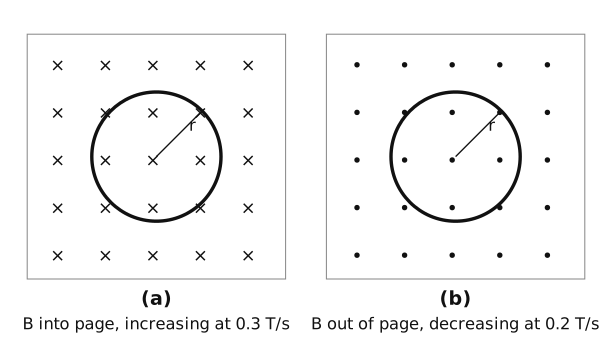
›Reveal solutionSolution
[!TLDR] Ring (a): into-page flux increasing -> induced current opposes it by making an out-of-page field -> anticlockwise. Ring (b): out-of-page flux decreasing -> induced current opposes by maintaining the out-of-page field -> anticlockwise. Both anticlockwise.
Apply Lenz's law, viewing each ring from the top (the reader's side), where x = into page (away from viewer) and . = out of page (toward viewer).
Ring (a): The field is into the page (x) and increasing, so into-page flux is growing. The induced current opposes this change and must create a magnetic field OUT of the page inside the ring. By the right-hand rule, a current producing an out-of-page field flows anticlockwise (as seen from the top). …
- GUJCET 2025Set 031 markMCQQ.In an AC generator, induced emf ε=0 at t=0, then its value ______. (A) minimum at time 3ω2π (B) minimum at time 2ωπ (C) maximum at time ω2π (D) maximum at time 2ωπ
›Reveal solutionSolution
[!TLDR]
With ε=ε0sinωt (zero at t=0), the emf is maximum at t=2ωπ — option (D).
Concept
In an AC generator the induced emf is sinusoidal. The condition ε=0 at t=0 selects the sine form:
ε=ε0sin(ωt). …
- GUJCET 2024Set 131 markMCQQ.A square loop of side 10 cm and resistance 0.5Ω is placed vertically in the east-west plane. A uniform magnetic field of 0.10 T is setup across the plane in the north-east direction. The magnetic field is decreased to zero in 0.70 S at a steady rate. Then the magnitude of induced current during this time interval will be ________. (A) 8.0×10⁻³ A (B) 4.0×10⁻³ A (C) 6.0×10⁻³ A (D) 2.0×10⁻³ A
›Reveal solutionSolution
Induced I=RΔtΔΦ, with the NE field making 45∘ to the loop's normal.
Concept. EMF =ΔtΔΦ; the normal to the east–west vertical plane points N–S, so a NE field makes 45∘ with it.
Area A=(0.10)2=0.01m2.
Φi=BAcos45∘=0.10×0.01×0.707=7.07×10⁻⁴Wb, Φf=0. …
- GUJCET 2024Set 131 markMCQQ.If the primary coil of a transformer has 100 turns and the secondary has 200 turns. Then for a input of 220 V at 10 A find output current, in step up transformer. (A) 5.0 A (B) 50.0 A (C) 0.5 A (D) 0.05 A
›Reveal solutionSolution
Ideal transformer: Is/Ip=Np/Ns (current steps down when voltage steps up).
Concept. Power conserved ⇒VpIp=VsIs and NpNs=VpVs=IsIp. …
- GUJCET 2023Set 091 markMCQQ.As shown in the figure a bar magnet is moving towards a stationary coil with constant speed v. The direction of induced current in the coil observed by the observer on R.H.S. is ______. [FIGURE: bar magnet with S on left and N on right moving right (velocity v) towards a coil; a galvanometer G is connected; observer stands to the right of the coil] (A) Anticlockwise (B) Clockwise (C) Current changes its direction randomly (D) Induced current will not be produced
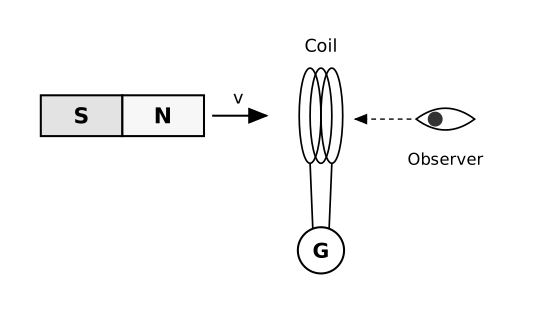
›Reveal solutionSolution
[!TLDR] The approaching N pole makes the coil's near face a North pole (Lenz's law); its far face - the one the R.H.S. observer sees - is therefore a South pole, which appears as a clockwise current.
The magnet's N pole moves toward the coil, so the coil flux directed away from the magnet increases. By Lenz's law the induced current opposes this change, so the coil's face nearest the magnet (its left face) becomes a North pole to repel the incoming N pole. Consequently the coil's opposite face - the right-hand face, which the observer on the R.H.S. is looking at - behaves as a South pole. For an observer facing a magnetic South pole of a current loop, the induced current circulates clockwise (the loop's magnetic moment points toward the m …
- GUJCET 2023Set 091 markMCQQ.A circular coil of area 2 cm2 is placed in a magnetic field of 3T perpendicularly. The coil has 10 turns and 5 Ω resistance. Now the coil is removed from magnetic field in 0.2 s. The value of induced charge flowing through the coil is ______. (A) 1.1 mC (B) 1.9 mC (C) 1.2 mC (D) Zero
›Reveal solutionSolution
[!TLDR]
q=NBA/R=1.2 mC (time is irrelevant); option (C).
Concept
When flux through a coil changes, the charge that flows is
q=∫idt=RNΔΦ,
which depends only on the total flux change and resistance, not on how fast it happens. Here ΔΦ=BA (flux goes from BA to 0).
Solution
Data: N=10, B=3 T, A=2 cm2=2×10⁻⁴ m2, R=5Ω.
q=RNBA=510×3×2×10−4=56×10−3×10= ... …
- GSEB Higher Secondary Certificate (HSC) Examination 2023Set ANNUAL1 markMCQQ.A square of side L meter lies in the x-y plane in a region where the magnetic field is given by B (vector) = B_0 (2 i + 4 j + 3 k) T, where B_0 is constant. The magnitude of flux passing through the square is ___.(a) 4 B_0 L^2 Wb(b) 3 B_0 L^2 Wb(c) 2 B_0 L^2 Wb(d) sqrt(29) B_0 L^2 Wb
›Reveal solutionSolution
The square lies in the x-y plane, so its area vector is along z; only the k-component (3 B_0) of B contributes: flux = 3 B_0 L^2.
The square (side L) lies in the x-y plane, so its area vector is A = L^2 k-hat (along z).
…
- GSEB Higher Secondary Certificate (HSC) Examination 2023Set ANNUAL1 markMCQQ.Magnetic flux linked with the coil is given by phi(t) = (2t^2 + 2t + 1) Wb and its resistance is 10 ohm. The current passing through the coil at t = 2 s is ___ A.(a) 1.5(b) 1(c) 0.5(d) 2
›Reveal solutionSolution
Induced emf = -dphi/dt = -(4t+2); at t = 2, magnitude = 10 V, giving I = 10/10 = 1 A.
Flux phi(t) = 2t^2 + 2t + 1. Induced emf:
e = -dphi/dt = -(4t + 2).
…
- GUJCET 2022Set 171 markMCQQ."The polarity of induced emf is such that it tends to produce a current which opposes the change in magnetic flux that produced it." This statement is known as ________. (A) Faraday (B) Maxwell (C) Kirchhoff (D) Lenz
›Reveal solutionSolution
The induced current opposing the change in flux that produced it is Lenz's law.
Concept: Lenz's law states that the polarity of the induced emf is such that the induced current opposes the change in magnetic …
- GSEB Higher Secondary Certificate (HSC) Examination 2022Set ANNUAL1 markMCQQ.A current-carrying coil with N turns and cross-sectional area A is placed in a uniform magnetic field of magnitude B such that its plane remains perpendicular to the magnetic field. If the number of turns of the coil is now doubled, the magnetic flux linked with it = ______.(a) N^2 B A(b) N B A / 2(c) N B A(d) 2 N B A
›Reveal solutionSolution
Flux linkage scales directly with the number of turns; doubling N doubles the flux linked with the coil.
Magnetic flux through a single loop with plane perpendicular to B: Φ=BA (since normal is parallel to B, cosθ=1).
…
🎓Unlock everything free for 14 days
- ✓Full step-by-step solutions
- ✓Concept-first explanations
- ✓Methods, shortcuts & mistakes
- ✓PYQ mapping + timed mock tests
Full access for 14 days. No credit card required.