Chemistry · Ch 3 — Thermodynamics
Heat
Heat
Heat
We can also change the internal energy of a system by transferring heat from the surroundings to the system (or vice versa) without doing any work. This exchange of energy, which results from a temperature difference, is called heat, denoted by .
Consider bringing about the same change in temperature (the same initial and final states as before) by transferring heat through thermally conducting walls instead of adiabatic walls. Take water at temperature in a container with copper walls (thermally conducting) and place it inside a huge heat reservoir at temperature . The heat absorbed by the system (water), , can be measured in terms of the temperature difference .
In this case, no work is done (the volume is constant), so the change in internal energy is simply:
…
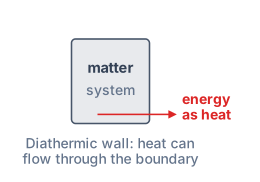
Drawn by us to help you understand the concept clearly, and verified to make sure it's accurate. For exams, practice from your textbook's own diagram.
What Fig. 5.4 Actually Shows
The figure is a simple schematic: a cylindrical vessel (labelled system, holding matter such as water) sits inside a larger region labelled surroundings. The vessel wall is the boundary, and a single white arrow crossing it, labelled "energy as heat", shows heat passing through the wall. The wall is thermally conducting (diathermic): heat can flow through it in either direction — the drawn arrow shows one direction, but which way heat actually flows depends only on which side is hotter.
There are no axes, curves, or plots — it is a conceptual diagram, not a graph. The figure contrasts directly with the preceding Fig. 5.3, which shows an adiabatic wall (insulated, no heat arrows). Together, these two figures establish the two fundamental ways to change a system's internal energy: by doing work (adiabatic case) or by transferring heat (diathermic case).
The Physical Idea
The textbook uses this figure to introduce heat () as a mode of energy transfer. When the wall is diathermic, a temperature difference drives heat flow: if the surroundings are hotter than the system, heat enters the system (); if the system is hotter, heat leaves (). Heat can go either way through such a wall — the direction depends on which side has the higher temperature.
This is the counterpart to the earlier adiabatic experiment where only work changed the internal energy. Here, the same change of state (same initial and final temperatures) is achieved without doing any work, purely by heat transfer through a conducting wall. The internal energy change is then:
The Key Formula Developed
The figure sets the stage for the first law of thermodynamics, which combines both heat and work:
Here:
- = change in internal energy of the system (a state function — depends only on initial and final states)
- = heat transferred to the system (positive when heat enters the system from surroundings)
- = work done on the system (positive when work is done on the system by the surroundings)
The sign convention is crucial: both and are defined from the system's perspective. Heat entering the system is ; work done on the system is . This is the IUPAC convention used in chemistry.
The figure itself does not show a formula — it provides the physical scenario (heat transfer through a diathermic wall) that allows the textbook to define and then combine it with into the first law.
Why This Matters for Problem Solving
When you see a problem involving a diathermic container, you know heat can cross the boundary. The system is not adiabatic, so unless the temperatures are equal. The figure reminds you that: …