Chemistry · Ch 3 — Thermodynamics
Types of the System
Types of the System
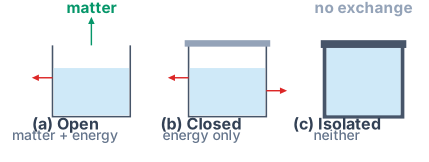
A system can exchange matter and/or energy with its surroundings, or neither — three possibilities, giving three types of system:
- Open System — exchanges both matter and energy (e.g. an open beaker).
- Closed System — exchanges only energy, never matter (e.g. a sealed conducting vessel).
- Isolated System — exchanges neither (e.g. an ideal thermos flask).
Drawn by us to help you understand the concept clearly, and verified to make sure it's accurate. For exams, practice from your textbook's own diagram.
The figure shows three beakers, each drawn inside a larger region labelled “surroundings.” The beaker itself is the system. The key visual difference is what crosses the boundary between the beaker and its surroundings.
In panel (a), labelled Open, the beaker is open at the top. Arrows cross the boundary in both directions for matter (shown as particles or a stream) and for energy (shown as wavy lines for heat and arrows for work). This tells you that both matter and energy can move freely between the system and the surroundings. A real open beaker on a lab bench is the classic example — reactants can evaporate, and heat flows in or out.
Panel (b), labelled Closed, shows the beaker covered with a lid. Only energy arrows cross the boundary; matter arrows stop at the lid. The system exchanges heat and work with the surroundings, but no material enters or leaves. A sealed copper vessel containing a reaction is the textbook example — the walls conduct heat, but nothing gets in or out.
Panel (c), labelled Isolated, shows the beaker completely sealed inside an insulating jacket (like a thermos flask). No arrows cross the boundary at all — neither matter nor energy. The system is completely cut off from the surroundings. A reaction in a perfect thermos flask approximates this: no heat transfer, no work done on or by the surroundings, and no material exchange.
The boundary itself can be real (a beaker wall, a lid) or imaginary (a fixed volume in space you define). What matters is what you allow to cross it. The same physical container can be treated as open, closed, or isolated depending on what you choose as your system and what you consider the surroundings.
The physical idea is foundational: the type of system determines which conservation laws apply and which terms appear in the energy balance equation. For an isolated system, the total energy is constant — no from the surroundings. For a closed system, the first law of thermodynamics applies in its simplest form:
…
The Boundary: Real or Imaginary
The textbook makes a crucial point: the boundary that separates the system from the surroundings can be real (like the walls of a beaker or a test tube) or imaginary (like a set of Cartesian coordinates defining a specific volume in space). This means you can define a system simply by drawing an imaginary box around a region of interest. The type of system (open, closed, or isolated) is then determined by what that imaginary boundary allows to pass through.
Summary Table
| System Type | Exchange of Matter | Exchange of Energy | Example | …