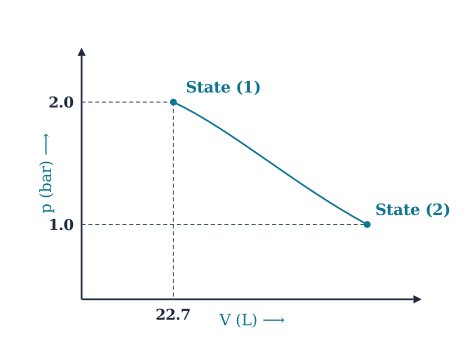
Q.1.0 mol of a monoatomic ideal gas is expanded from state
🔒You're viewing a preview — the full solution, concept, methods & PYQ mapping are locked.
🔒 Start your 14-day free trial to unlock the full solution →Concept understanding — Irreversible Expansion Work
Irreversible Expansion Work – From Intuition to Precision
Imagine you have a gas trapped inside a cylinder with a piston. If you suddenly pull the piston outward, the gas expands rapidly into the newly available space. That's an irreversible expansion — the gas doesn't pass through a series of equilibrium states; it rushes, swirls, and settles only at the end.
Now, think about the work done by the gas during this process. Work, in physics, is force times displacement. For a piston, force is pressure times area, so work becomes PΔV. But here's the catch: during an irreversible expansion, the pressure of the gas is not uniform throughout the cylinder. There are pressure gradients, turbulence, and the gas near the piston face may be at a different pressure than the gas deeper inside.
So how do we calculate the work done?
The Key Insight
The work done by the gas is determined by the external pressure it pushes against — not its own internal pressure. Why? Because the piston moves only in response to the net force acting on it. That net force comes from the external pressure on the other side of the piston.
For any expansion (reversible or irreversible), the work done by the gas is:
W=∫PextdV
where Pext is the pressure exerted on the gas by the surroundings (the piston face).
During a reversible expansion, the gas is always in equilibrium with the surroundings, so Pgas=Pext at every instant. That's why you can replace Pext with Pgas and integrate using the gas's equation of state.
During an irreversible expansion, Pgas is not equal to Pext — and often, Pext is held constant (like when you suddenly release the piston against atmospheric pressure). In that case, the work simplifies dramatically:
W=PextΔV
The Intuitive Picture
Think of pushing a heavy box across a rough floor. The work you do depends on the force you apply (your "external" force), not on the internal stresses inside the box. Similarly, the gas does work against the external resistance it meets — the piston's opposing force.
If the external pressure is constant (say, 1 atm), the gas does work equal to Pext× (change in volume), regardless of how chaotically it expands. The gas might have been at 10 atm initially, but it only does work against the 1 atm it actually pushes.
A common mistake: using the gas's own pressure to calculate irreversible work. Unless the process is reversible, Pgas=Pext, and using Pgas gives the wrong answer.
The Precise Statement
Irreversible expansion work is the work done by a gas when it expands through a series of non-equilibrium states. It is calculated using the external pressure that opposes the expansion:
Wirr=∫V1V2PextdV
For the most common case — expansion against a constant external pressure (like the atmosphere or a fixed weight on the piston): …
Concept: Reversible Isothermal Expansion Work
For a reversible isothermal process, the gas does maximum work because it expands against an external pressure that is infinitesimally smaller than the internal pressure at every instant. The work is given by:
w=−nRTln(V1V2)=−nRTln(p2p1)
The negative sign reflects the convention that work done by the system is negative (energy leaves the system).
Calculation:
Given n=1.0 mol, T=298 K, p1=2 bar, p2=1 bar, and R=8.314 J K⁻¹ mol⁻¹: …
For a reversible isothermal expansion of an ideal gas, the work done by the gas equals nRTln(V2/V1) because temperature (and hence internal energy) stays constant. Here w=−1718J (negative because the gas does work on the surroundings).
Why this approach works
In an isothermal process the temperature remains fixed, so for an ideal gas the internal energy U does not change (ΔU=0). The first law then tells us that all the heat absorbed goes entirely into doing work: q=−w.
For a reversible path the external pressure tracks the gas pressure infinitesimally closely at every instant, pext=p=VnRT. The work is then the integral of pdV from the initial to the final volume, and because T is constant we can pull nRT out front and integrate VdV to get a logarithm. That logarithm can be written in terms of the volume ratio V2/V1 or equivalently the pressure ratio p1/p2 (since pV=const. at fixed T).
Step-by-step calculation
1. Recognize the process type.
The expansion is both reversible and isothermal at T=298K. We have n=1.0mol, p1=2bar, p2=1bar, so V1V2=p2p1=2.
2. Write the work formula for reversible isothermal expansion.
The work done by the gas (our sign convention: work done by the system is negative) is
w=−∫V1V2pextdV=−∫V1V2VnRTdV.
Because T is constant,
w=−nRT∫V1V2VdV=−nRTln(V1V2).
w=−nRTln(V1V2)=−nRTln(p2p1).
3. Substitute the numbers.
Take R=8.314J mol−1K−1, n=1.0mol, T=298K, and ln(2)≈0.693.
w=−(1.0)(8.314)(298)ln(2)=−2477.6×0.693≈−1717J. …
- KCET 2025Set D-41 markMCQQ.Given below are two statements. Statement-I : Adiabatic work done is positive when work is done on the system and internal energy of the system increases. Statement – II : No work is done during free expansion of an ideal gas. In the light of the above statements, choose the correct answer from the options given below. (A) Both statements – I and Statement – II are false (B) Statement – I is true but statement – II is false (C) Statement – I is false but statement – II is true (D) Both statements – I and Statement – II are true.
›Reveal solutionSolution
Both statements are standard thermodynamic facts: adiabatic work done on a system is positive and raises U, and free expansion against vacuum does zero work.
Step 1 — Statement I.
For an adiabatic process q=0, so the first law ΔU=q+w reduces to
ΔU=w
By the IUPAC sign convention, work done on the system is positive (w>0). Hence ΔU=w>0: the internal energy increases. Statement-I is true.
Step 2 — Statement II.
Free expansion means the gas expands into an evacuated space, so the external pressure is zero:
w=−pextΔV=−(0)ΔV=0 …
- COMEDK 2025Set 2025-E1 markMCQQ.Two moles of an ideal gas at 1 bar pressure and 298 K is expanded into vacuum to double the volume. The work done is : (A) 2 J (B) 0 J (C) 1.5 J (D) 10 J
›Reveal solutionSolution
For expansion into a vacuum (free expansion), no opposing pressure exists, so the work done by the gas is zero. The correct answer is 0 J.
The key concept here is work in thermodynamics. Work done by a gas during expansion is given by W=−∫PextdV, where Pext is the external pressure against which the gas pushes. If the gas expands into a vacuum, there is no external pressure to oppose it — the gas does not "push" against anything. This is called a free expansion, and the work done is always zero, regardless of the gas type, temperature, or volume change.
Let’s walk through it step by step:
-
Identify the process: The problem says "expanded into vacuum." This means the gas expands against zero external pressure (Pext=0).
-
Recall the formula for work: In thermodynamics, the work done by the gas is
W=−∫V1V2PextdV
The negative sign is a sign convention (work done by the system is negative in some conventions, but here we care about magnitude). Crucially, it is the external pressure, not the gas pressure, that matters.
- Apply the condition: Since Pext=0, the integral becomes
W=−∫V1V20dV=0
No matter how much the volume changes, the product of zero and any volume change is zero.
- Check for traps: Some might mistakenly use the gas’s own pressure in PdV work, but that would be the reversible work, which requires a finite opposing pressure. Here, the expansion is irreversible and into vacuum — no work is done. …
-
- COMEDK 2024Set 2024-E1 markMCQQ.5.0 moles of an Ideal gas at 3.0 atm pressure and 27∘C is compressed isothermally to half its volume by application of an external pressure of 3.5 atm. What is the amount of work done (in joules) on the gas? Given: 1 L atm=101.3 J:R=0.082 L atm K−1 mol−1 (A) −3559.9 (B) 7268.3 (C) −10367.4 (D) 14359.2
›Reveal solutionSolution
Against a constant external pressure of 3.5 atm the gas is halved from 41.0 L to 20.5 L; w=−PextΔV=+71.75 L·atm =+7268.3 J (done on the gas).
Initial volume from ideal gas law:
V1=PnRT=35×0.082×300=3123=41.0 L
Compressed to half: V2=20.5 L, so ΔV=20.5−41.0=−20.5 L.
Irreversible work against constant Pext=3.5 atm: …
- KCET 2023Set D-21 markMCQQ.A gas at a pressure of 2 atm is heated from 25∘C to 323∘C and simultaneously compressed to 32 of its original value. Then the final pressure is (A) 1.33 atm (B) 6 atm (C) 2 atm (D) 4 atm
›Reveal solutionSolution
Apply the combined gas law: doubling T doubles P, and squeezing V to 2/3 multiplies P by 3/2 — together ×3.
Step 1 — Choose the law
The amount of gas is fixed but both V and T change, so neither Boyle's nor Charles's law alone will do. Combining them gives the combined gas law:
T1P1V1=T2P2V2
(This is just PV=nRT with n and R constant.)
Step 2 — Convert to absolute temperature
Gas laws require kelvin — using ∘C here would be the classic error.
T1=25+273=298 K
T2=323+273=596 K
Note T1T2=298596=2 exactly — the numbers were chosen so the temperature doubles.
Step 3 — Volume change
"Compressed to 32 of its original value":
V2=32V1⟹V2V1=23
Step 4 — Solve for P2 …
- COMEDK 2022Set 20221 markMCQQ.The relation between work done in reversible and irreversible process is (A) Wirr>Wrev (B) Wirr<Wrev (C) Wirr=Wrev (D) Wirr=Wrev
›Reveal solutionSolution
For a given change of state, reversible work is the maximum possible work that can be obtained from a system (or the minimum work required on it), so irreversible work is always less in magnitude — the correct option is (B).
The key idea here is that reversible processes are ideal — they are carried out infinitely slowly so that the system remains in equilibrium at every step, avoiding any dissipative losses like friction, turbulence, or unrestrained expansion. Irreversible processes, by contrast, involve finite driving forces and internal friction, which waste some of the available work.
Let’s reason through it step by step.
-
Define the context
We are comparing the work done for the same change of state (same initial and final conditions) — for example, expanding a gas from volume V1 to V2 against an external pressure. The reversible path uses an external pressure that is always infinitesimally less than the internal pressure (for expansion), so the system does work against the maximum possible opposing force at every instant.
-
Reversible work is the maximum
For expansion, the work done by the system is:
Wrev=−∫V1V2PextdV=−∫V1V2PgasdV
because Pext=Pgas±dP. This integral gives the largest magnitude of work the system can deliver. For compression, the reversible work is the minimum work that must be done on the system.
- Irreversible work is smaller in magnitude In an irreversible expansion (e.g., against a constant external pressure much lower than the gas pressure), the system does work against a smaller opposing force, so:
∣Wirr∣<∣Wrev∣
The “lost” work is dissipated as heat due to internal friction or turbulence. For compression, an irreversible process requires more work input (since you push against a higher internal pressure suddenly), so again the magnitude of work done on the system is larger for irreversible — but the sign convention matters.
- Sign convention In thermodynamics, work done by the system is usually taken as negative (if we use the IUPAC sign convention: W<0 for expansion). So for expansion: Wrev<Wirr<0 …
-
- KCET 2021Set B-21 markMCQQ.When the absolute temperature of ideal gas is doubled and pressure is halved, the volume of gas (A) will be half of original volume (B) will be 4 times the original volume (C) will be 2 times the original volume (D) will be 1/4 times the original volume
›Reveal solutionSolution
Use the combined gas law T1P1V1=T2P2V2: doubling T and halving P each double the volume, giving 4V1.
1. The concept — the ideal gas equation.
For a fixed amount of gas (n constant),
PV=nRT⟹V=PnRT
So volume is directly proportional to absolute temperature (Charles's law) and inversely proportional to pressure (Boyle's law). Both effects act at once here, which is what the combined gas law captures:
T1P1V1=T2P2V2
2. Write down the changes.
T2=2T1andP2=2P1
(The phrase "absolute temperature is doubled" matters — the relation V∝T only holds on the Kelvin scale.)
3. Solve for V2.
V2=V1×P2P1×T1T2=V1×P1/2P1×T12T1 …
🎓Unlock everything free for 14 days
- ✓Full step-by-step solutions
- ✓Concept-first explanations
- ✓Methods, shortcuts & mistakes
- ✓PYQ mapping + timed mock tests
Full access for 14 days. No credit card required.