Q.Match the following :
Column A
Column B
(k) Entropy
(l) Pressure
(m) Specific heat
🔒You're viewing a preview — the full solution, concept, methods & PYQ mapping are locked.
🔒 Start your 14-day free trial to unlock the full solution →Concept understanding — First Law of Thermodynamics
First Law of Thermodynamics
The Intuition: Energy is a Bank Account
Imagine you have a bank account. You can deposit money into it, or withdraw money from it. The total amount of money in your account changes only by the net of what goes in and what comes out. You cannot create money from nothing, nor can you destroy it — it just moves.
Energy works the same way. In any physical or chemical process, energy is never created or destroyed. It is only transferred from one place to another, or converted from one form to another. This is the First Law of Thermodynamics — the law of conservation of energy, applied to systems where heat and work are the currencies.
When you heat a gas in a piston, the gas expands and pushes the piston up. The energy you put in as heat doesn't vanish — part of it stays inside the gas (raising its temperature), and part of it leaves as work done on the piston. The total energy of the universe remains constant.
The Precise Statement
ΔU=Q−W
Where:
- ΔU = change in the internal energy of the system (the energy stored inside — kinetic energy of molecules, potential energy in bonds, etc.)
- Q = heat added to the system (positive if heat flows into the system)
- W = work done by the system on the surroundings (positive if the system expands and pushes against something)
The sign convention is crucial. Many textbooks use Q+W with work done on the system. The version above (Q−W) is the most common in Indian exam syllabi (CBSE, JEE, NEET). Stick to one convention and be consistent.
Common Mistake
Students often forget the sign of work. If a gas expands, it does positive work on the surroundings — so W is positive, and ΔU=Q−W becomes smaller. If a gas is compressed, work is done on the gas — so W is negative, and ΔU=Q−(−∣W∣)=Q+∣W∣, which increases internal energy.
What Each Term Means Physically
Internal energy (U) is the total microscopic energy of the system. For an ideal gas, it depends only on temperature — higher temperature means higher U. For real substances, it also depends on volume and phase.
Heat (Q) is energy transferred due to a temperature difference. If you put a hot pan on a cold stove, heat flows from pan to stove. In thermodynamics, we always ask: who is the system? If the system is the gas, then Q is positive when heat flows into the gas.
Work (W) in thermodynamics is usually pressure-volume work: W=∫PdV. When a gas expands against a piston, it does work on the piston. When you compress a gas, you do work on it.
A Simple Example
Take a cylinder with a movable piston, containing 1 mole of an ideal gas. You supply 500 J of heat to the gas. The gas expands and does 200 J of work on the piston.
- Q=+500 J (heat enters the system)
- W=+200 J (work done by the system)
ΔU=500−200=300 J …
Matching Thermodynamic Concepts
This tests your grasp of fundamental thermodynamic definitions and relationships. Each term in Column A corresponds to exactly one descriptor in Column B.
Concept: Thermodynamic processes, systems, and properties
Work through by identifying defining characteristics:
-
Process types: Adiabatic means no heat transfer (e); isothermal means constant temperature (f); reversible proceeds infinitely slowly through equilibrium states (j); free expansion occurs against zero external pressure (h).
-
System classification: An isolated system exchanges neither energy nor matter (d).
-
Functions: Path functions (like heat and work) depend on the route taken—heat is the classic example (a). State functions (like internal energy, enthalpy, entropy) depend only on the current state—internal energy (g), entropy (k) are state functions.
-
First Law relations: ΔU=q+w. At constant volume, w=0, so ΔU=q (b). At constant pressure, ΔH=q (i). The First Law itself embodies energy conservation (c). …
Each thermodynamic term in Column A pairs with its defining characteristic in Column B. Note that an intensive property matches two entries — both pressure and specific heat are intensive.
Using the definitions from the First Law and the classification of processes, systems and properties, each item matches as follows.
Matching
- (i) Adiabatic process → (e) No transfer of heat. An adiabatic process has q=0; the system is thermally insulated.
- (ii) Isolated system → (d) No exchange of energy and matter. Neither energy nor matter crosses the boundary.
- (iii) Isothermal change → (f) Constant temperature. ΔT=0 throughout.
- (iv) Path function → (a) Heat. Heat depends on the route between states, not just the end states.
- (v) State function → (g) Internal energy, (k) Entropy, (l) Pressure. All three depend only on the state of the system, not on how it was reached.
- (vi) ΔU=q → (b) At constant volume. At constant volume, w=0, so ΔU=qV.
- (vii) Law of conservation of energy → (c) First law of thermodynamics. The First Law, ΔU=q+w, is the energy-conservation statement.
- (viii) Reversible process → (j) Infinitely slow process which proceeds through a series of equilibrium states. A reversible (quasi-static) change passes through equilibrium states.
- (ix) Free expansion → (h) pext=0. Expansion into a vacuum, so w=−pextΔV=0.
- (x) ΔH=q → (i) At constant pressure. At constant pressure, ΔH=qp.
- (xi) Intensive property → (l) Pressure and (m) Specific heat. Both are independent of the amount of substance (specific heat is heat capacity per unit mass), so both are intensive.
- (xii) Extensive property → (g) Internal energy, (k) Entropy. Both scale with the amount of substance. …
Showing the 12 most recent of 19 on this concept.
- COMEDK 2026Set 2026-A1 markMCQQ.For an ideal gas undergoing an isothermal change, there is ____ (A) no change in Internal energy of the system and heat released by the system is equal to the work done by the system (B) an increase in Internal energy of the system and heat absorbed by the system is greater than the work done on the system (C) a decrease in Internal energy of the system and heat released by the system is equal to the work done by the system (D) no change in Internal energy of the system and heat absorbed by the system is equal to the work done by the system
›Reveal solutionSolution
For an ideal gas undergoing an isothermal process, temperature is constant, so internal energy (which depends only on temperature) does not change. By the first law of thermodynamics, any heat absorbed equals the work done by the gas. The correct option is (D).
The key concept here is the first law of thermodynamics combined with the properties of an ideal gas. The first law states:
ΔU=Q−W
where ΔU is the change in internal energy, Q is the heat added to the system, and W is the work done by the system. For an ideal gas, internal energy depends only on temperature. In an isothermal process, temperature is constant, so ΔU=0. This immediately tells us that Q=W. The sign convention matters: if the gas expands, it does positive work and absorbs heat; if compressed, work is done on it and heat is released. The question’s phrasing “heat absorbed by the system is equal to the work done by the system” matches the expansion case, which is the standard interpretation.
Let’s walk through the reasoning step by step:
-
Identify the process: “Isothermal change” means the temperature of the gas remains constant throughout the process. For an ideal gas, internal energy is a function of temperature only (since intermolecular forces are negligible). Therefore, ΔU=0.
-
Apply the first law: With ΔU=0, the first law ΔU=Q−W becomes 0=Q−W, so Q=W. This means the heat added to the system equals the work done by the system. If the gas expands, W>0 and Q>0 (heat absorbed). If compressed, W<0 and Q<0 (heat released). The statement in option (D) says “heat absorbed by the system is equal to the work done by the system,” which is exactly the expansion scenario.
-
Evaluate the options:
- (A) says “no change in internal energy” (correct) but “heat released by the system is equal to the work done by the system.” This would imply Q negative and W negative, which is possible for compression, but the phrasing “heat released” and “work done by the system” (positive work) are contradictory in sign. Typically, “work done by the system” is taken as positive, so this option is inconsistent.
- (B) says internal energy increases — false for isothermal.
- (C) says internal energy decreases — false. …
-
- COMEDK 2026Set 2026-M1 markMCQQ.1 kg of water at 100∘C is converted to steam at the same temperature. Volume of 1 cc of water changes to 1671×103cc on boiling. The change in internal energy of the system is (Latent Heat of vaporisation of water is 22.68×10⁵ J kg−1;1 atm=1.0×10⁵ Pa ) (A) 21.01×10³J (B) 19.01×10⁵J (C) 20.1×10⁵J (D) 21.01×10⁵J
›Reveal solutionSolution
The change in internal energy is found from the first law: ΔU=Q−W, where Q is the latent heat absorbed and W is the work done against the atmosphere during expansion. The result is 21.01×10⁵J, which corresponds to option (D).
Concept & Intuition
When water boils at constant pressure (1 atm), it absorbs latent heat to break intermolecular bonds, but it also does work pushing the atmosphere back as it expands dramatically (from 1 cc to 1671 litres). The first law of thermodynamics tells us that the heat added (Q) goes partly into increasing internal energy (ΔU) and partly into doing work (W). So we compute Q from the latent heat, W from PΔV, and subtract.
Step-by-step solution
- Heat absorbed (Q) The latent heat of vaporisation is L=22.68×10⁵J/kg. For 1 kg of water:
Q=mL=1×22.68×105=22.68×10⁵J.
- Work done (W)
At constant pressure, W=PΔV.
- Initial volume of water: Vi=1cc=1×10⁻⁶m3.
- Final volume of steam: Vf=1671×103cc=1671×10−3m3=1.671m3.
- Change in volume: ΔV=Vf−Vi≈1.671m3 (the tiny initial volume is negligible).
- Pressure: P=1atm=1.0×10⁵Pa. Hence, W=PΔV=(1.0×105)×1.671=1.671×10⁵J. …
- COMEDK 2025Set 2025-A1 markMCQQ.The Enthalpy of combustion of 1.0 mole of a reactive metal X at 27∘C and 1.0 bar pressure to form a solid oxide ( XO ) is −601.83 kJ/mol. The Internal energy change for this reaction is ___________ kJ. (R=8.314j K−1 mol−1) (A) 701.33 (B) 754.58 (C) −614.30 (D) −600.58
›Reveal solutionSolution
The key idea is to relate enthalpy change (ΔH) to internal energy change (ΔU) via ΔH=ΔU+ΔngRT, where Δng is the change in moles of gas. For the reaction X(s)+21O2(g)→XO(s), Δng=−0.5, giving ΔU=−601.83−(−0.5)(8.314×10⁻³)(300)=−600.58 kJ/mol. The correct option is (D).
The relationship between enthalpy and internal energy is fundamental in thermochemistry. Enthalpy (H) is defined as H=U+PV, so for a constant-pressure process, the change in enthalpy equals the heat exchanged. The difference between ΔH and ΔU comes from the PV work done when gases expand or contract. For reactions involving gases, the key formula is:
ΔH=ΔU+ΔngRT
where Δng = (moles of gaseous products) – (moles of gaseous reactants).
Here, the reaction is:
X(s)+21O2(g)→XO(s)
We are given ΔH=−601.83 kJ/mol at 27∘C (300 K) and 1 bar. We need ΔU.
Step-by-step:
-
Determine Δng
Reactants: 1 solid + 21 mole of gas. Products: 1 solid (no gas).
So Δng=0−21=−21 mol.
-
Convert units consistently
R=8.314 J K−1 mol−1 = 8.314×10⁻³ kJ K−1 mol−1.
Temperature T=27+273=300 K.
-
Compute the PV work term
ΔngRT=(−0.5)×(8.314×10−3)×300
=−0.5×2.4942=−1.2471 kJ/mol.
-
Solve for ΔU …
-
- COMEDK 2024Set 2024-A1 markMCQQ.At Constant volume, the heat required to raise the temperature of 4.48 L of an ideal gas at STP by 15∘C is 12.0 calories. The Cp of the gas is _____________ (R=2 Cal kg−1 mol−1) (A) 6 cal (B) 9 cal (C) 3 cal (D) 12 cal
›Reveal solutionSolution
Using the first law at constant volume, we find Cv from the given heat and moles, then use Cp=Cv+R to get Cp=6 cal mol−1K−1, which corresponds to option (A).
Concept & Intuition
At constant volume, no work is done (W=0), so the heat added equals the change in internal energy: Q=nCvΔT. Once we know Cv, we can find Cp using the relation Cp−Cv=R for an ideal gas. The trick is to first find the number of moles from the given volume at STP.
Step-by-step solution
- Find the number of moles of gas At STP (Standard Temperature and Pressure: 0∘C, 1 atm), 1 mole of an ideal gas occupies 22.4 L. Given volume = 4.48 L, so
n=22.44.48=0.2 moles.
- Use the constant-volume heat equation At constant volume, Q=nCvΔT. Given Q=12.0 cal, ΔT=15∘C=15 K, and n=0.2:
12=0.2×Cv×15
12=3Cv⇒Cv=4 cal mol−1K−1.
- Apply the relation between Cp and Cv For an ideal gas: Cp−Cv=R. Here R=2 cal mol−1K−1 (note: the problem gives R in these units, so we use them directly).
Cp=Cv+R=4+2=6 cal mol−1K−1.
Watch outA common mistake is to forget that R is given in cal mol−1K−1 and to try converting units. The problem explicitly states R=2 Cal kg−1mol−1 — but note the capital C in "Cal" is a typographical quirk; it means calories per mole per Kelvin. So just use R=2 directly.
- Check the options …
- COMEDK 2024Set 2024-A1 markMCQQ.The correct option for free expansion of an ideal gas under adiabatic condition is: (A) q=0,ΔT=0,w=0 (B) q=0,ΔT<0,w=0 (C) q=0,ΔT=0,w=0 (D) q=0,ΔT=0,w=0
›Reveal solutionSolution
For the free expansion of an ideal gas under adiabatic conditions, no heat is exchanged (q = 0), no work is done (w = 0), and because the internal energy of an ideal gas depends only on temperature, the temperature remains constant (ΔT = 0). The correct option is (D).
The key concept here is free expansion combined with adiabatic conditions. Free expansion means the gas expands into a vacuum — there is no opposing pressure, so the gas does no work. Adiabatic means no heat enters or leaves the system. For an ideal gas, internal energy depends only on temperature. Since no work is done and no heat is transferred, internal energy doesn’t change, so temperature stays constant.
Let’s walk through it step by step:
-
Adiabatic condition means the system is thermally insulated: no heat exchange with the surroundings. Therefore, q=0. This eliminates option (C), which claims q=0.
-
Free expansion means the gas expands into a vacuum. There is no external pressure to push against, so the gas does no work: w=0. This eliminates option (B), which claims w=0.
-
First Law of Thermodynamics states:
ΔU=q+w
With q=0 and w=0, we get ΔU=0. …
-
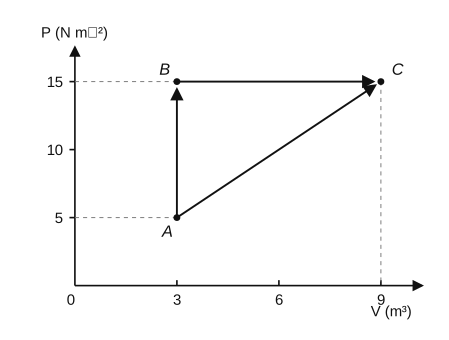
- COMEDK 2024Set 2024-A1 markMCQQ.An ideal gas changes its state from A to C in two different paths ABC and AC. The internal energy of the gas at state C is 20 J and at state B is 10 J. Heat supplied to the gas to go from B→C is (A) 90 J (B) zero (C) 70 J (D) 60 J
›Reveal solutionSolution
Internal energy is a state function, so ΔUB→C=10 J; adding the isobaric work WB→C=60 J from the P–V diagram gives QB→C=70 J — option (C).
Because internal energy depends only on state,
ΔUB→C=UC−UB=20−10=10 J.
The step B→C is an isobaric expansion; the work done by the gas (area under B→C on the P–V diagram) is WB→C=60 J. Applying the first law of thermodynamics, with Q the heat supplied to the gas and W the work done by the gas: …
- COMEDK 2024Set 2024-E1 markMCQQ.The latent heat of vaporisation of water is 2240 J. If the work done in the process of vaporisation of 1 g is 168 J, the increase in internal energy is (A) 1408 J (B) 2072 J (C) 2208 J (D) 2408 J
›Reveal solutionSolution
ΔU=Q−W=2240−168=2072 J.
Heat supplied (latent heat for 1 g) Q=2240 J; work done by the vapour W=168 J.
First law of thermodynamics: …
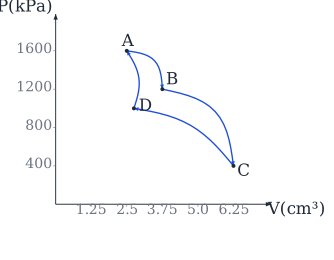
- KCET 2023Set A-31 markMCQQ.The P-V diagram of a Carnot's engine is shown in the graph below. The engine uses 1 mole of an ideal gas as working substance. From the graph, the area enclosed by the P-V diagram is [The heat supplied to the gas is 8000J]
 (A) 2000J
(B) 3000J
(C) 1000J
(D) 1200J
(A) 2000J
(B) 3000J
(C) 1000J
(D) 1200J›Reveal solutionSolution
The area enclosed by any closed P–V loop is the net work done; for a Carnot engine W=ηQH, and η follows from the two isotherm temperatures read off the graph via PV=nRT.
1. What the enclosed area means
For a cyclic process, ΔU=0, so the first law gives Wnet=Qnet. Graphically, the area enclosed by the closed loop is exactly the net work done by the gas (positive for a clockwise loop, which this is). So the question is really: what is the work output of this Carnot engine?
2. Carnot efficiency
η=QHW=1−THTC
We are told QH=8000 J, so we only need TC/TH.
3. Get the temperatures from the graph
For n=1 mole of an ideal gas, T=RPV, so temperature is proportional to the product PV. On a Carnot cycle, A→B is the hot isotherm (TH) and C→D the cold isotherm (TC), so we may take the PV product at any point on each isotherm. Use the two points whose coordinates fall exactly on printed gridlines:
- Point A (on the hot isotherm): P=1600 kPa, V=2.5 cm3
(PV)A=1600×2.5=4000 kPa⋅cm3
- Point C (on the cold isotherm): P=400 kPa, V=6.25 cm3 (PV)C=400×6.25=2500 kPa⋅cm3 …
- COMEDK 2023Set 2023-E1 markMCQQ.Gaseous Nitrous oxide decomposes at 298 K to form Nitrogen gas and Oxygen gas. The ΔH for the reaction at 1.0 atm pressure and 298 K is −163.15 kJ. Calculate Internal energy change for the decomposition of 100 g of Nitrous oxide gas under the same conditions of temperature and pressure. (A) −166 kJ (B) −188.2 kJ (C) −230.3 kJ (D) −376.43 kJ
›Reveal solutionSolution
Internal energy change: dU = dH - dn_g R T = -185.4 - (1.136)(8.314 x 10^-3 kJ/mol K)(298 K) = -185.4 - 2.81 = -188.2 kJ
Concept: dU = dH - (dn_g) R T, applied to the amount actually decomposed.
Reaction: 2 N2O(g) -> 2 N2(g) + O2(g); dH = -163.15 kJ (for 2 mol N2O)
dn_g = (2 + 1) - 2 = +1 (per 2 mol N2O)
Moles of N2O in 100 g (M = 44 g/mol):
n = 100/44 = 2.273 mol
Scale the reaction: factor = 2.273/2 = 1.136
dH = -163.15 x 1.136 = -185.4 kJ …
- COMEDK 2023Set 2023-M1 markMCQQ.For an adiabatic change in a system, the condition which is applicable is (A) q=0 (B) w=0 (C) q=−w (D) q=w
›Reveal solutionSolution
Adiabatic means “no heat transfer,” so q=0.
By definition, in an adiabatic change the system is thermally insulated and exchanges no heat with the surroundings:
q=0. …
- COMEDK 2022Set 20221 markMCQQ.The difference between heat capacity at constant pressure and heat capacity at constant volume is (A) R (B) TR (C) VR (D) 1
›Reveal solutionSolution
Derivation: at constant volume, qv = Cv dT = dU. At constant pressure, qp = Cp dT = dH = dU + d(pV) = Cv dT + R dT for one mole of an ideal gas. Hence Cp = Cv + R, i.e. Cp - Cv = R.
Concept: Relation between molar heat capacities of an ideal gas (Mayer's relation).
Cp - Cv = R …
- COMEDK 2022Set 20221 markMCQQ.If heat engine is filled at temperature 27∘C and heat of 100 k cal is taken from source at temperature 677∘C. Work done (in J) is (A) 0.28×10⁶ (B) 2.8×10⁶ (C) 28×106 (D) 0.028×10⁶
›Reveal solutionSolution
W = ηQ = 0.684 × 4.2 × 10⁵ ≈ 2.87 × 10⁵ J = 0.28 × 10⁶ J (≈0.29 × 10⁶).
Concept: Maximum (Carnot) efficiency η = 1 − T_sink/T_source, and W = ηQ.
T_sink = 27 °C = 300 K; T_source = 677 °C = 950 K.
η = 1 − 300/950 = 650/950 = 0.684.
Q = 100 kcal = 10⁵ cal = 10⁵ × 4.2 J = 4.2 × 10⁵ J. …
🎓Unlock everything free for 14 days
- ✓Full step-by-step solutions
- ✓Concept-first explanations
- ✓Methods, shortcuts & mistakes
- ✓PYQ mapping + timed mock tests
Full access for 14 days. No credit card required.