Q.Fill in the blanks.
Concept understanding — Ecological Concepts
Ecological Concepts: Zooming Out From Organism to Biosphere
Point a camera at a single deer grazing in a forest, and you are looking at an organism. Zoom out a little and you see the whole herd of deer sharing that forest — a population. Zoom out further and the tigers, grasses, insects and fungi living alongside that herd come into frame — a community. Pull back once more and you see the community together with the soil, water, sunlight and air it depends on — an ecosystem. Keep pulling back and entire regions of similar ecosystems (all the world's tropical forests, say) form a biome, and every biome on Earth together makes up the biosphere.
This is the idea of levels of ecological organisation — the same living world, examined at successively larger scales. The NCERT Class XII Biology ecology unit (Chapters 11–13) is built around exactly this zoom-out: Chapter 11 (Organisms and Populations) stays at the organism/population scale, Chapter 12 (Ecosystem) zooms out to the community-plus-environment scale, and Chapter 13 (Biodiversity and Conservation) zooms out again to ask how much variety of life exists and how to protect it. "Ecological Concepts" as a bucket covers facts that sit at any of these scales — not one single narrow idea, but the connected vocabulary ecologists use to describe life at every zoom level.
If a question is specifically about who benefits and who loses when two species interact (mutualism, competition, predation, parasitism, commensalism, amensalism), that is covered in depth in the Ecological Interactions concept. This concept covers the broader structural and functional ideas around it — organisation, ecosystem function, and the systems that move matter and energy through it.
Populations: The First Zoom-Out From the Individual
A population is a group of individuals of the same species living in a defined geographical area at a given time, capable of interbreeding. Because it is a group and not a single organism, a population has properties an individual cannot have on its own — birth rate and death rate (measured per capita, not as raw counts), a sex ratio, an age distribution, and a population density (the size of the population relative to a unit of space). These "group-level" attributes are exactly what distinguishes population ecology from studying one organism's physiology.
Ecosystem Structure: What an Ecosystem Is Made Of
An ecosystem is a functional unit of nature in which living organisms interact with each other and with their physical surroundings. Every ecosystem — a pond, a forest, a crop field, even an aquarium — is built from the same two kinds of components:
- Abiotic components — the non-living inorganic and organic materials: air, water, soil, and the nutrients dissolved in them.
- Biotic components — the living organisms, organised by their functional role: producers (autotrophs that fix solar energy), consumers (heterotrophs that eat producers or each other), and decomposers (fungi and bacteria that break down dead matter).
Two things give an ecosystem its physical shape: its species composition (which plant and animal species are present) and its stratification — the vertical layering of species at different heights, such as tall trees forming the top canopy of a forest, shrubs below them, and grasses and herbs at the ground.
An ecosystem is studied as a working unit through four linked processes: productivity, decomposition, energy flow, and nutrient cycling. Every "how does an ecosystem function" question is really asking about one of these four.
Productivity: How Fast an Ecosystem Makes New Matter
Primary productivity is the rate at which producers capture solar energy and convert it into organic (biomass) matter.
- Gross Primary Productivity (GPP) — the total rate of production of organic matter, i.e. the total solar energy fixed by all producers.
- Net Primary Productivity (NPP) — what is left of GPP after the producers themselves use some of it up in their own respiration: NPP = GPP − Respiration losses (R). NPP is the biomass actually available to the consumers (herbivores and decomposers) of the ecosystem.
- Secondary productivity is the rate at which consumers assimilate the food energy they take in from producers or from other consumers.
Decomposition: Breaking Matter Back Down
Decomposers convert the complex organic compounds in dead plant and animal remains ("detritus") back into simple inorganic nutrients, so those nutrients can be reused by producers. This happens in three overlapping steps:
- Fragmentation — detritivores (like earthworms) physically break detritus into smaller particles.
- Leaching — water-soluble inorganic nutrients seep down through the soil and are lost from the topsoil layer as precipitates.
- Catabolism — bacterial and fungal enzymes chemically break down the remaining detritus into simpler inorganic substances.
Partial decomposition leaves behind a dark, colloidal, highly microbe-resistant substance called humus, which acts as a slow-release nutrient reservoir; its further breakdown to release inorganic nutrients is called mineralisation. Decomposition is largely an oxygen-requiring process, is slower when detritus is rich in lignin/chitin, and is faster when it is rich in nitrogen and simple sugars — warm, moist conditions favour it, while cold and waterlogged (anaerobic) conditions suppress it and let organic matter accumulate.
Energy Flow and Ecological Pyramids
Unlike nutrients, energy in an ecosystem flows in one direction only — from the sun, into producers, and then into successive consumers — and is progressively lost as heat at every transfer; it is never recycled back to the producers the way a nutrient is. Because a real ecosystem rarely has a single, unbranched sequence of "who eats whom," feeding relationships form an interconnected food web rather than one isolated food chain.
Ecological pyramids represent this trophic structure visually (producers at the base, successive consumers stacked above):
A pyramid of energy is always upright — it can never be inverted, because energy is always lost as heat at each transfer, so a lower trophic level must always contain more energy than the level above it. Pyramids of numbers and biomass can be inverted in some ecosystems — the classic example is a marine ecosystem, where the biomass of fish (consumers) can exceed the biomass of the phytoplankton (producers) that support them, because the phytoplankton reproduce and get eaten so fast.
Nutrient (Biogeochemical) Cycling
Ecosystems do not manufacture the elements life is built from — carbon, nitrogen, phosphorus, water — they only cycle them, repeatedly, between the living (biotic) and non-living (abiotic) parts of the system. This is why it is called nutrient cycling or a biogeochemical cycle. NCERT groups these cycles into two types, based on where the element is mainly stored between uses:
| Cycle type | Main reservoir | Example element(s) |
|---|---|---|
| Gaseous cycle | Atmosphere or hydrosphere | Carbon, nitrogen |
| Sedimentary cycle | Earth's crust (rocks, soil) | Phosphorus, sulphur |
Carbon, for instance, moves from the atmosphere into producers via photosynthesis, through the food chain into consumers, and returns to the atmosphere through respiration (by both plants and animals) and the decomposition of dead matter — as well as through the combustion of fossil fuels. Phosphorus, by contrast, has no significant atmospheric gas phase; it cycles by weathering out of rocks into the soil, is taken up by plant roots, passed along the food chain, and eventually returns to the earth's crust as sediment.
Ecosystem Services
The processes above are not just academic — they are the reason a functioning ecosystem is valuable to humans. The benefits people derive from healthy ecosystem functioning are called ecosystem services — for example, forests continuously purifying air and water, pollinating insects sustaining food crops, and wetlands buffering floods. Valuing these services (even though they carry no direct price tag) is one argument ecologists make for conserving natural ecosystems.
Zooming Out One Last Time: Biodiversity
If you keep zooming out past a single ecosystem, the next question ecology asks is simply: how much variety of life is there, at every level — genes, species, and ecosystems — and how do we keep it from being lost? That is the subject of the next chapter, Biodiversity and Conservation, and it has its own dedicated concepts on the platform covering the causes of biodiversity loss, in-situ and ex-situ conservation strategies, and why biodiversity itself is valuable.
Whatever scale a question operates at — a single population's sex ratio, an ecosystem's energy pyramid, or the reservoir of the phosphorus cycle — it is testing the same underlying habit of mind: ecology studies life as a nested system, where the behaviour of the whole (a community, an ecosystem, the biosphere) emerges from, and in turn shapes, the parts within it.
"Ecological Concepts: Levels of Organisation & Real-World Examples" is a broad-overview search that maps directly onto the NCERT Class 12 Biology unit on Ecology, spanning organisms, populations, communities, ecosystems, and the biosphere. This unifying topic is consistently tested in CBSE board exams and NEET, since examiners often frame questions around the hierarchy explained here.
- Plants are called producers because they fix carbon dioxide.
- In an ecosystem dominated by trees, the pyramid of numbers is inverted type.
- In aquatic ecosystems, the limiting factor for productivity is light (or sunlight).
- Common detritivores in our ecosystem are earthworms (and millipedes, woodlice, etc., as per NCERT).
- The major reservoir of carbon on earth is oceans.
✓Final answer
Plants are producers, tree-dominated ecosystems show an inverted pyramid of numbers, light limits aquatic productivity, earthworms are common detritivores, and oceans are the major carbon reservoir.
This answer explains the ecological roles of producers, the shape of pyramids in forests, the limiting factor in water bodies, examples of detritivores, and the largest carbon store on Earth — all based strictly on NCERT Class 12 Biology.
- Plants are called producers because they fix carbon dioxide. The logic here is straightforward. In any ecosystem, the flow of energy begins with organisms that can manufacture their own food using sunlight and inorganic substances. Plants, through photosynthesis, take in carbon dioxide from the atmosphere and convert it into organic compounds like glucose. This process of "fixing" carbon — turning an inorganic gas into a usable organic form — is what makes them the foundation of every food chain. NCERT explicitly states that producers are autotrophs that fix carbon dioxide, and plants are the most familiar example on land.
- In an ecosystem dominated by trees, the pyramid of numbers is inverted type. A pyramid of numbers shows how many individual organisms exist at each trophic level. In a forest, a single large tree (the producer) supports hundreds or thousands of herbivores like insects, birds, and squirrels. Those herbivores, in turn, feed a smaller number of carnivores. So the base of the pyramid — the number of producers — is very small, while the next level has far more individuals. This gives the pyramid an inverted, or upside-down, shape. NCERT itself poses this exact scenario as an open question for students to work out ("if you were to count the number of insects feeding on a big tree what kind of pyramid would you get?"), and the accepted conclusion — an inverted pyramid of numbers — follows directly from reasoning through that scenario.
- In aquatic ecosystems, the limiting factor for productivity is light (or sunlight). Productivity in water depends on how much photosynthesis can occur. Sunlight penetrates only to a certain depth in oceans, lakes, and rivers. Below that depth, light is too weak for plants and algae to fix carbon efficiently. So the availability of light directly limits the rate of primary production in aquatic systems. NCERT itself leaves this as an open discussion question ("discuss the main reason for the low productivity of ocean with your teacher") rather than stating the answer outright; light availability (with nutrient scarcity as a secondary factor) is the standard, accepted explanation.
- Common detritivores in our ecosystem are earthworms and beetles (or termites, millipedes, woodlice). Detritivores are organisms that feed on dead organic matter — fallen leaves, dead animals, waste — and break it down into simpler substances. Earthworms are the classic example: they consume soil and decaying plant material, and their activity enriches the soil. NCERT names the earthworm as its own example of a detritivore; beetles, termites, and millipedes are commonly cited alongside it as the same functional type of organism.
- The major reservoir of carbon on Earth is the oceans (or the ocean).
Carbon cycles through the atmosphere, living organisms, soils, and water bodies. But the largest storehouse by far is the ocean. It holds carbon in dissolved forms (like bicarbonate and carbonate ions) and in the tissues of marine organisms. This chapter's own Summary classifies carbon as a gaseous-type cycle whose reservoir is "the atmosphere or hydrosphere" — and since the ocean (hydrosphere) holds far more carbon than the atmosphere, it is the major reservoir referred to here.
✓Final answer
In short: (a) producers,
(b) inverted,
(c) light/sunlight,
(d) earthworms and beetles, (e) the oceans.
Work blank by blank against the chapter's own vocabulary rather than recalling the finished sentence from memory. For each blank, first name WHICH ecosystem concept it is testing (biotic role, pyramid shape, limiting factor, decomposer type, or nutrient reservoir), then supply the one term this chapter defines for that concept — producers/autotrophs, inverted-vs-upright pyramid shape, light as the aquatic limiting factor, detritivores, and the ocean as the carbon reservoir.
Showing the 12 most recent of 17 on this concept.
- KCET 2025Set C-41 markMCQQ.Match Column-I with Column-II and choose the correct option given below:(A) a-iii, b-i, c-iv, d-ii (B) a-iii, b-ii, c-iv, d-i (C) a-iv, b-iii, c-ii, d-i (D) a-iv, b-i, c-ii, d-iii
Column-I (Bacteria) Column-II (Shape) a. Coccus i. Rod-shaped b. Bacillus ii. Spiral c. Vibrio iii. Spherical d. Spirillum iv. Comma-shaped ›Reveal solutionSolution
Match each bacterial genus-name to the shape its name literally describes — coccus (berry) = spherical, bacillus (rod) = rod, vibrio = comma, spirillum = spiral.
Step 1 — Why bacteria are classified by shape.
Bacteria are the sole members of Kingdom Monera, and although they are structurally simple they are metabolically the most diverse organisms. The most basic morphological classification uses four shapes, and the shape is built into the name itself — which is exactly what this matching question tests.
Step 2 — Take each entry of Column-I in turn.
Column-I Meaning of the name Shape Column-II a. Coccus Greek kokkos = 'berry' Spherical (round). Grow in pairs (diplococci), chains (streptococci) or clusters (staphylococci). iii. Spherical b. Bacillus Latin bacillum = 'little stick/rod' Rod-shaped (cylindrical). i. Rod-shaped c. Vibrio from the vibrating/darting motion; the classic example is Vibrio cholerae Comma-shaped (a short curved rod) iv. Comma-shaped d. Spirillum Latin spira = 'coil' Spiral (a rigid helical/corkscrew form) ii. Spiral Step 3 — Assemble the matching.
a–iii,b–i,c–iv,d–ii
Step 4 — Eliminate.
- (B) a-iii, b-ii, c-iv, d-i — makes Bacillus 'spiral' and Spirillum 'rod-shaped': both wrong. ✗
- (C) a-iv, … — makes Coccus 'comma-shaped'. ✗
- (D) a-iv, … — same error. ✗
- (A) a-iii, b-i, c-iv, d-ii ✓
Shortcut for the exam hall: only the options starting a-iii can survive, since 'Coccus = spherical' is unarguable. That leaves (A) and (B), and 'Bacillus = rod' then picks (A) at once.
✓Final answerThe correct option is (A) — a-iii, b-i, c-iv, d-ii.
ANSWER: A
- KCET 2024Set B-41 markMCQQ.Auxins : Apical dominance :: Gibberellins _______________. (A) Adventitious shoot formation (B) Accelerates abscission (C) Closure of stomata (D) Bolting
›Reveal solutionSolution
Read the analogy as "hormone : its signature effect". Auxin's signature effect is apical dominance; gibberellin's is BOLTING.
1. Decode the analogy
Auxins:Apical dominance::Gibberellins:?
The left pair links a plant growth regulator to the physiological effect it is famous for. Apical dominance is the suppression of the growth of lateral (axillary) buds by the apical bud — the auxin made at the shoot tip inhibits the buds below it (which is why removing the tip, i.e. decapitation/pruning, makes a plant bushy). So we need the corresponding hallmark effect of gibberellins.
2. The signature effects of gibberellins
Gibberellins (GA, e.g. GA3) are best known for elongation:
- BOLTING — the sudden, dramatic elongation of the internodes just prior to flowering in rosette plants (e.g. cabbage, beet). In a rosette the internodes are so short that the leaves sit in a whorl at ground level; applying GA causes the stem to shoot up. This is the textbook GA effect.
- Increase in axis length in grapes; improved fruit shape in apple; delaying senescence; and inducing α-amylase in germinating barley (a brewing application).
So the effect that stands to gibberellin as apical dominance stands to auxin is bolting. ✓
3. Why the others belong to different hormones
- (A) Adventitious shoot formation ✗ — the rooting of stem cuttings (adventitious root formation) is a classic AUXIN effect; shoot/bud formation in tissue culture is governed by the cytokinin-to-auxin ratio. Not GA.
- (B) Accelerates abscission ✗ — abscission of leaves/fruits is promoted by ABSCISIC ACID (ABA) and ethylene. Gibberellins, if anything, delay senescence and abscission.
- (C) Closure of stomata ✗ — this is the hallmark of ABSCISIC ACID, the "stress hormone", which shuts stomata under water stress to cut transpiration.
✓Final answerThe correct option is (D) — Bolting.
ANSWER: D
- KCET 2023Set B-41 markMCQQ.Choose the incorrect statement with reference to Kangaroo rat. (A) eliminates dilute urine. (B) found in North American desert. (C) meets its water requirements through internal fat oxidation. (D) uses minimal water to remove excretory products.
›Reveal solutionSolution
The Kangaroo rat is a desert-adapted mammal that conserves water by producing highly concentrated urine, not dilute urine. The incorrect statement is (A).
The Kangaroo rat (Dipodomys) is a classic example in biology of an animal perfectly adapted to an arid environment. The question tests your understanding of its specific water-conservation strategies. Let's examine each statement against the known biology of this animal.
-
Statement (A): "eliminates dilute urine."
This is the trap. A desert animal that needs to conserve every drop of water would never waste it by excreting dilute urine. The Kangaroo rat does the opposite — it produces the most concentrated urine of any mammal, with an osmolarity up to 5000–6000 mOsm/L. This is achieved by having exceptionally long loops of Henle in its nephrons, which create a steep osmotic gradient in the kidney medulla, allowing maximal water reabsorption. So this statement is factually wrong.
-
Statement (B): "found in North American desert."
This is correct. The Kangaroo rat is native to the arid and semi-arid regions of southwestern North America, including the Mojave, Sonoran, and Great Basin deserts.
-
Statement (C): "meets its water requirements through internal fat oxidation."
This is correct. The Kangaroo rat does not drink water. It obtains metabolic water from the oxidation of fats in its diet (mostly seeds). The reaction C57H104O6+80O2→57CO2+52H2O shows that fat oxidation yields more than 1 gram of water per gram of fat metabolized. This is a key adaptation for survival without free water.
-
Statement (D): "uses minimal water to remove excretory products."
This is correct. By producing highly concentrated urine and dry feces, the Kangaroo rat loses very little water in excretion. Its total daily water loss is remarkably low, often less than 10 mL per day for an adult.
Watch outA common mistake is to confuse "concentrated urine" with "dilute urine." Remember: desert animals conserve water by excreting concentrated urine (low water content, high solute concentration). Dilute urine would mean wasting precious water.
✓Final answerThe incorrect statement is (A) — the Kangaroo rat eliminates highly concentrated urine, not dilute urine.
-
- KCET 2023Set B-41 markMCQQ.Match the column-I with column-II and choose the correct option from the following : Column-I (Plant groups) | Column-II (Examples)
- Bryophyta | p. Pinus
- Gymnosperm | q. Adiantum
- Algae | r. Sphagnum
- Pteridophyta | s. Ectocarpus
›Reveal solutionSolution
Place each example in its plant group: Sphagnum → Bryophyta, Pinus → Gymnosperm, Ectocarpus → Algae, Adiantum → Pteridophyta.
Concept — Plant Kingdom classification.
-
Bryophyta — the "amphibians of the plant kingdom": non-vascular, gametophyte-dominant. Sphagnum (the bog/peat moss) is the standard textbook example. → r
-
Gymnosperm — naked-seeded plants with no ovary and hence no fruit. Pinus is the standard example. → p
-
Algae — chlorophyll-bearing, simple, thalloid, autotrophic. Ectocarpus is a brown alga (Phaeophyceae). → s
-
Pteridophyta — the first true vascular land plants, reproducing by spores. Adiantum (maiden-hair fern) is the standard example. → q
Assembling the match: 1-r,2-p,3-s,4-q.
This is exactly option (C). Option (A) and (D) wrongly make Adiantum a bryophyte; option (B) makes the brown alga Ectocarpus a bryophyte.
✓Final answerThe correct option is (C) — 1-r, 2-p, 3-s, 4-q.
ANSWER: C
- KCET 2023Set B-41 markMCQQ.Match column-I with column-II. Select the option with correct combination. Column-I 1. Hypertonic 2. Capillarity 3. Symport 4. Guttation Column-II p. Two molecules move in the same direction across the membrane. q. External solution is more concentrated than cell sap. r. Water loss in the form of droplets. s. Ability of water to rise in thin tubes. (A) 1-q, 2-s, 3-p, 4-r (B) 1-q, 2-s, 3-r, 4-p (C) 1-q, 2-t, 3-p, 4-s (D) 1-q, 2-p, 3-s, 4-r
›Reveal solutionSolution
This is a matching exercise linking biological and physical terms with their correct definitions. The correct combination is 1-q, 2-s, 3-p, 4-r, which corresponds to option (A).
The question tests your grasp of four distinct concepts — two from plant physiology (hypertonic, guttation), one from membrane transport (symport), and one from physics applied to biology (capillarity). Each term in Column-I has a precise, non-overlapping definition in Column-II, so the task is to match each one correctly without confusion.
Let’s go through them one by one.
-
Hypertonic — This describes a solution whose solute concentration is higher than that inside a cell (or cell sap). When a cell is placed in a hypertonic solution, water moves out by osmosis, causing the cell to shrink. The correct match is q: “External solution is more concentrated than cell sap.” No other option fits.
-
Capillarity — This is the physical phenomenon where a liquid rises in a narrow tube due to adhesive and cohesive forces. In plants, it helps water move upward through xylem vessels. The correct match is s: “Ability of water to rise in thin tubes.” This is a textbook definition.
-
Symport — This is a type of membrane transport where two different molecules or ions move across the membrane in the same direction, using a common carrier protein. The correct match is p: “Two molecules move in the same direction across the membrane.” (The opposite, where they move in opposite directions, is called antiport.)
-
Guttation — This is the process by which plants lose water in the form of liquid droplets, typically from the tips or edges of leaves, especially when humidity is high and transpiration is low. The correct match is r: “Water loss in the form of droplets.” (Do not confuse this with transpiration, which is water loss as vapour.)
Watch outA common mistake is to confuse guttation with transpiration, or to mix up symport with antiport. Guttation involves liquid water droplets, not vapour. Symport always means same-direction movement — never opposite.
Now, assembling the matches:
1 → q, 2 → s, 3 → p, 4 → r.
This sequence corresponds exactly to option (A).
✓Final answerThe correct option is (A).
-
- KCET 2022Set A-11 markMCQQ.The given graph represents
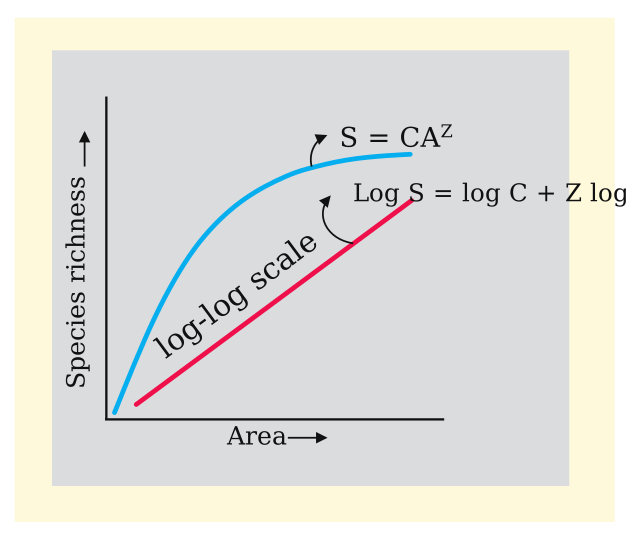 (A) Population growth
(B) Enzyme activity
(C) Species area relationship
(D) Growth of organisms
(A) Population growth
(B) Enzyme activity
(C) Species area relationship
(D) Growth of organisms›Reveal solutionSolution
Axes = species richness vs area, and the printed equation S=CAZ is the species–area relationship.
1. Read the axes — they name the relationship
- Y-axis: Species richness, S
- X-axis: Area, A
A graph of species number against area is, by definition, the species–area relationship.
2. The printed equation clinches it
The curve carries the label
S=CAZ
where
- S = species richness,
- A = area,
- C = the Y-intercept (a regression constant),
- Z = the slope, the regression coefficient.
Taking logarithms turns it into the straight line also drawn in the figure:
logS=logC+ZlogA
This is exactly von Humboldt's finding — within a region, species richness rises with explored area but only up to a limit, so the plot is a rectangular hyperbola (concave-down, flattening). Typical values: Z=0.1–0.2 for small regions, and 0.6–1.2 for very large areas such as whole continents (the frugivorous birds and mammals example).
3. Eliminate the others
- (A) Population growth — would plot population density N against time, and would be sigmoid (logistic) or exponential; the equation would be dN/dt=rN(KK−N).
- (B) Enzyme activity — would plot velocity against substrate concentration (Michaelis–Menten), never "species richness".
- (D) Growth of organisms — again a function of time, not area.
✓Final answerThe correct option is (C) — Species area relationship, described by S=CAZ (i.e. logS=logC+ZlogA).
ANSWER: C
- KCET 2021Set C-31 markMCQQ.Match the compounds of Column I with their functions in Column II. Column-I | Column-II
- Trypsin | p) Fights infectious agents
- GLUT-4 | q) Is an intercellular Ground substance
- Collagen | r) Works as an enzyme
- Antibody | s) Enables glucose transport into cells. (A) 1-s, 2-r, 3-q, 4-p (B) 1-r, 2-s, 3-p, 4-q (C) 1-s, 2-r, 3-p, 4-q (D) 1-r, 2-s, 3-q, 4-p
›Reveal solutionSolution
Give each protein its single function: trypsin → enzyme, GLUT-4 → glucose transporter, collagen → ground substance, antibody → defence.
Concept — Protein function table (Biomolecules). NCERT lists proteins together with the function each performs.
-
Trypsin — a pancreatic proteolytic enzyme; it catalyses the hydrolysis of proteins into peptides in the small intestine. → r
-
GLUT-4 — an integral membrane transport protein that enables glucose transport into cells; it is the insulin-responsive glucose transporter of muscle and adipose tissue. → s
-
Collagen — the most abundant protein in the animal world; it forms the intercellular ground substance of connective tissue. → q
-
Antibody — an immunoglobulin that fights infectious agents, binding antigens on pathogens and neutralising them. → p
Assembling the match: 1-r,2-s,3-q,4-p.
That is option (D). Option (B) is the tempting distractor — it gets trypsin and GLUT-4 right but then swaps collagen and antibody, which is wrong since collagen is structural, not immunological. Options (A) and (C) even call trypsin a glucose transporter.
✓Final answerThe correct option is (D) — 1-r, 2-s, 3-q, 4-p.
ANSWER: D
- KCET 2021Set C-31 markMCQQ.Identify the incorrect statement (A) CAM plants close their stomata during daytime (B) Seals have a thick layer of fat to reduce body heat (C) Lizards bask in the sun during winter (D) Tribes living in high altitude have the same RBC count as people living in the plaits
›Reveal solutionSolution
Check each statement against the standard adaptations in Organisms and Populations: only the high-altitude RBC claim is false.
Step 1 — (A) CAM plants close their stomata during daytime. TRUE.
Crassulacean Acid Metabolism is a temporal separation of CO2 uptake from the Calvin cycle. Desert succulents open their stomata at night (fixing CO2 as malic acid) and keep them shut by day, when transpiration would be ruinous; the stored acid is decarboxylated by day to feed RuBisCO behind closed stomata. Correct statement.
Step 2 — (B) Seals have a thick layer of fat to reduce body heat loss. TRUE.
Blubber is the classic mammalian insulating adaptation of polar aquatic mammals — a low-conductivity subcutaneous fat layer that cuts heat loss to icy water. Correct statement.
Step 3 — (C) Lizards bask in the sun during winter. TRUE.
Lizards are ectotherms with no internal thermostat; they behaviourally regulate temperature — basking to absorb solar heat when it is cold, moving into shade or burrows when it is hot. Correct statement.
Step 4 — (D) High-altitude tribes have the same RBC count as plains people. FALSE.
At altitude the atmospheric pO2 is low, so less O2 is loaded per breath. The body acclimatises:
- the kidneys release erythropoietin, so RBC count (and haemoglobin) increases — polycythaemia;
- haemoglobin's binding affinity is raised and breathing rate goes up. This is the standard NCERT example of acclimatisation, and it says explicitly that the RBC count of high-altitude people is higher, not the same. So this statement is the incorrect one — which is what the question asks for.
✓Final answerThe correct option is (D) — Tribes living at high altitude have the same RBC count as people living in the plains (false: their RBC count is higher).
ANSWER: D
- KCET 2020Set A-11 markMCQQ.Which of the following features of plants is not helpful in adapting to desert life? (A) Presence of thick cuticle on the leaf surface (B) Leaves modified into spines (C) Presence of sunken stomata (D) Absence of trichomes on leaf surface
›Reveal solutionSolution
Desert plants need to conserve water, so features that reduce water loss (thick cuticle, spines, sunken stomata) are helpful. The feature that is not helpful is the absence of trichomes — because trichomes actually help reduce water loss, so lacking them would be a disadvantage.
The question tests your understanding of xerophytic adaptations — the structural modifications that allow plants to survive in dry, hot deserts where water is scarce. Every feature listed either helps the plant retain water or prevents excessive transpiration. Your job is to spot the one that does the opposite.
Let’s examine each option one by one.
-
Thick cuticle on the leaf surface
The cuticle is a waxy, waterproof layer covering the epidermis. A thick cuticle acts as a barrier to water vapour, reducing transpiration. In a desert, this is clearly beneficial — it keeps precious water inside the leaf. So this is a helpful adaptation.
-
Leaves modified into spines
Spines are essentially highly reduced leaves with very little surface area. Since transpiration happens mostly through leaves, minimising leaf area drastically cuts water loss. Spines also deter herbivores. This is a classic desert adaptation (think cacti). Definitely helpful.
-
Presence of sunken stomata
Stomata are the pores through which gas exchange and water loss occur. In many xerophytes, stomata are located in pits or depressions (sunken) on the leaf surface. This creates a pocket of still, humid air just outside the stomatal pore, which reduces the gradient for water vapour diffusion and thus slows transpiration. This is a clever, helpful adaptation.
-
Absence of trichomes on leaf surface
Trichomes are hair-like outgrowths from the epidermis. In desert plants, trichomes are often present — they serve multiple water-conserving roles: they reflect sunlight (reducing leaf temperature and thus transpiration), trap a layer of humid air near the leaf surface, and can even block wind from directly hitting stomata. So the absence of trichomes would remove these benefits, making the plant more vulnerable to water loss. This is not helpful for desert life.
Watch outA common mistake is to think trichomes are useless or only for protection against herbivores. In desert plants, trichomes are a key water-saving feature — their absence is a disadvantage, not an advantage.
TipIf you ever forget, think of the "felt-like" leaves of many desert plants (like Lavandula or Artemisia) — those fuzzy hairs are trichomes, and they're there for a reason.
✓Final answerThe feature that is not helpful in adapting to desert life is the absence of trichomes on the leaf surface, which corresponds to option (D).
-
- KCET 2020Set A-11 markMCQQ.In the following equation of Verhulst - Pearl logistic growth, the letter 'r' denotes ________. dtdN=rN(KK−N) (A) Extrinsic rate of natural increase (B) Intrinsic rate of natural increase (C) Carrying capacity (D) Population density
›Reveal solutionSolution
In the logistic growth equation, r is the intrinsic rate of natural increase — the per-capita rate at which the population would grow if resources were unlimited.
Step 1 — Identify every symbol in the equation.
dtdN=rN(KK−N)
- N = population density/size at time t
- t = time
- dtdN = rate of change of the population
- K = carrying capacity — the maximum population the habitat can support with its available resources
- r = intrinsic rate of natural increase = (birth rate − death rate) per individual; it is a per-capita constant that measures the population's inherent growth potential
Step 2 — Understand what r does in the model.
If resources were unlimited, growth would be exponential: dtdN=rN, whose solution Nt=N0ert is the familiar J-shaped curve. Here r is the multiplier that scales growth to the number of individuals already present — hence "intrinsic" (belonging to the species/population itself) and "natural increase" (births minus deaths, without migration).
Step 3 — What the extra bracket adds.
Real habitats are finite, so Verhulst and Pearl multiplied the exponential term by the braking factor (KK−N):
- When N≪K, the bracket ≈1 and growth is nearly exponential.
- As N→K, the bracket →0 and growth slows to a halt.
- At N=K, dtdN=0 — the population plateaus.
This gives the sigmoid (S-shaped) logistic curve, considered the more realistic model because no resource is truly unlimited.
Step 4 — Screen the options.
- (A) "Extrinsic rate of natural increase" — not a term used in this model (a distractor built by flipping "intrinsic").
- (B) Intrinsic rate of natural increase — the meaning of r. ✓
- (C) Carrying capacity — that is K, not r.
- (D) Population density — that is N, not r.
✓Final answerThe correct option is (B) — Intrinsic rate of natural increase.
ANSWER: B
- KCET 2020Set A-11 markMCQQ.Which one of the following is not included under in-situ conservation ? (A) National Park (B) Sanctuary (C) Botanical Garden (D) Biosphere Reserve
›Reveal solutionSolution
In-situ conservation means protecting species in their natural habitat. National Parks, Sanctuaries, and Biosphere Reserves are all in-situ methods, while a Botanical Garden is an ex-situ method. The answer is (C).
The key idea here is the difference between in-situ (on-site) and ex-situ (off-site) conservation. In-situ conservation means protecting biodiversity right where it naturally occurs — in the wild. Ex-situ conservation means taking species out of their natural habitat and protecting them in a controlled, artificial setting.
Let’s check each option against this definition.
-
National Park (A) — A National Park is a large, legally protected area where wildlife and its habitat are preserved in their natural state. No human activities like grazing or forestry are allowed. This is a classic example of in-situ conservation.
-
Sanctuary (B) — A Wildlife Sanctuary is also a protected natural area, though some limited human activities may be permitted. The core purpose is still to protect species in their own environment. This is also in-situ.
-
Botanical Garden (C) — A Botanical Garden is a man-made collection of living plant species, often grown in beds, greenhouses, or landscaped areas. The plants are taken from their original habitats and maintained artificially. This is ex-situ conservation, not in-situ.
-
Biosphere Reserve (D) — A Biosphere Reserve is a large, multi-use protected area that includes core zones (strictly protected), buffer zones (limited human activity), and transition zones (sustainable development). It is designed to conserve biodiversity in its natural setting. This is in-situ.
Watch outA common mistake is to think that because a Botanical Garden contains living plants, it must be "in" the natural habitat. But the plants are deliberately removed from their wild locations and cultivated elsewhere — that’s the defining feature of ex-situ conservation.
TipA quick memory aid: In-situ = "in site" = in the original site. Ex-situ = "ex site" = out of the original site. National Parks, Sanctuaries, and Biosphere Reserves are all "in site" areas. Botanical Gardens, Zoos, and Gene Banks are "out of site" methods.
✓Final answerThe option that is not included under in-situ conservation is (C) Botanical Garden.
-
- KCET 2019Set A-11 markMCQQ.In Amphibians and reptiles, the body temperature changes corresponding to external temperature. The organisms which show this kind of response is termed as – (A) Regulators (B) Conformers (C) Partial Regulators (D) Thermophiles
›Reveal solutionSolution
The key idea is that organisms whose body temperature changes with the environment are called conformers — they do not regulate their internal temperature. The correct answer is (B) Conformers.
The question tests your understanding of how organisms respond to changes in their external environment, specifically temperature. In ecology, we classify organisms based on whether they maintain a stable internal environment or let it fluctuate with the surroundings.
Regulators are organisms that use physiological or behavioral mechanisms to keep their internal conditions (like body temperature or salt concentration) constant, regardless of what’s happening outside. Humans and other mammals are classic regulators — we maintain a body temperature around 37°C whether it’s a hot summer day or a cold winter night.
Conformers, on the other hand, do not expend energy to regulate their internal environment. Instead, their body temperature, metabolic rate, or other internal conditions change along with the external environment. Amphibians and reptiles are textbook examples — a lizard basking in the sun warms up, and when it moves into the shade, it cools down. Their body temperature is not internally controlled; it simply matches the surroundings.
Partial regulators are a middle ground — they can regulate to some extent but not completely. Some fish and invertebrates fall into this category.
Thermophiles are a completely different group — they are organisms (usually microbes) that thrive at very high temperatures, like those found in hot springs. This term describes their habitat preference, not their response strategy to environmental change.
So the question directly asks: what do we call organisms whose body temperature changes with the external temperature? That is the definition of a conformer.
- Identify the key behavior: body temperature changes with the external environment.
- Recall the classification: regulators maintain constant internal temperature; conformers allow it to vary with the environment.
- Eliminate the other options: regulators (A) do the opposite; partial regulators (C) have some control, not full conformity; thermophiles (D) are about heat-loving organisms, not about regulation strategy.
- The term that matches the description is conformers.
Watch outA common mistake is to confuse "conformers" with "regulators" because both terms sound like they involve some kind of control. Remember: conformers conform to the environment (they change with it), while regulators regulate against the environment (they keep things constant).
✓Final answerThe correct option is (B) Conformers.
🎓Unlock everything free for 14 days
- ✓Full step-by-step solutions
- ✓Concept-first explanations
- ✓Methods, shortcuts & mistakes
- ✓PYQ mapping + timed mock tests
Full access for 14 days. No credit card required.