Q.How will you bring out the following conversion: p-nitroaniline (an aniline with a –NO2 group para to the –NH2) is to be converted into 3,4,5-tribromonitrobenzene (a benzene ring bearing –NO2 at position 1 and –Br at positions 3, 4 and 5)?
Imagine you have a benzene ring, and you want to attach a new group — say a chlorine, a bromine, a cyano group, or even a hydroxyl — directly onto the ring. The benzene ring is stubborn; it doesn't easily let go of its hydrogen atoms for simple substitution. But there is a clever trick: first convert the ring into a diazonium salt, a highly reactive intermediate that will let you swap in almost any group you want.
That is the core idea. A diazonium salt is a temporary, energetic handle on the benzene ring that you can then replace with a wide variety of substituents. It is one of the most powerful tools in aromatic synthesis.
What is a Diazonium Salt?
A diazonium salt has the general formula Ar–N₂⁺ X⁻, where Ar is an aryl group (like phenyl, C₆H₅–), N₂⁺ is a diazonium cation (two nitrogen atoms triple-bonded, with a positive charge on the terminal nitrogen), and X⁻ is a counterion like chloride, bromide, or hydrogensulfate.
The key structural feature: the –N₂⁺ group is attached directly to the benzene ring. This group is unstable — it wants to leave as N₂ gas. That instability is exactly what makes it useful: when the N₂ leaves, the ring is left with a highly reactive carbocation-like intermediate that can be attacked by a nucleophile.
Watch out
Diazonium salts are thermally unstable and can explode if dried. They are almost always prepared and used in cold solution (0–5 °C) without isolation.
How Do You Make One? (Diazotization)
You start with a primary aromatic amine (Ar–NH₂). Treat it with nitrous acid (HNO₂) at low temperature (0–5 °C). The reaction is:
Ar–NH2+NaNO2+2HCl0−5∘CAr–N2+Cl−+NaCl+2H2O
The nitrous acid is generated in situ from sodium nitrite and a mineral acid. The amine gets converted into the diazonium salt almost instantly. You must keep the solution cold; if it warms up, the diazonium salt decomposes and you get phenol and nitrogen gas.
Two Major Classes of Reactions
Once you have the diazonium salt in solution, you can do two fundamentally different things with it:
1. Substitution Reactions (N₂ leaves)
Here the –N₂⁺ group is replaced by another group. The nitrogen gas bubbles away, and the ring gets a new substituent. This is called dediazoniation. The leaving group is N₂, which is extremely stable, so the reaction is thermodynamically driven.
The most common substitutions:
Reagent/Condition
Product
Name
CuCl / HCl, heat
Ar–Cl
Sandmeyer reaction
CuBr / HBr, heat
Ar–Br
Sandmeyer reaction
CuCN / KCN, heat
Ar–CN
Sandmeyer reaction
KI, heat
Ar–I
Direct substitution
H₂O, heat
Ar–OH
Hydrolysis
H₃PO₂ (hypophosphorous acid)
Ar–H
Reduction (replaces N₂ with H)
Cu₂O, Cu(NO₃)₂, H₂O
Ar–NO₂
Replacement with nitro group
Tip
The Sandmeyer reaction uses copper(I) halide or cyanide as a catalyst. The copper helps transfer the halide or cyanide to the ring. Without copper, the reaction is much slower or gives different products.
The mechanism for Sandmeyer: the diazonium salt accepts an electron from Cu⁺, forming an aryl radical, which then abstracts a halogen from CuX₂. The N₂ leaves as a gas.
2. Coupling Reactions (N₂ stays)
Here the diazonium salt keeps its N₂ group and attacks another aromatic ring (usually an activated one like phenol or aniline). The result is an azo compound with the general structure Ar–N=N–Ar'. These compounds are intensely coloured — many are used as dyes.
The reaction is an electrophilic aromatic substitution. The diazonium cation is a weak electrophile, so it only attacks rings that are strongly activated (with –OH, –NH₂, –NHR, –NR₂ groups). The coupling occurs at the para position if available; otherwise ortho.
Coupling requires the coupling component (phenol or aniline) to be in its reactive form: phenol is used in alkaline solution (phenoxide ion is more activating), aniline is used in slightly acidic or neutral solution (to avoid protonation of the amino group).
Bromination of p-nitroaniline installs –Br at the two positions ortho to –NH2 (para is blocked by –NO2). The –NH2 is then converted to a diazonium salt and replaced by –Br (Sandmeyer). The three –Br groups end up at positions 3, 4 and 5 relative to –NO2.
Step 1 – Bromination (directed by –NH2)
In p-nitroaniline (–NH2 at C1, –NO2 at C4), the strongly activating –NH2 directs bromine ortho/para to itself. The para position (C4) is occupied by –NO2, so Br2 substitutes at both ortho positions (C2 and C6):
Method: Multistep Aromatic Synthesis - Use -NH2 to Direct Substitution, Then Remove/Replace It (Sandmeyer)
Core Concept
When a target molecule needs substituents at positions that a deactivating group (like -NO2) alone cannot direct to, the strongly activating -NH2 group is used first to install those substituents by its own ortho/para-directing power, and is then converted via a diazonium salt into the final desired group (here, -Br via the Sandmeyer reaction).
Steps
Compare the starting material and target to see which new groups must be added and at which ring positions.
Use the amino group's strong activation to introduce the new electrophile at the position(s) it directs to (ortho/para); if para is already blocked, the electrophile goes to both remaining ortho positions.
Diazotise the amino group: ArNH2 + NaNO2/HCl, 273-278 K gives ArN2+ Cl-.
Convert the diazonium salt to the desired halogen via the Sandmeyer reaction: ArN2+ + CuBr/HBr gives ArBr + N2.
Renumber the final ring based on the substituent that stayed fixed throughout (here, -NO2). …
Same / Similar Concept — real previous-year questions on the same or a closely similar concept, not this exact question.
KCET 2026Set D31 markMCQ
Q.The compound from which chlorobenzene cannot be prepared easily is
(A) Aniline
(B) Benzene
(C) Phenol
(D) Benzene diazonium chloride
›Reveal solutionSolution
The C–OH bond in phenol is strengthened by resonance with the aromatic ring, so phenol resists conversion to chlorobenzene, unlike benzene, aniline, or benzene diazonium chloride.
Step 1 — Routes that DO give chlorobenzene easily
Benzene undergoes direct electrophilic aromatic chlorination with Cl2 in the presence of a Lewis acid catalyst such as anhydrous FeCl3, giving chlorobenzene in one step. Aniline can first be converted to benzene diazonium chloride by diazotisation (NaNO2/HCl, 0–5°C), and this diazonium salt then undergoes the Sandmeyer reaction with CuCl/HCl to directly replace −N2+Cl− with −Cl, giving chlorobenzene. So benzene, aniline, and benzene diazonium chloride are all genuine, well-established starting materials for chlorobenzene.
Q.In the reaction :
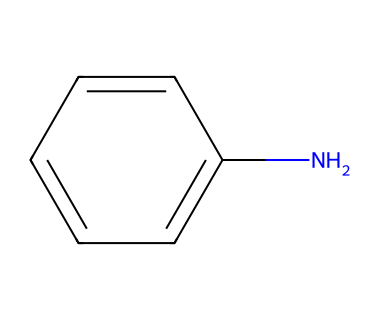
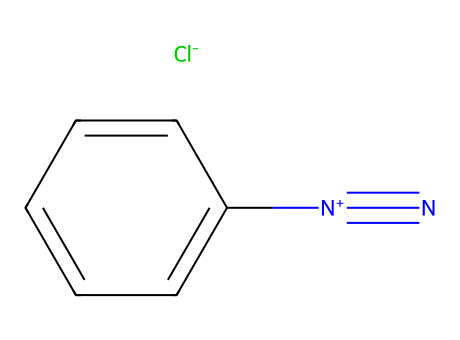
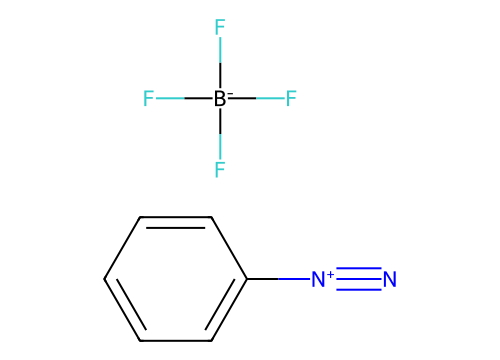
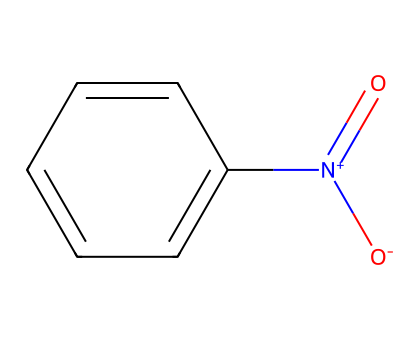
C6H5NH2PC6H5N+2Cl−QC6H5N+2B−F4RC6H5NO2
The four species drawn as structures:
P, Q and R respectively are :
(A) NaNO2 + dil. HCl, HBF4, Cu + NaNO2
(B) NaNO2 + con.HCl, F2, Cu + NaNO3
(C) NaNO2 + dil.HCl, BF3, Cu + NaNO2
(D) NaNO3 + dil. HCl, F2, Cu + NaNO3
›Reveal solutionSolution
Aniline → diazonium chloride (NaNO₂/dil. HCl, 273–278 K) → diazonium fluoroborate (HBF₄) → nitrobenzene (Cu + NaNO₂) — the standard Balz–Schiemann-type sequence.
Step 1 — Identify P (diazotisation).
The conversion C6H5NH2→C6H5N+2Cl− is diazotisation. A primary aromatic amine reacts with nitrous acid, which is unstable and must be generated in situ:
NaNO2+HCl⟶HNO2+NaCl
C6H5NH2+HNO2+HCl273−278KC6H5N+2Cl−+2H2O
The reagent is therefore NaNO2 + dilute HCl at 0–5 °C (ice-cold; the diazonium salt decomposes above ~278 K).
Why not NaNO3? Nitrate gives no nitrous acid — it cannot diazotise. That eliminates option (D). (Dil. HCl is the textbook condition, which is what (A) and (C) carry.)
Step 2 — Identify Q (the counter-ion swap).
The chloride Cl− must be replaced by the tetrafluoroborate ion BF4−. This is done with fluoroboric acid, HBF4:
C6H5N+2Cl−+HBF4⟶C6H5N+2B−F4↓+HCl
The fluoroborate salt is insoluble and precipitates out — that is the point of this step (it is stable enough to be isolated and dried).
Why not F2 or BF3? Elemental F2 would destroy the substrate and supplies no BF4− (eliminates (B) and (D)); BF3 alone is only the Lewis acid, not the HBF4 source used in the standard preparation (eliminates (C)).
Q.Which among the following will not liberate nitrogen on reaction with nitrous acid?
(A) dimethylamine
(B) 2-aminopropane
(C) ethylamine
(D) methylamine
 P, Q and R respectively are :
(A)
P, Q and R respectively are :
(A)