Q.Assertion: Hoffmann's bromamide reaction is given by primary amines.
Reason: Primary amines are more basic than secondary amines.
🔒You're viewing a preview — the full solution, concept, methods & PYQ mapping are locked.
🔒 Start your 14-day free trial to unlock the full solution →Concept understanding — Inductive Effect on Acidity
Inductive Effect on Acidity – From Intuition to Precision
Imagine you are holding a rope tied to a heavy box. If you pull the rope, the box moves toward you. Now imagine the rope is made of rubber bands — the pull still reaches the box, but it gets weaker the farther away you are. That is exactly how the inductive effect works inside a molecule.
The Core Intuition
An acid donates a proton (H+). After it does, the remaining part (the conjugate base) carries a negative charge. The stability of that negative charge determines how willing the molecule is to give up the proton. More stable conjugate base → stronger acid.
Now, some atoms or groups are electron-withdrawing — they pull electron density toward themselves through the sigma bonds. If such a group is attached near the acidic proton, it pulls some electron density away from the negative charge on the conjugate base. That spreads out (delocalises) the negative charge, making the conjugate base more stable. The acid becomes stronger.
Conversely, electron-donating groups push electron density toward the negative charge, concentrating it and making the conjugate base less stable. The acid becomes weaker.
The inductive effect operates through sigma bonds only. It does not involve pi bonds or resonance. It is a permanent, through-bond polarisation.
The Precise Statement
Inductive effect on acidity: The acidity of a compound increases with the presence of electron-withdrawing groups (EWGs) near the acidic site, and decreases with electron-donating groups (EDGs). The effect is strongest when the group is closest to the acidic proton, and diminishes rapidly with distance.
Mathematically, for a series of substituted carboxylic acids:
R-COOHwhere R = substituent
The acid dissociation constant Ka changes as:
- If R is electron-withdrawing (e.g., −Cl, −NO2, −CF3): Ka increases → stronger acid.
- If R is electron-donating (e.g., −CH3, −C2H5): Ka decreases → weaker acid.
Why Distance Matters
The inductive effect falls off with distance because sigma bonds are localised. Each bond attenuates the effect by roughly a factor of 2–3. For example, compare:
| Compound | pKa | Explanation |
|---|---|---|
| CH3COOH | 4.76 | Reference (no EWG) |
| ClCH2COOH | 2.86 | Cl withdraws through one bond |
| Cl2CHCOOH | 1.29 | Two Cl atoms, stronger withdrawal |
| Cl3CCOOH | 0.65 | Three Cl atoms, strongest withdrawal |
| CH3CH2COOH | 4.87 | Ethyl group is electron-donating (slightly weaker acid) |
Notice: ClCH2COOH is about 100 times stronger than acetic acid (ΔpKa≈1.9). But if the Cl is moved further away:
| Compound | pKa |
|---|---|
| ClCH2CH2COOH | 4.08 |
| ClCH2CH2CH2COOH | 4.52 |
The effect fades as the chlorine moves farther from the carboxyl group. …
Why this formula?
Inductive Effect on Acidity: Why It Works
The inductive effect is a through-bond electron displacement caused by differences in electronegativity. When we ask why it affects acidity, we must first understand what acidity means at the molecular level.
The Core Idea: Stabilising the Conjugate Base
Acidity is governed by the equilibrium:
HA⇌H++A−
The stronger the acid, the more it favours the right side. This happens when the conjugate base A− is more stable. The inductive effect directly influences this stability.
Why Electron-Withdrawing Groups (EWG) Increase Acidity
Consider a carboxylic acid with an electronegative atom (like Cl) attached to the carbon chain:
Cl−CH2−COOH
- The inductive pull: The Cl atom is more electronegative than carbon. It pulls electron density toward itself through the sigma bonds.
- Effect on the O–H bond: This electron withdrawal travels along the carbon chain, reducing electron density around the O–H bond. The bond becomes more polarised, making the H⁺ easier to remove.
- Stabilising the conjugate base: After losing H⁺, the negative charge on the carboxylate ion (RCOO−) is delocalised by resonance. But the inductive effect further stabilises this negative charge by pulling electron density away from the oxygen atoms. This makes the conjugate base less reactive (more stable), shifting equilibrium toward dissociation.
Key insight: The inductive effect doesn't just weaken the O–H bond — it stabilises the anion that forms after deprotonation.
The Quantitative Relationship: Hammett Equation
For substituted benzoic acids, the effect is quantified by the Hammett equation:
log(Ka0Ka)=σρ
Where:
- Ka = acid dissociation constant of substituted acid
- Ka0 = acid dissociation constant of unsubstituted benzoic acid
- σ = substituent constant (measures inductive + resonance effect)
- ρ = reaction constant (sensitivity of the reaction to substituent effects)
Why This Formula Holds
The derivation comes from linear free-energy relationships:
- Free energy change: For any acid dissociation:
ΔG∘=−RTlnKa
- Effect of substituent: A substituent changes ΔG∘ by an amount proportional to its electronic effect:
Δ(ΔG∘)=−RTln(Ka0Ka)
-
Separability assumption: The total effect of a substituent on any reaction can be factored into:
- A substituent-specific term (σ) — how strongly it pulls/pushes electrons
- A reaction-specific term (ρ) — how sensitive the reaction is to electronic effects
-
Empirical validation: Hammett found that for meta and para substituted benzoic acids, plotting log(Ka/Ka0) against σ gives a straight line. This confirms the additive nature of inductive effects.
The Inductive Effect Constant (σI) …
The key idea here is to check the factual accuracy of both statements independently, then see if the reason explains the assertion.
Step 1 – Assertion check: Hoffmann’s bromamide reaction (Hofmann rearrangement) converts a primary amide into a primary amine with one fewer carbon. It is not given by primary amines — it produces them. So the assertion is wrong. …
Hoffmann bromamide reaction is given by amides (not amines), so the assertion is false. The reason is also false because secondary amines are more basic than primary amines in the gas phase, and the usual teaching order in aqueous solution is secondary > primary > tertiary > ammonia. Neither statement is correct.
Let’s unpack this carefully — the question tests two separate ideas: the Hoffmann bromamide reaction and the basicity order of amines. Each needs to be examined on its own merit.
1. What is the Hoffmann bromamide reaction?
This is a classic name reaction where an amide (RCONHX2) is treated with bromine and a strong base (like NaOH) to give a primary amine with one fewer carbon atom. The reaction proceeds through a rearrangement (the Hofmann rearrangement) and is famously not given by amines themselves. The starting material must be an amide, not an amine.
So the assertion says: "Hoffmann's bromamide reaction is given by primary amines." That is factually incorrect. Primary amines are the product of the reaction, not the reactant. The assertion is wrong.
A common mistake is to confuse "amines" with "amides" — they sound similar but are entirely different functional groups. Amides have a carbonyl group (−CONHX2), amines do not. The Hoffmann reaction starts with an amide.
2. What about the basicity of primary vs secondary amines?
Basicity depends on the availability of the lone pair on nitrogen for protonation. In the gas phase, alkyl groups are electron-donating (through the inductive effect), so more alkyl groups on nitrogen increase electron density and thus basicity. The order in the gas phase is:
tertiary>secondary>primary>ammonia
However, in aqueous solution, solvation effects complicate things. The ammonium cation formed after protonation is stabilized by hydrogen bonding with water. More hydrogen atoms on the nitrogen (as in primary amines) allow better solvation, but this does not make primary amines the most basic — for simple alkyl amines the commonly taught aqueous order is:
secondary>primary>tertiary>ammonia …
Concept: Hoffmann Bromamide Reaction & Basicity of Amines
Method: Factual Verification + Logical Linkage Check
This is a standard assertion-reason problem. The method is to:
- Verify the Assertion independently.
- Verify the Reason independently.
- Check if the Reason correctly explains the Assertion.
Step 1: Verify the Assertion
Assertion: Hoffmann's bromamide reaction is given by primary amines.
- Fact: Hoffmann bromamide degradation is a reaction where a primary amide (RCONH₂) is treated with bromine and a strong base (NaOH/KOH) to give a primary amine with one less carbon atom.
- The reactant is an amide, not an amine. The product is a primary amine.
- Therefore, the assertion is wrong — primary amines do not give this reaction; they are produced by it.
Result: Assertion is false.
Step 2: Verify the Reason
Reason: Primary amines are more basic than secondary amines.
- Fact: In aqueous solution, the order of basicity for aliphatic amines is: …
Here are the common mistakes students make with this Assertion-Reason question, along with how to avoid each.
Mistake 1: Confusing the Reactant in Hoffmann Bromamide Reaction
The Mistake: Students often think the reaction starts with a primary amine (R-NH₂). They see "Hoffmann's bromamide reaction is given by primary amines" and assume it's correct because the product is a primary amine.
The Correction: The reactant is an amide (R-CONH₂), not an amine. The reaction converts an amide into a primary amine with one less carbon atom.
- Reactant: Amide (R−CONHX2)
- Reagent: Bromine (BrX2) in aqueous/alkaline medium (NaOH)
- Product: Primary amine (R−NHX2)
How to Avoid: Memorize the exact starting material. Write the reaction equation every time you revise:
R−CONHX2+BrX2+4NaOHR−NHX2+NaX2COX3+2NaBr+2HX2O
Mistake 2: Misjudging the Assertion's Truth Value
The Mistake: Because the reactant is an amide, students incorrectly mark the Assertion as "wrong."
The Correction: The Assertion says: "Hoffmann's bromamide reaction is given by primary amines." This is false. The reaction is given by amides, not amines. The product is a primary amine, but the reactant is not.
How to Avoid: Read Assertions literally. The statement says the reaction is "given by" (i.e., performed on) primary amines. That is incorrect. Do not confuse the product with the reactant.
Mistake 3: Assuming All Amines are More Basic Than Others
The Mistake: Students accept the Reason ("Primary amines are more basic than secondary amines") as correct without checking the actual trend.
The Correction: In aqueous solution, the basicity order is:
Secondary>Primary>Tertiary>Ammonia
So, secondary amines are more basic than primary amines. The Reason is wrong.
How to Avoid: Memorize the correct order. Use the logic of inductive effect and solvation:
- Alkyl groups are electron-donating (+I effect), which increases electron density on nitrogen.
- More alkyl groups = more electron density = stronger base (in gas phase).
- In water, solvation of the conjugate acid matters. Tertiary amines have poor solvation, so secondary amines win in aqueous medium.
Mistake 4: Choosing Option (B) — "Both correct, Reason not the explanation"
The Mistake: Students think both statements are true but unrelated, so they pick (B).
The Correction: Both statements are actually false, so (B) is invalid. Evaluate each part independently:
- Assertion: "Hoffmann's bromamide reaction is given by primary amines." → False (it is given by amides).
- Reason: "Primary amines are more basic than secondary amines." → False (secondary amines are more basic in aqueous medium).
Both statements are wrong, so the correct answer is (A) Both assertion and reason are wrong. …
- COMEDK 2025Set 2025-A1 markMCQQ.Choose the incorrect statement from the following. (A) Acetic acid on reaction with HI and red P at 473 K gives iodoethane (B) Acetic acid is a weaker acid than formic acid (C) Acetic acid gives effervescence with aqueous NaHCO3 solution (D) Acetic acid does not reduce Fehling's solution
›Reveal solutionSolution
The question asks for the incorrect statement about acetic acid. Option (A) is wrong because the reaction of acetic acid with HI and red P at 473 K yields ethane, not iodoethane. The correct answer is (A).
The key here is to recall the specific reactions and properties of acetic acid. Each option tests a different fact: a reduction reaction, acid strength comparison, a test for acidity, and a test for reducing sugars. We need to spot the one that doesn't match reality.
-
Option (A): Acetic acid on reaction with HI and red P at 473 K gives iodoethane
This describes the reduction of a carboxylic acid to an alkane. Red phosphorus and hydroiodic acid (HI) at high temperature are a strong reducing agent. They first convert the –COOH group to –CH₃, but the mechanism involves replacing the –OH with iodine, then reducing the iodine to hydrogen. For acetic acid (CH₃COOH), the product is ethane (CH₃CH₃), not iodoethane (CH₃CH₂I). Iodoethane would require stopping at the alkyl iodide stage, but under these conditions, the reduction goes all the way to the alkane. So this statement is false.
-
Option (B): Acetic acid is a weaker acid than formic acid
This is true. Formic acid (HCOOH) has a pKa of about 3.75, while acetic acid (CH₃COOH) has a pKa of about 4.76. The methyl group in acetic acid is electron-donating (inductive effect), which destabilizes the conjugate base (acetate ion) by increasing electron density, making it a weaker acid. Formic acid’s hydrogen has no such donating effect, so it is stronger.
-
Option (C): Acetic acid gives effervescence with aqueous NaHCO₃ solution
This is true. Acetic acid is a carboxylic acid, and it reacts with sodium bicarbonate to produce carbon dioxide gas, which causes effervescence:
-
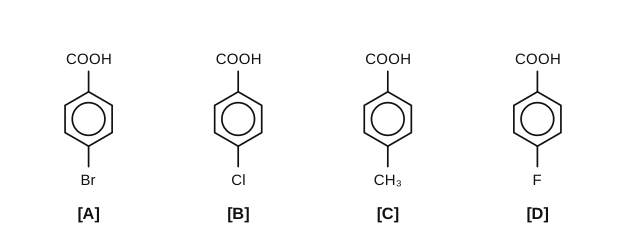
- COMEDK 2025Set 2025-M1 markMCQQ.Two statements, One Assertion [ A ] and the other Reason [ R ] are given. Identify the correct option Assertion [A] : The decreasing order of the acidic character of the following is B>D>A>C Reason [R] : Fluorine has larger -I effect than Cl and Br . (A) A is correct but R is wrong. (B) Both A and R are correct and R is the correct explanation of A . (C) A is wrong but R is correct. (D) Both A and R are correct but R is not the correct explanation of A .
›Reveal solutionSolution
[!TLDR]
The stated acidity order (Cl>F>Br>CH3) is wrong because para-fluorobenzoic acid is actually a weaker acid than para-bromobenzoic acid, while the Reason (F has the largest −I effect) is a correct statement — so option (C).
Concept
In CBSE/NCERT aromatic chemistry, a para substituent affects benzoic-acid acidity through both its inductive (−I) and resonance (±M) effects. Electron-withdrawing groups strengthen the acid (stabilise the carboxylate); electron-donating groups (like −CH3) weaken it. Halogens are −I (acid-strengthening) but also weak +M donors, and at the para position the +M donation is felt directly.
Solution
The four acids are para-substituted benzoic acids with substituents Br [A], Cl [B], CH3 [C], F [D]. Their measured strengths (pKa in water) are approximately:
p-Cl 3.98,p-Br 3.97,p-F 4.14,p-CH3 4.37.
Lower pKa = stronger acid, giving the real order
Cl≈Br>F>CH3.
The Assertion claims Cl > F > Br > CH3, i.e. it places F above Br. This is incorrect: although fluorine has the strongest −I pull, at the para position its lone pairs donate electron density into the ring by resonance (+M), destabilising the carboxylate and making p-F-benzoic acid a weaker acid than p-Br-benzoic acid. So the Assertion order is wrong. …
- COMEDK 2024Set 2024-A1 markMCQQ.Among the following compounds, the most acidic is : (A) 3, 4-dinitrobenzoic acid (B) Benzoic acid (C) 4-methoxybenzoic acid (D) 4-nitrobenzoic acid
›Reveal solutionSolution
The acidity of benzoic acid derivatives is governed by the electron-withdrawing or electron-donating nature of substituents. The most acidic compound here is 3,4-dinitrobenzoic acid because two nitro groups strongly stabilize the conjugate base by resonance and induction.
Concept & Intuition
Acidity in carboxylic acids depends on the stability of the conjugate base (the carboxylate anion). Electron-withdrawing groups (EWGs) like –NO₂ pull electron density away from the carboxylate, dispersing its negative charge and making the acid stronger. Electron-donating groups (EDGs) like –OCH₃ do the opposite, destabilizing the anion and weakening the acid. The more EWGs and the closer they are to the –COOH group, the greater the effect.
Step-by-step reasoning
-
Identify the substituent effects
- Benzoic acid (B) has no substituent — it’s the reference.
- 4-Methoxybenzoic acid (C) has –OCH₃ at the para position. Methoxy is an electron-donating group (resonance donor), so it decreases acidity relative to benzoic acid.
- 4-Nitrobenzoic acid (D) has –NO₂ at the para position. Nitro is a strong electron-withdrawing group (both inductive and resonance), so it increases acidity.
- 3,4-Dinitrobenzoic acid (A) has two –NO₂ groups at the meta and para positions. Both withdraw electrons, and their effects are additive.
-
Compare acid strengths qualitatively
- (C) is the weakest because of electron donation.
- (B) is stronger than (C) but weaker than any nitro-substituted acid.
- (D) is stronger than (B) because one –NO₂ stabilizes the carboxylate.
- (A) has two –NO₂ groups, so it should be stronger than (D). The meta nitro also withdraws electrons inductively, and the para nitro does so via both induction and resonance. Together, they create a highly stabilized conjugate base.
-
Quantitative check (pKa values)
- Benzoic acid: pKa ≈ 4.20
- 4-Methoxybenzoic acid: pKa ≈ 4.47 (less acidic)
- 4-Nitrobenzoic acid: pKa ≈ 3.41 (more acidic) …
-
- KCET 2023Set D-21 markMCQQ.Match the List-I with List-II in the following : List-I
- Caprolactum
- Vinyl chloride
- Styrene
- Propene
(a)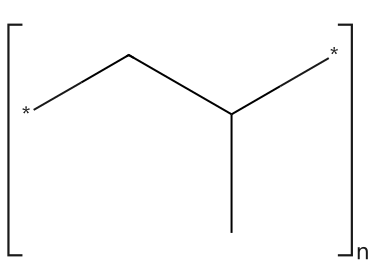 (b)
(b)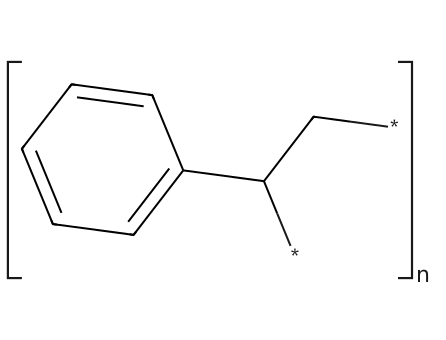 (c)
(c)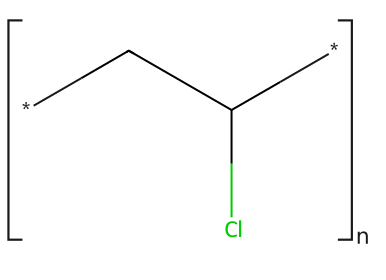 (d)
(d)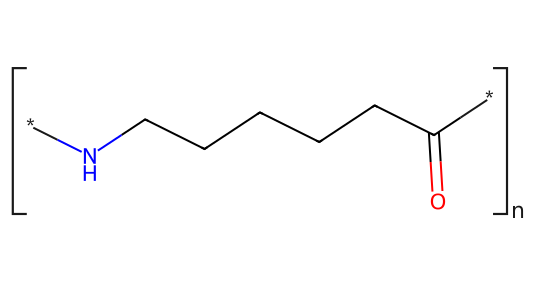 (A) 1-c, 2-d, 3-a, 4-b
(B) 1-a, 2-d, 3-c, 4-b
(C) 1-d, 2-c, 3-a, 4-b
(D) 1-d, 2-c, 3-b, 4-a
(A) 1-c, 2-d, 3-a, 4-b
(B) 1-a, 2-d, 3-c, 4-b
(C) 1-d, 2-c, 3-a, 4-b
(D) 1-d, 2-c, 3-b, 4-a›Reveal solutionSolution
In addition polymerisation the C=C opens and the substituent on the monomer's CH stays on the backbone CH — so match each monomer to the repeat unit carrying its substituent; caprolactam is the odd one out (condensation → polyamide).
Step 1 — The concept: what a repeat unit tells you.
For an addition polymer of a vinyl monomer CH2=CH−X, the double bond opens and the chain grows as
nCH2=CH−X⟶−(CH2−XCH)n−
So the group X hanging off the CH carbon in the drawn repeat unit is the substituent of the monomer. Structures (a), (b) and (c) are all of this −(CH2−CHX)n− type, so they must come from the three vinyl monomers; the amide unit (d) must come from the remaining monomer.
Step 2 — Match 4. Propene → (a).
CH2=CH−CH3 has X=CH3, so it gives −(CH2−CH(CH3))n− = polypropene = structure (a) (the CH3-bearing unit). ⇒ 4-a
Step 3 — Match 2. Vinyl chloride → (c).
CH2=CHCl has X=Cl, giving −(CH2−CHCl)n− = PVC = structure (c) (the Cl-bearing unit). ⇒ 2-c
Step 4 — Match 3. Styrene → (b).
CH2=CH−C6H5 has X=C6H5, giving −(CH2−CH(C6H5))n− = polystyrene = structure (b) (the phenyl-bearing unit). ⇒ 3-b
Step 5 — Match 1. Caprolactam → (d). …
- COMEDK 2023Set 2023-E1 markMCQQ.Choose the correct order of increasing acidic strength of the following compounds. (A) CH3CH2OH<CCl3CH2OH<CF3CH2OH (B) CF3CH2OH<CCl3CH2OH<CH3CH2OH (C) CH3CH2OH<CF3CH2OH<CCl3CH2OH (D) CCl3CH2OH<CF3CH2OH<CH3CH2OH
›Reveal solutionSolution
Acidity of RCH2OH increases with the −I (electron-withdrawing) power of R, which stabilises the conjugate base (alkoxide). CH3 (electron-donating) gives the weakest acid; CF3 (most electronegative halogen) gives the strongest, with CCl3 in between.
The acidic strength of an alcohol is governed by how well the resulting alkoxide RCH2O− is stabilised.
- CH3− is weakly electron donating (+I), destabilising the alkoxide ⇒ ethanol is the weakest acid.
- CCl3− is strongly electron withdrawing (−I), stabilising the negative charge. …
- KCET 2018Set A-11 markMCQQ.Acidity of BF3 can be explained on which of the following concepts? (A) Arrhenius concept (B) Bronsted-Lowry concept (C) Lewis concept (D) Bronsted-Lowry as well as Lewis concept
›Reveal solutionSolution
BF3 is an electron-deficient molecule that accepts a lone pair, so its acidity is explained by the Lewis concept — it acts as a Lewis acid. The correct option is (C).
The key is to understand what "acidity" means in each of the three classical theories. Arrhenius and Brønsted-Lowry both define acids in terms of protons (H+). Lewis, on the other hand, defines an acid as an electron-pair acceptor — a much broader definition that includes molecules like BF3.
BF3 has only six electrons in its valence shell (boron has three, each fluorine contributes one in a single bond). This makes it electron-deficient and highly eager to accept a lone pair from a base (like NH3 or F−). It has no proton to donate, so it cannot fit the Arrhenius or Brønsted-Lowry definitions.
Let’s check each option systematically.
-
Arrhenius concept — An acid must produce H+ in water. BF3 does not have a hydrogen atom to release, so it is not an Arrhenius acid. This option is out.
-
Brønsted-Lowry concept — An acid must donate a proton (H+) to a base. Again, BF3 has no proton to give. It is not a Brønsted-Lowry acid. This option is also out.
-
Lewis concept — An acid is any species that can accept an electron pair. BF3 has an incomplete octet on boron, so it readily accepts a lone pair from a Lewis base (e.g., BF3+NH3→F3B−NH3). This fits perfectly. BF3 is a classic example of a Lewis acid.
-
Brønsted-Lowry as well as Lewis — Since BF3 fails the Brønsted-Lowry test, this combined option is incorrect. …
-
🎓Unlock everything free for 14 days
- ✓Full step-by-step solutions
- ✓Concept-first explanations
- ✓Methods, shortcuts & mistakes
- ✓PYQ mapping + timed mock tests
Full access for 14 days. No credit card required.