Physics · Ch 1 — Electric Charges and Fields
Field Due to a Uniformly Charged Thin Spherical Shell
Field Due to a Uniformly Charged Thin Spherical Shell
Why This Result Matters
The electric field of a uniformly charged thin spherical shell is a classic application of Gauss’s law. The key insight is that spherical symmetry forces the field to be radial and depend only on the distance from the centre. This leads to two strikingly different results: outside the shell, the field behaves as if all charge is at the centre; inside the shell, the field is zero.
Step-by-Step Derivation
1. Setup and Symmetry
- Let the shell have radius and uniform surface charge density (charge per unit area).
- Total charge on the shell: .
- Because of spherical symmetry, the electric field at any point must be radial (along the radius vector ) and its magnitude depends only on .
2. Field Outside the Shell ()
- Gaussian surface: A sphere of radius (with ) centred at the shell’s centre . This sphere passes through the point where we want the field.
- Flux through Gaussian surface: At every point on this sphere, is parallel to the outward normal , and is constant in magnitude. So the flux is:
- Charge enclosed: The Gaussian surface encloses the entire shell, so:
- Apply Gauss’s law ():
Solving for :
- Vector form (with the unit radial vector):
- Direction: outward if , inward if .
- Physical interpretation: This is exactly the field of a point charge placed at the centre . For points outside, the shell behaves as if all its charge is concentrated at its centre.
3. Field Inside the Shell ()
- Gaussian surface: A sphere of radius (with ) centred at , passing through .
- Flux: Same reasoning gives .
- Charge enclosed: The Gaussian surface lies inside the shell, so it encloses no charge: …
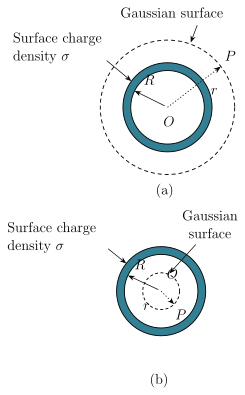
Drawn by us to help you understand the concept clearly, and verified to make sure it's accurate. For exams, practice from your textbook's own diagram.
What the Figure Shows
The figure presents two cross-sectional views of a thin spherical shell of radius , carrying a uniform surface charge density . A dashed circle in each panel represents a Gaussian surface — an imaginary sphere centered at the same point as the shell. The key difference between the two panels is the radius of this Gaussian sphere relative to :
- Panel (a): The Gaussian sphere has radius , so it completely encloses the charged shell. A point is marked on the Gaussian surface to the right.
- Panel (b): The Gaussian sphere has radius , so it lies entirely inside the shell. Point is at the lower-right of this sphere, and is labeled below .
A solid arrow from to the shell indicates the radius . The labels "Surface charge density " and "Gaussian surface" point to the shell and the dashed circle, respectively.
The Physical Idea
The figure illustrates Gauss's law applied to a spherically symmetric charge distribution. Because the shell is uniformly charged and spherical, the electric field at any point depends only on the radial distance from the center and points radially outward (or inward). The Gaussian surface is chosen as a sphere centered at to exploit this symmetry: on such a sphere, the electric field has the same magnitude everywhere and is parallel to the area element vector .
The two cases show how the enclosed charge changes:
- Outside the shell (): The Gaussian surface encloses the entire shell, so the enclosed charge is .
- Inside the shell (): The Gaussian surface encloses no charge because all the charge lies on the shell outside it.
Key Formulas Developed
From Gauss's law, the electric flux through the Gaussian surface is (since is constant and parallel to ). Setting this equal to gives:
For (outside the shell):
where is the total charge on the shell. In vector form: …