Q.A system has two charges qA=2.5×10⁻⁷C and qB=−2.5×10⁻⁷C located at points A: (0,0,−15cm) and B: (0,0,+15cm), respectively. What are the total charge and electric dipole moment of the system?
🔒You're viewing a preview — the full solution, concept, methods & PYQ mapping are locked.
🔒 Start your 14-day free trial to unlock the full solution →Concept understanding — Coulomb Force Superposition
Coulomb Force Superposition – From Intuition to Precision
Imagine you're in a room with three friends. Each friend can push or pull you. If two friends push you from the same side, you feel a stronger push — the combined effect. If one pushes from the left and another from the right, you feel the net effect, which might be smaller or even zero if they push equally hard.
This is exactly how electric forces work. When multiple charged particles are present, each one exerts its own force on a given charge. The total force that charge feels is simply the vector sum of all the individual forces — as if each other charge were acting alone, completely ignoring the presence of the rest.
That's the core idea: forces add like arrows, not like numbers.
The Precise Statement
Fnet on q0=∑i=1nFi→0=4πε01∑i=1nri02q0qir^i0
Where:
- q0 is the charge you're calculating the force on
- qi are all other charges (excluding q0 itself)
- ri0 is the distance between qi and q0
- r^i0 is a unit vector pointing from qi to q0 (or away, depending on sign convention — be consistent)
The key point: Each pair of charges interacts independently. The presence of a third charge does not alter the force between the first two. This is what "superposition" means — the forces simply layer on top of each other.
Why This Matters (and a Common Trap)
Never add the magnitudes of forces directly unless all forces are along the same line and in the same direction. Force is a vector — direction matters.
If two forces point in opposite directions, they partially cancel. If they're at right angles, the net force is found using the Pythagorean theorem, not simple addition.
Example: Three charges on a line:
- q1=+2μC at x=0
- q2=−1μC at x=3cm
- q0=+1μC at x=1cm
Step 1: Force from q1 on q0 — both positive, so repulsive. q0 is pushed to the right.
Step 2: Force from q2 on q0 — opposite signs, so attractive. q0 is pulled to the right (toward q2).
Step 3: Both forces point right. Now you add magnitudes: Fnet=F1→0+F2→0.
If q2 were also positive, the force from q2 would push q0 left, and you'd subtract.
The Deeper Reason
Coulomb's law is a linear law — the force is proportional to each charge individually. If you double q1, the force from q1 doubles, but the force from q2 stays the same. This linearity is what makes superposition possible. It's not a coincidence — it's a fundamental property of electromagnetic interactions at the classical level.
Superposition works because electric forces obey a linear inverse-square law. If the force depended on products of three charges (like q0q1q2), superposition would fail. It doesn't — and that's why we can break down any multi-charge problem into a series of two-charge calculations.
--- …
Why this formula?
Coulomb Force Superposition — Why the Formula Holds
The principle of superposition for Coulomb forces states that the net electrostatic force on a given charge due to a collection of other charges is the vector sum of the individual forces from each charge, as if the others were absent.
The Key Formula
If we have a charge q0 at position r0, and N other point charges q1,q2,…,qN at positions r1,r2,…,rN, the net force on q0 is:
Fnet=4πε01∑i=1N∣r0−ri∣2q0qir^0i
where r^0i is the unit vector pointing from qi to q0.
Why This Works — The Physical Reasoning
1. Coulomb's Law is a Two-Body Interaction
Coulomb's law describes the force between exactly two point charges. It depends only on:
- The product of their charges (q0qi)
- The inverse square of the distance between them
- The direction along the line joining them
Crucially, the force between q0 and qi does not depend on the presence of any other charges qj.
2. Forces Add as Vectors (Newton's Third Law + Linearity)
Electrostatic forces are real physical forces — they obey Newton's laws. If multiple forces act on the same charge, the net effect is the vector sum of each individual force. This is a fundamental property of forces in classical mechanics.
3. The Electric Field is Linear
A deeper reason: the electric field E obeys superposition. Since F=q0E, and E from multiple sources adds linearly, the force automatically adds linearly.
The electric field at r0 due to qi is:
Ei(r0)=4πε01∣r0−ri∣2qir^0i
Then:
Fnet=q0∑iEi=∑iFi
The Crucial Assumption (Why It's Not Trivial)
Superposition holds because Maxwell's equations are linear in the electric field. If the equations were nonlinear (e.g., if the field depended on E2), then the force from two charges together would not be the sum of the individual forces.
In electrostatics, the electric field satisfies:
∇⋅E=ε0ρ,∇×E=0
Both equations are linear — if E1 and E2 are solutions, then E1+E2 is also a solution. This linearity is the mathematical reason superposition works.
--- …
The total charge of a system is the algebraic sum of its individual charges. The electric dipole moment is a vector quantity defined for a system of two equal and opposite charges.
-
Total Charge (Concept: Algebraic Sum of Charges):
The total charge Qtotal is the sum of qA and qB.
Qtotal=qA+qB=(2.5×10⁻⁷C)+(−2.5×10⁻⁷C)=0C.
-
Electric Dipole Moment (Concept: Definition of Electric Dipole Moment):
The electric dipole moment p is given by p=qd, where q is the magnitude of either charge and d is the displacement vector from the negative charge to the positive charge.
Here, q=∣qA∣=∣qB∣=2.5×10⁻⁷C.
-
Determine Displacement Vector d:
The positive charge qA is at rA=(0,0,−15cm)=(0,0,−0.15m).
The negative charge qB is at rB=(0,0,+15cm)=(0,0,+0.15m). …
The total charge of the system is the algebraic sum of the individual charges, which is zero. The electric dipole moment is a vector quantity pointing from the negative charge to the positive charge, with a magnitude equal to the product of the charge magnitude and the separation distance; for this system, it is −7.5×10⁻⁸k^C⋅m.
When dealing with a system of charges, two fundamental properties are often of interest: the total charge and the electric dipole moment. The total charge tells us about the net amount of charge present, while the electric dipole moment provides insight into how the charges are distributed, particularly when there's a separation between positive and negative charges.
Understanding the Concepts
-
Total Charge: This is the simplest property. Charge is a scalar quantity, meaning it only has magnitude. The total charge of a system is simply the algebraic sum of all individual charges within that system. If charges are positive and negative, they can cancel each other out.
-
Electric Dipole Moment: An electric dipole consists of two equal and opposite charges, +q and −q, separated by a small distance. While the total charge of a dipole is zero, it still creates an electric field in its vicinity due to the separation of charges. The electric dipole moment, denoted by p, is a vector quantity that quantifies this separation and the strength of the dipole. Its direction is conventionally defined from the negative charge to the positive charge.
For a simple electric dipole consisting of charges +q and −q separated by a displacement vector d (from the negative charge to the positive charge), the electric dipole moment is given by:
p=qd
For a general system of N point charges qi located at position vectors ri, the electric dipole moment is defined as:
p=∑i=1Nqiri
This general formula is particularly useful when the origin is chosen at the center of mass or if the total charge is zero. If the total charge is zero, the dipole moment is independent of the choice of origin.
Let's apply these concepts to the given system.
Step-by-Step Solution
First, let's list the given information and convert units to SI:
- Charge qA=2.5×10⁻⁷C at point A: (0,0,−15cm)=(0,0,−0.15m)
- Charge qB=−2.5×10⁻⁷C at point B: (0,0,+15cm)=(0,0,+0.15m)
1. Calculate the Total Charge of the System
The total charge (Qtotal) is the algebraic sum of all charges in the system.
Qtotal=qA+qB
Substitute the given values:
Qtotal=(2.5×10⁻⁷C)+(−2.5×10⁻⁷C)
Qtotal=0C
The system has a net charge of zero. This is characteristic of an electric dipole.
2. Calculate the Electric Dipole Moment of the System
This system consists of two equal and opposite charges, which perfectly fits the definition of an electric dipole. We can use the formula p=qd.
-
Identify the magnitude of the charge (q):
The magnitude of either charge is q=∣qA∣=∣qB∣=2.5×10⁻⁷C.
-
Determine the displacement vector (d):
The vector d points from the negative charge to the positive charge.
The negative charge is qB at rB=(0,0,0.15m).
The positive charge is qA at rA=(0,0,−0.15m).
Therefore, d=rA−rB.
d=(0i^+0j^−0.15k^)m−(0i^+0j^+0.15k^)m
d=(0−0)i^+(0−0)j^+(−0.15−0.15)k^m
$$\vec{d} = -0.30\hat{k}\,\text{m}$$ …
Method: Dipole Moment Calculation Using Superposition
We treat the two point charges as a physical electric dipole — two equal and opposite charges separated by a distance. The total charge and dipole moment are found by direct vector addition.
Steps
Step 1: Find total charge
Total charge is the algebraic sum:
qtotal=qA+qB=2.5×10⁻⁷+(−2.5×10⁻⁷)=0
Step 2: Identify the position vectors
Convert cm to m:
- A: (0,0,−0.15) m
- B: (0,0,+0.15) m
So:
rA=−0.15k^andrB=+0.15k^
Step 3: Apply dipole moment formula
The electric dipole moment vector is:
p=qArA+qBrB
Substitute:
p=(2.5×10⁻⁷)(−0.15k^)+(−2.5×10⁻⁷)(+0.15k^)
Step 4: Simplify
p=−3.75×10⁻⁸k^−3.75×10⁻⁸k^ …
Here are the common mistakes students make on this exact problem, along with how to avoid each one.
1. Forgetting the Vector Nature of Dipole Moment
The Mistake:
Students often treat the dipole moment as a scalar and simply multiply the charge magnitude by the separation distance, writing:
p=q×d=(2.5×10−7)×(30×10−2)
This gives a number but ignores direction.
How to Avoid:
Always remember: dipole moment is a vector from negative to positive charge.
p=q×d
where d points from −q to +q. Here:
- qB is negative (at +15 cm)
- qA is positive (at −15 cm)
So d points from B to A, i.e., along the negative z-direction.
Correct result:
p=(2.5×10−7)×(0.30m)×(−k^)=−7.5×10⁻⁸C mk^
2. Using Separation Distance in cm Instead of Metres
The Mistake:
Plugging d=30 cm directly into the formula without converting to metres.
p=(2.5×10−7)×30=7.5×10⁻⁶
This is wrong by a factor of 100.
How to Avoid:
Always convert cm → m before calculation:
15cm=0.15m
So separation d=0.15+0.15=0.30m
Correct magnitude:
p=(2.5×10−7)×0.30=7.5×10⁻⁸C m
3. Confusing Total Charge with Net Charge
The Mistake:
Some students add magnitudes: 2.5×10⁻⁷+2.5×10−7=5.0×10⁻⁷C and call it "total charge."
How to Avoid:
"Total charge" means algebraic sum including signs:
qtotal=qA+qB=(+2.5×10⁻⁷)+(−2.5×10⁻⁷)=0
Key insight: This is an electric dipole — equal and opposite charges → net charge is zero.
4. Misidentifying Which Charge is Positive/Negative
The Mistake:
Assuming the charge at the positive coordinate (+15 cm) is positive, and vice versa.
How to Avoid:
Read the given data carefully:
- qA=+2.5×10⁻⁷C at (0,0,−15cm)
- qB=−2.5×10⁻⁷C at (0,0,+15cm) …
Showing the 12 most recent of 22 on this concept.
- COMEDK 2026Set 2026-A1 markMCQQ.Two point charges P=+25μC and Q=−16μC are placed 5 cm apart. Find the position of the point at which the resultant electric field is zero: (A) 1 cm from Q and 4 cm from P on the dipole axis (B) 2.5 cm from Q and 2.5 cm from P on the dipole axis (C) 20 cm from Q and 25 cm from P on the dipole axis (D) 25 cm from Q and 20 cm from P on the dipole axis
›Reveal solutionSolution
For two opposite charges, the net electric field is zero outside the smaller charge on the line joining them. Solving EP=EQ gives distances 20 cm from Q and 25 cm from P, so option (C) is correct.
Concept & Intuition
The electric field due to a point charge is E=k∣q∣/r2, directed away from a positive charge and toward a negative charge. Here we have +25μC and −16μC. Because the charges are opposite, the fields point in opposite directions between the charges, but they can never cancel there because the magnitudes are different and the directions are opposite — the net field is nonzero.
The only place where the fields can cancel is outside the smaller charge (the −16μC), because there the fields from both charges point in opposite directions (away from the positive, toward the negative) and the distances can be adjusted to make magnitudes equal.
We set up the condition ∣EP∣=∣EQ∣ and solve for the distances.
Step-by-step solution
-
Define the geometry
Let the charges be on the x‑axis: P at x=0 with +25μC, Q at x=5 cm with −16μC.
Let the zero‑field point be at distance x from P (so x cm from P).
If the point is to the right of Q, then distance from P is x and from Q is x−5 (both in cm).
-
Write the field magnitudes
EP=(x)2k⋅25,EQ=(x−5)2k⋅16
(We drop the sign because we only care about magnitude; direction is handled by the geometry.)
- Set magnitudes equal for cancellation
x225=(x−5)216
Take square roots (positive distances):
x5=x−54
- Solve for x Cross‑multiply:
5(x−5)=4x⇒5x−25=4x⇒x=25 cm
So the point is 25 cm from P. …
-
- COMEDK 2026Set 2026-M1 markMCQQ.Two identical charged spheres are suspended by strings of equal lengths. The strings make an angle of 45∘ with each other. When the system is immersed in a liquid of relative density 0.8 , the angle between the strings remains unchanged. If the density of the material of the sphere is 2.4gcm−3, what is the dielectric constant of the liquid? (A) 1.6 (B) 1.5 (C) 0.5 (D) 2
›Reveal solutionSolution
The key idea is that the angle remains the same because the electric force is reduced by the dielectric constant exactly as much as the effective weight is reduced by buoyancy. Solving the equilibrium condition gives the dielectric constant as 1.5.
We have two identical charged spheres hanging from strings of equal length, making an angle of 45∘ with each other. That means each string makes an angle of 22.5∘ with the vertical. When immersed in a liquid, the angle stays the same. This tells us that the ratio of the electric repulsion to the effective weight (weight minus buoyancy) must be the same in air and in the liquid.
Concept and intuition:
In air, the spheres repel each other with a force Fe=r2kq2 (where k=1/(4πε0)). In the liquid, the electric force is reduced by the dielectric constant κ: Fe′=κr2kq2. Meanwhile, the weight of each sphere is mg, but in the liquid there is an upward buoyant force Fb=ρliquidVg. The effective weight becomes mg−Fb=(ρsphere−ρliquid)Vg. Since the angle doesn’t change, the ratio of electric force to effective weight must be the same in both cases. That gives us an equation to solve for κ.
Let’s work through it step by step.
- Set up the equilibrium in air. Each sphere has mass m=ρsV, where ρs=2.4g/cm3 and V is its volume. The tension in the string has vertical component Tcosθ=mg and horizontal component Tsinθ=Fe, where θ=22.5∘ (half the angle between the strings). Dividing:
tanθ=mgFe.
- Set up the equilibrium in the liquid. The effective weight is mg−Fb=(ρs−ρl)Vg, with ρl=0.8g/cm3 (relative density 0.8 means density 0.8 g/cm³). The electric force is now Fe′=κFe because the medium reduces the Coulomb force by the dielectric constant. The angle is the same, so:
tanθ=(ρs−ρl)VgFe′.
- Equate the two expressions for tanθ. From air: tanθ=ρsVgFe. From liquid: tanθ=(ρs−ρl)VgFe/κ. …
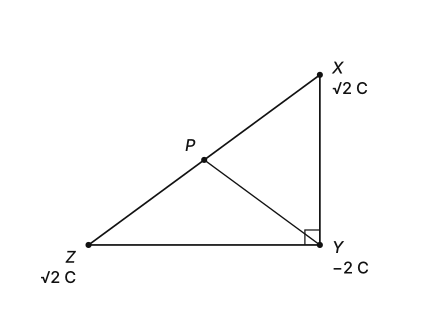
- COMEDK 2026Set 2026-M1 markMCQQ.Point charge 2C,2C, and −2C are placed at the three vertices of a right-angled triangle in air. [as shown in the figure below] What is the electric field at a point P on the hypotenuse that is equidistant from all three charges. Given distances XP=YP=ZP=0.5 m (A) 0⋅72×1010NC−1 along YP (B) 7.2×10¹⁰NC−1 along PY (C) 0.72×10⁹NC−1 along YP (D) 7.2×10⁹NC−1 along PY
›Reveal solutionSolution
The two equal 2C charges sit at the ends of the hypotenuse, collinear through the midpoint P; their fields cancel there. Only the −2C charge remains, giving 7.2×10¹⁰N C−1.
Geometry
P is equidistant from all three vertices of a right-angled triangle, so it is the circumcentre — the midpoint of the hypotenuse — with XP=YP=ZP=0.5m.
Fields of the two positive charges cancel
The two +2C charges lie at opposite ends of the hypotenuse, so P is exactly between them and on the line joining them. Each produces a field of equal magnitude directed away from itself; being back-to-back along the same line, they are equal and opposite at P and cancel:
E2=r2kq=(0.5)29×109×2each, but they sum to zero. …
- KCET 2025Set D-41 markMCQQ.Which of the following statements is not true? (A) Work done to move a charge on an equipotential surface is not zero (B) Equipotential surfaces are the surfaces where the potential is constant (C) Equipotential surfaces for a uniform electric field are parallel and equidistant from each other (D) Electric field is always perpendicular to an equipotential surfaces.
›Reveal solutionSolution
Work on an equipotential surface is W=qΔV=0 by definition, so the statement that it is 'not zero' is the false one.
Step 1 — Definition of an equipotential surface.
An equipotential surface is a surface on which the electrostatic potential V has the same value at every point. This makes statement (B) true — it is simply the definition.
Step 2 — Test statement (A): work done moving a charge on such a surface.
The work done by an external agent in moving a charge q from point A to point B is
W=q(VB−VA)=qΔV
If A and B both lie on the same equipotential surface, then VA=VB, so
ΔV=0⟹W=q×0=0
The work is zero. Statement (A) asserts it is not zero — therefore (A) is FALSE, and since the question asks which statement is not true, (A) is the answer.
Step 3 — Confirm (D) is true (field ⊥ surface).
If E had any component E∥ along the surface, moving a charge a distance dℓ along the surface would do work W=qE∥dℓ=0, which would mean a potential difference between two points of the surface — contradicting its being equipotential. Hence E∥=0, i.e. E is always normal (perpendicular) to the equipotential surface. (D) is true.
Step 4 — Confirm (C) is true (uniform field case). …
- COMEDK 2025Set 2025-M1 markMCQQ.Two identical conducting balls having positive charges q1 and q2 are separated by a distance r. If they are made to touch each other and then separated to the same distance, the force between them will be (A) Same as before (B) zero (C) Less than before (D) More than before
›Reveal solutionSolution
When two identical charged conductors touch, they share charge equally, and the electrostatic force after separation is always greater than or equal to the original force unless one charge was zero. The correct option is (D).
The key idea here is charge redistribution upon contact. When two identical conducting spheres touch, they become a single conductor, and charge flows until both have the same potential. Since they are identical, this means they end up with equal charges. The force between them after separation depends on the product of the new charges compared to the original product.
- Original force The initial electrostatic force between the balls is given by Coulomb’s law:
Finitial=kr2q1q2
where k=4πε01.
- Charge redistribution on contact When the two identical conducting balls touch, the total charge q1+q2 is shared equally because they are identical in size and shape. So each ball ends up with:
q′=2q1+q2
- Force after separation After they are separated back to the same distance r, the new force is:
Fnew=kr2(q′)2=kr2(2q1+q2)2=k4r2(q1+q2)2
- Compare Fnew and Finitial We compare the products:
Initial product: Pi=q1q2
New product: Pn=4(q1+q2)2
The difference is:
Pn−Pi=4(q1+q2)2−q1q2=4q12+2q1q2+q22−4q1q2=4q12−2q1q2+q22=4(q1−q2)2
Since (q1−q2)2≥0, we have Pn≥Pi. Equality only if q1=q2.
- Conclusion for the given problem …
- KCET 2024Set D-21 markMCQQ.The total electric flux through a closed spherical surface of radius ‘r’ enclosing an electric dipole of dipole moment 2aq is (Given ϵ0= permittivity of free space) (A) Zero (B) ϵ0q (C) ϵ02q (D) ϵ08πr2q
›Reveal solutionSolution
Gauss's law counts only the net enclosed charge, and a dipole's net charge is zero.
Step 1 — State Gauss's law
For any closed surface S,
∮SE⋅dA=ϵ0qenc
The crucial point of this law is that the right-hand side depends only on the algebraic sum of the charges inside — not on their positions, not on the size or shape of the surface, and not on any charges outside.
Step 2 — Find the charge enclosed by the sphere
A dipole of moment p=2aq consists of two point charges +q and −q separated by 2a. Since the whole dipole lies inside the spherical surface, both charges are enclosed:
qenc=(+q)+(−q)=0
Step 3 — Apply Gauss's law
ϕ=ϵ0qenc=ϵ00=0
Step 4 — Why this is not a trick …
- KCET 2024Set D-21 markMCQQ.Under electrostatic condition of a charged conductor, which among the following statements is true? (A) The electric field on the surface of a charged conductor is 2ϵ0σ, where σ is the surface charge density (B) The electric potential inside a charged conductor is always zero (C) Any excess charge resides on the surface of the conductor (D) The net electric field is tangential to the surface of the conductor
›Reveal solutionSolution
Under electrostatic conditions, a conductor’s excess charge sits only on its surface, making option (C) the correct statement.
The key idea is that in electrostatics, charges inside a conductor are free to move until they reach equilibrium. Once equilibrium is reached, the electric field inside the conductor must be zero everywhere. If there were any field, charges would keep moving. This single fact — zero internal field — forces all the other properties: the surface is an equipotential, the field just outside is perpendicular to it, and any extra charge cannot stay inside.
Let’s examine each statement carefully.
-
Option (A): The electric field on the surface of a charged conductor is 2ϵ0σ.
This formula is actually the field due to an infinite sheet of charge. For a conductor, the field just outside the surface is ϵ0σ, not half that. Why? Because the field inside the conductor is zero, so all the flux through a Gaussian pillbox that straddles the surface comes from the outside face. That gives ϵ0σ. The 2ϵ0σ result applies to a thin sheet of charge in free space, where field exists on both sides. Here, the conductor’s interior has no field, so the outside field is double that. So (A) is false.
-
Option (B): The electric potential inside a charged conductor is always zero.
Potential is defined relative to a reference (usually infinity). Inside a conductor in equilibrium, the field is zero, so the potential is constant throughout — but that constant need not be zero. It could be positive or negative depending on the charge and the reference. For example, a positively charged isolated conductor has a positive potential. So (B) is false.
-
Option (C): Any excess charge resides on the surface of the conductor. …
-
- KCET 2024Set D-21 markMCQQ.A cube of side 1 cm contains 100 molecules each having an induced dipole moment of 0.2×10⁻⁶C−m in an external electric field of 4NC−1. The electric susceptibility of the material is _____ C2N−1m−2. (A) 50 (B) 5 (C) 0.5 (D) 0.05
›Reveal solutionSolution
Get the polarisation (total dipole moment per unit volume), then divide by the applied field, since the stated unit C2N−1m−2 means χ is defined here by P=χE.
Step 1 — The concept: polarisation
When a dielectric is placed in an external field, each molecule acquires an induced dipole moment. The macroscopic measure of this is the polarisation vector
P=volumenet dipole moment
and for a linear dielectric P is proportional to the field, the constant of proportionality being the electric susceptibility.
Step 2 — Volume of the cube
a=1 cm=10−2 m⇒V=a3=(10−2)3=10−6 m3
Step 3 — Total dipole moment
The 100 molecules each carry p=0.2×10⁻⁶ Cm and (being induced by the same field) are aligned, so their moments simply add:
ptotal=Np=100×0.2×10−6=2×10⁻⁵ Cm
Step 4 — Polarisation
P=Vptotal=10−62×10−5=20 Cm−2
Step 5 — Susceptibility …
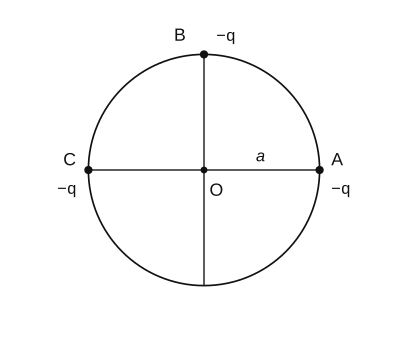
- COMEDK 2024Set 2024-A1 markMCQQ.3 point charges each of −q are placed on the circumference of a circle of diameter 2a at A,B and C respectively as shown in figure. The electric field at O is (A) Zero (B) 2aKq towards OC (C) aKq towards OB (D) aKq towards OA
›Reveal solutionSolution
Two of the three equal charges sit at opposite ends of a diameter and their fields at O cancel; only the third charge (at B) is left, so the net field points towards OB - option (C).
The field at O is the vector sum of the fields of the three charges. Each charge is −q at a distance equal to the radius a (diameter =2a), and for a negative charge the field at O points toward that charge.
Charges A and C lie at opposite ends of a diameter, so their fields at O are equal in magnitude and exactly opposite in direction:
EA+EC=a2Kqu^OA+a2Kqu^OC=0.
Charge B is then unopposed, so the resultant is its field alone, directed from O toward B:
EO=a2Kq along OB. …
- COMEDK 2024Set 2024-E1 markMCQQ.Two point charges M and N having charges +q and −q respectively are placed at a distance apart. Force acting between them is F. If 30% of charge of N is transferred to M, then the force between the charges becomes: (A) F (B) 49100F (C) 10049F (D) 169F
›Reveal solutionSolution
Transferring 30% of N's charge leaves both magnitudes at 0.7q, so the force scales by 0.7×0.7=0.49, giving 10049F.
Initial force between +q and −q separated by r:
F=4πε01r2q⋅q.
30% of N's charge is 0.3q, transferred from N to M:
qM=q−0.3q=0.7q,qN=q−0.3q=0.7q (magnitude). …
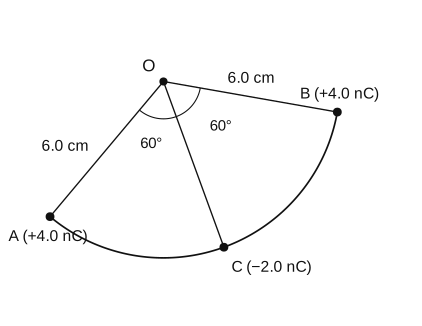
- COMEDK 2024Set 2024-E1 markMCQQ.Three point charges are located on a circular arc at A,B and C as shown in the figure below. The total electric field at the centre of the arc(C) is (A) 15000 NC−1 (B) 10000 NC−1 (C) 20000 NC−1 (D) 5000 NC−1
›Reveal solutionSolution
The two equal positive charges give 10000 N/C net along the axis and the negative charge 5000 N/C the other way; resultant =5000 N/C.
With r=6.0 cm =0.06 m, k=9×10⁹:
E+4=(0.06)2(9×10⁹)(4×10⁻⁹)=0.003636=10000 N/C
E−2=(0.06)2(9×10⁹)(2×10⁻⁹)=5000 N/C …
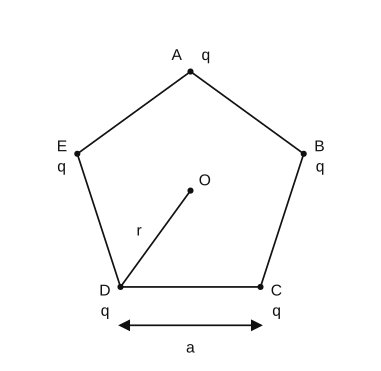
- COMEDK 2024Set 2024-M1 markMCQQ.Five charges, 'q' each are placed at the comers of a regular pentagon of side 'a' as shown in figure. First, charge from 'A' is removed with other charges intact, then charge at 'A' is replaced with an equal opposite charge. The ratio of magnitudes of electric fields at O, without charge at A and that with equal and opposite charge at A is (A) 4 : 1 (B) 2 : 1 (C) 1 : 4 (D) 1 : 2
›Reveal solutionSolution
The key idea is that the electric field at the centre of a regular pentagon due to five equal charges is zero by symmetry. Removing one charge leaves a net field equal in magnitude to the field of that missing charge alone. Replacing it with an equal opposite charge doubles that field. The ratio of magnitudes is therefore 1 : 2, corresponding to option (D).
Concept and intuition:
For a regular pentagon, the centre is equidistant from all vertices. If five equal charges are placed at the vertices, the vector sum of the electric fields at the centre is zero — each field is cancelled by the others due to symmetry. This is the same principle that makes the field at the centre of a regular polygon with equal charges zero.
Now, if we remove one charge, the symmetry is broken. The net field at O is exactly the field that the missing charge would have produced (since the remaining four still sum to the negative of that one field). If we instead replace the removed charge with an equal opposite charge, that charge now contributes a field in the same direction as the field from the missing charge (because the sign flips), so the total field becomes twice the field of a single charge. The ratio of the magnitudes (first case : second case) is therefore 1 : 2.
Step-by-step reasoning:
- Original configuration (five equal charges): The centre O is equidistant from all vertices. Let this distance be r (the circumradius). Each charge q produces a field of magnitude E0=r2kq at O, directed radially outward (if q>0). Because the pentagon is regular, the five vectors are equally spaced in direction by 72∘. Their vector sum is zero:
Etotal=0.
- First scenario: charge at A is removed. Now only four charges remain (at B, C, D, E). Their net field at O is no longer zero. However, since the original five fields summed to zero, the sum of the four remaining fields must be exactly the negative of the field that was produced by the charge at A:
Efour=−EA.
The magnitude is therefore ∣Efour∣=E0.
- Second scenario: charge at A is replaced with an equal opposite charge −q. …
🎓Unlock everything free for 14 days
- ✓Full step-by-step solutions
- ✓Concept-first explanations
- ✓Methods, shortcuts & mistakes
- ✓PYQ mapping + timed mock tests
Full access for 14 days. No credit card required.