Q.An electric dipole with dipole moment 4×10⁻⁹C m is aligned at 30∘ with the direction of a uniform electric field of magnitude 5×10⁴N C−1. Calculate the magnitude of the torque acting on the dipole.
🔒You're viewing a preview — the full solution, concept, methods & PYQ mapping are locked.
🔒 Start your 14-day free trial to unlock the full solution →Concept understanding — Torque On Dipole
Torque on a Dipole — From Intuition to the Formula
Imagine a bar magnet placed in a uniform magnetic field. You know that the north pole gets pulled one way and the south pole the opposite way. If the magnet is not aligned with the field, these two equal and opposite forces create a twist — a torque — that tries to rotate the magnet until it lines up with the field. That's the core idea.
The same thing happens with an electric dipole (two equal and opposite charges +q and −q separated by a small distance d) placed in a uniform electric field E. The two charges experience forces in opposite directions, and unless the dipole is already parallel to the field, those forces produce a torque.
Step 1: The Forces on the Two Charges
Let the dipole moment p point from the negative charge to the positive charge, with magnitude p=qd.
In a uniform electric field E:
- The positive charge +q feels a force F+=+qE (in the direction of E).
- The negative charge −q feels a force F−=−qE (opposite to E).
These two forces are equal in magnitude but opposite in direction. They form a couple — a pair of equal, opposite, parallel forces that do not share the same line of action. A couple always produces a pure torque, with no net force.
Step 2: Why a Torque Appears
If the dipole is at an angle θ to the field, the two forces are not along the same line. They are separated by the perpendicular distance between their lines of action. That perpendicular distance is dsinθ, where d is the separation between the charges.
The torque τ due to a couple is:
τ=(force magnitude)×(perpendicular distance between forces)
Here:
- Force magnitude on each charge: F=qE
- Perpendicular distance: dsinθ
So:
τ=(qE)×(dsinθ)=qdEsinθ
But qd=p, the magnitude of the dipole moment. Therefore:
τ=pEsinθ
Step 3: The Vector Form
Torque is a vector — it has a direction. The direction of the torque is perpendicular to both p and E, following the right-hand rule. The complete vector equation is:
τ=p×E
The magnitude is ∣τ∣=pEsinθ, where θ is the angle between p and E.
Step 4: What the Torque Does
- When θ=0∘ (dipole aligned with the field): sin0=0, so τ=0. The dipole is in stable equilibrium — if you nudge it slightly, the torque brings it back.
- When θ=90∘ (dipole perpendicular to the field): sin90∘=1, so torque is maximum: τmax=pE. …
Why this formula?
Torque on a Dipole in a Uniform Electric Field
Let's build this from first principles — understanding why the torque formula is what it is, not just memorizing it.
What is a Dipole?
A dipole consists of two equal and opposite charges +q and −q, separated by a small distance 2a (or d). The dipole moment vector is:
p=q⋅d
where d points from −q to +q, and ∣d∣=2a.
The Physical Situation
Place this dipole in a uniform external electric field E. Uniform means the field has the same magnitude and direction everywhere.
- The +q charge experiences a force: F+=+qE
- The −q charge experiences a force: F−=−qE
These two forces are equal in magnitude but opposite in direction.
Why is there a Torque?
Since the forces are equal and opposite, the net force on the dipole is zero:
Fnet=qE+(−qE)=0
So the dipole won't accelerate linearly. But — crucially — the two forces act at different points in space (the two charges are separated). This creates a couple (a pair of equal, opposite, parallel forces not acting along the same line). A couple always produces a torque (rotational effect).
Deriving the Torque Magnitude
Let the dipole be oriented at an angle θ with respect to the field E.
- The line joining the charges makes angle θ with E.
- The perpendicular distance between the lines of action of the two forces is the "lever arm."
Step 1: The force on each charge is qE.
Step 2: The perpendicular distance between the two forces is:
Lever arm=2asinθ
Why sinθ? Because the separation vector d is at angle θ to E. The component of d perpendicular to E is dsinθ=2asinθ.
Step 3: Torque = Force × Perpendicular distance (for one force about the midpoint):
τ=(qE)×(2asinθ)
Step 4: But q×2a=p, the dipole moment magnitude. So:
τ=pEsinθ
Vector Form — The Full Picture
Torque is a vector. Its direction is given by the right-hand rule: it tends to rotate the dipole toward alignment with the field.
The vector form captures both magnitude and direction:
τ=p×E
- Magnitude: ∣τ∣=pEsinθ (as derived)
- Direction: Perpendicular to both p and E, given by the cross product rule.
--- …
Concept: Torque on an Electric Dipole
When an electric dipole of moment p is placed in a uniform electric field E, it experiences a torque that tries to align it with the field. The magnitude of this torque is given by
τ=pEsinθ
where θ is the angle between the dipole moment and the electric field direction.
Calculation:
Given:
- Dipole moment: p=4×10⁻⁹C m
- Electric field: E=5×10⁴N C−1
- Angle: θ=30∘
Substituting into the torque formula: …
A dipole in a uniform field experiences maximum torque when perpendicular to the field and zero when aligned; here at 30° the torque is τ=pEsinθ=10−4N m.
Why a dipole experiences torque
An electric dipole consists of two equal and opposite charges separated by a small distance. When placed in a uniform electric field, both charges experience forces of equal magnitude but in opposite directions. Because the charges are spatially separated, these forces don't simply cancel—they create a couple that tries to rotate the dipole.
The key insight is that the torque depends on how misaligned the dipole is with the field. When the dipole moment vector p points along the field E, the forces on both charges lie along the dipole axis and produce no rotation. When perpendicular, the lever arm is maximum and torque peaks. At any intermediate angle θ, only the component of force perpendicular to the dipole axis contributes to rotation.
τ=pEsinθ
where p is the dipole moment magnitude, E is the field strength, and θ is the angle between p and E.
Step-by-step calculation
-
Identify the given quantities
- Dipole moment: p=4×10⁻⁹C m
- Electric field: E=5×10⁴N C−1
- Angle between dipole and field: θ=30°
-
Recognize the torque formula
The magnitude of torque on a dipole in a uniform field is the cross-product magnitude:
τ=∣p×E∣=pEsinθ …
Instead of applying τ=pEsinθ directly, derive the torque from the dipole's potential energy in the field — torque is the rate of change of energy with orientation. Both routes give τ=1×10⁻⁴N m.
Method: Torque from the Potential Energy Function
A dipole in a uniform field doesn't just feel a torque — it has an orientation-dependent potential energy. Torque is nothing but how fast that energy changes as you rotate the dipole, which gives an equivalent, more general way to arrive at the same result.
- Write down the potential energy of the dipole. When a dipole moment p makes angle θ with a uniform field E, its potential energy is
U(θ)=−pEcosθ
This is lowest (most stable) when p is aligned with E (θ=0) and highest when anti-aligned (θ=180°) — exactly what we'd expect physically.
- Recall the rotational analogue of F=−dxdU. For rotation, the torque about an axis is the negative derivative of potential energy with respect to the rotation angle:
τ=−dθdU
- Differentiate. τ=−dθd(−pEcosθ)=pEsinθ …
Step 1 — The Correct Formula
The torque τ on an electric dipole in a uniform electric field E is:
τ=p×E
Magnitude:
τ=pEsinθ
Where:
- p = dipole moment magnitude
- E = electric field magnitude
- θ = angle between p and E
Step 2 — Apply the Given Data
Given:
- p=4×10⁻⁹C m
- E=5×10⁴N C−1
- θ=30∘
So:
τ=(4×10−9)×(5×104)×sin30∘
τ=20×10−5×21
τ=10×10−5=1.0×10⁻⁴N m
Answer: 1.0×10⁻⁴N m
Common Mistakes Students Make
✗ Mistake 1: Using cosθ instead of sinθ
- Why it happens: Students confuse torque with the formula for potential energy (U=−pEcosθ).
- How to avoid:
- Torque comes from the cross product → use sinθ.
- Potential energy comes from the dot product → use cosθ.
- Remember: Torque is maximum when dipole is perpendicular (θ=90∘) — that’s sin90∘=1, not cos90∘=0.
✗ Mistake 2: Taking θ as the angle with the field direction incorrectly
- Why it happens: Some problems give the angle between dipole and field as 60∘ or 120∘, and students use that directly without checking.
- How to avoid:
- θ in τ=pEsinθ is always the angle between p and E.
- If the problem says “aligned at 30∘ with the field”, that’s exactly θ=30∘ — correct here.
✗ Mistake 3: Forgetting to convert units or misreading powers of 10
- Why it happens: p is given in 10−9 and E in 104 — students sometimes multiply without tracking exponents.
- How to avoid:
- Write all numbers in scientific notation before multiplying.
- Do exponent arithmetic separately: 10−9×104=10−5.
--- …
- COMEDK 2026Set 2026-M1 markMCQQ.Two-point charges of equal magnitude 0.01 C and opposite in sign are separated by 0.2 mm , forming an electric dipole. The electric dipole moment of the dipole is: (A) 2×10⁻³Cm along the line joining the two charges and the direction of the dipole moment vector is from negative to positive 0.01 C (B) 4×10⁻⁶Cm along the line joining the two charges and the direction of the dipole moment vector is from positive to negative 0.01 C (C) 2×10⁻⁶Cm along the line joining the two charges and the direction of the dipole moment vector is from negative to positive 0.01 C (D) 2×10⁶Cm along the line joining the two charges and the direction of the dipole moment vector is from positive to negative 0.01 C
›Reveal solutionSolution
The electric dipole moment is the product of charge magnitude and separation distance, directed from negative to positive charge. Here, p=(0.01C)(0.2×10⁻³m)=2×10⁻⁶Cm, so the correct option is (C).
The electric dipole moment is a vector that measures the strength and orientation of a dipole. Its magnitude is simply p=qd, where q is the magnitude of one charge and d is the separation between the charges. The direction is always from the negative charge toward the positive charge — this is the standard convention in physics.
Let’s apply this step by step.
-
Identify the given quantities
- Charge magnitude: q=0.01 C
- Separation distance: d=0.2 mm=0.2×10⁻³ m=2×10⁻⁴ m
- Charges are opposite in sign, so this is a pure dipole.
-
Compute the magnitude of the dipole moment
p=q⋅d=(0.01)×(2×10−4)=2×10⁻⁶ Cm
-
Determine the direction
By definition, the dipole moment vector points from the negative charge to the positive charge. The problem states the charges are opposite in sign, so the direction is along the line joining them, from negative to positive.
-
Match with the options
- Option (A): magnitude 2×10⁻³ — too large. …
-
- KCET 2025Set D-41 markMCQQ.You are given a dipole of charge +q and −q separated by a distance 2R. A sphere ‘A’ of radius ‘R’ passes through the centre of the dipole as shown below and another sphere ‘B’ of radius ‘2R’ passes through the charge +q. Then the electric flux through the sphere A is (A) q/ε0 (B) Zero (C) 2q/ε0 (D) −q/ε0
›Reveal solutionSolution
Sphere A encloses only the −q charge of the dipole, so Gauss's law gives a flux of −q/ε0.
Step 1 — Fix the geometry from the wording.
The two charges are 2R apart. Sphere B has radius 2R and passes through the charge +q — a sphere of radius 2R whose surface contains +q must be centred on the other charge, −q (the only point at distance 2R from +q on the dipole axis). Sphere A, radius R, is drawn about that same centre, and indeed a sphere of radius R centred at −q has its surface passing through the mid-point of the dipole, exactly as stated.
Step 2 — Find the charge enclosed by A.
Sphere A is centred on −q and has radius R, while +q lies at a distance 2R>R from that centre. Hence:
qenclosed=−q(+q is outside A) …
- COMEDK 2025Set 2025-A1 markMCQQ.Which physical quantity has the unit joule / tesla? (A) Magnetic permeability (B) Magnetic Induction (C) Magnetic Susceptibility (D) Magnetic dipole moment.
›Reveal solutionSolution
The unit joule per tesla (J/T) is equivalent to ampere·meter² (A·m²), which is the SI unit of magnetic dipole moment. Therefore, the correct answer is (D).
The key to this question is recognizing that joule per tesla is not a common way to write a unit, but it can be simplified by recalling the relationship between energy, magnetic field, and magnetic moment. The magnetic dipole moment μ of a current loop is defined as μ=I⋅A, where I is current (amperes) and A is area (m²). Its SI unit is A·m². Meanwhile, the energy of a magnetic dipole in a uniform magnetic field B is U=−μ⋅B, so energy (joules) = magnetic moment (A·m²) × magnetic field (tesla). Rearranging, magnetic moment = energy / magnetic field = J/T. So J/T is exactly the unit of magnetic dipole moment.
Let’s verify each option:
-
Magnetic permeability (μ) has units of henry per meter (H/m) or, equivalently, N/A². Since 1 H = 1 J/A², we get J/(A²·m), not J/T. So (A) is wrong.
-
Magnetic induction (magnetic flux density B) is measured in tesla (T) itself. 1 T = 1 N/(A·m) = 1 J/(A·m²). That is not J/T (which would be J per tesla, not tesla itself). So (B) is wrong.
-
Magnetic susceptibility (χ) is a dimensionless quantity (ratio of magnetization to applied field). It has no units at all, so certainly not J/T. So (C) is wrong. …
-
- COMEDK 2025Set 2025-E1 markMCQQ.A short bar magnet placed with its axis at 45∘ with an external field of 400×10−4 T experiences a torque of 0.024 Nm . If a solenoid of cross-sectional area 10−4 m2 and 500 turns replaces the short bar magnet such that they have the same magnetic moment, then the current flowing through the solenoid is: (A) 22 A (B) 52 A (C) 122 A (D) 42 A
›Reveal solutionSolution
The torque on a magnetic dipole in a uniform field is τ=MBsinθ; equating the magnetic moment of the bar magnet to that of the solenoid gives the current. The final answer is 42A, option (D).
The core idea here is that torque on a magnetic dipole depends only on the dipole moment M, the external field B, and the angle between them. Since the bar magnet and the solenoid are said to have the same magnetic moment, we can first find M from the torque data, then use the formula for a solenoid’s magnetic moment (M=NIA) to solve for the current I.
1. Recall the torque on a magnetic dipole
A magnetic dipole of moment M placed in a uniform external field B experiences a torque
τ=MBsinθ
where θ is the angle between the dipole axis and the field direction.
Here θ=45∘, B=400×10−4T, and τ=0.024Nm.
2. Solve for the magnetic moment M
0.024=M⋅(400×10−4)⋅sin45∘
Since sin45∘=21,
0.024=M⋅(0.04)⋅21
M=0.040.024×2=0.62A m2
TipNotice the units: magnetic moment in SI is A m2. Keeping 2 symbolic avoids rounding errors.
3. Magnetic moment of a solenoid
A solenoid with N turns, cross-sectional area A, and carrying current I has magnetic moment
M=NIA …
- COMEDK 2025Set 2025-E1 markMCQQ.Two electric dipoles of dipole moments 3.9×10⁻³⁰Cm and 5.2×10⁻³⁰Cm are placed in two different uniform electric fields of strengths 16×104NC−1 and 4×10⁴NC−1 respectively. What is the ratio of maximum torque experienced by the electric dipoles? (A) 12:1 (B) 9:1 (C) 1:9 (D) 3:1
›Reveal solutionSolution
The maximum torque on a dipole in a uniform field is simply the product of its dipole moment and the field strength. Computing that product for each dipole and taking the ratio gives 3:1, so the answer is (D).
The key idea is that the torque on an electric dipole in a uniform electric field is given by τ=p×E, so its magnitude is ∣τ∣=pEsinθ. The maximum torque occurs when sinθ=1, i.e., when the dipole is perpendicular to the field. Therefore, the maximum torque is simply pE — no angles, no fuss. The problem reduces to comparing two simple products.
-
Identify the given data
Dipole 1: p1=3.9×10⁻³⁰ Cm, E1=16×104 N/C
Dipole 2: p2=5.2×10⁻³⁰ Cm, E2=4×10⁴ N/C
-
Write the expression for maximum torque
For any dipole, τmax=pE. So:
τ1,max=p1E1,τ2,max=p2E2
- Compute the ratio
τ2,maxτ1,max=p2E2p1E1=(5.2×10⁻³⁰)(4×10⁴)(3.9×10⁻³⁰)(16×104)
Cancel the common factor 10−30×104=10−26:
=5.2×43.9×16
- Simplify the numbers First, 16/4=4, so: =5.23.9×4=5.215.6 …
-
- COMEDK 2024Set 2024-E1 markMCQQ.A bar magnet is held perpendicular to a uniform field. If the couple acting on the magnet is to be halved, by rotating it, the angle by which it is to be rotated is (A) 90∘ (B) 30∘ (C) 60∘ (D) 45∘
›Reveal solutionSolution
[!TLDR]
Halving the torque means the magnet-field angle changes from 90∘ to 30∘, so the required rotation is 60∘.
Concept
A magnetic dipole of moment m in a uniform field B experiences a couple τ=mBsinθ (CBSE Class 12 magnetism), where θ is the angle between the dipole axis and the field. The torque is largest when the magnet is perpendicular to the field.
Solution
Initially the magnet is perpendicular to the field, so θ=90∘ and
τ1=mBsin90∘=mB.
We need the couple halved:
τ2=2τ1=2mB.
With τ2=mBsinθ2:
mBsinθ2=2mB⇒sinθ2=21⇒θ2=30∘. …
- KCET 2023Set A-31 markMCQQ.The horizontal component of Earth's magnetic field at a place is 3×10⁻⁵T. If the dip at that place is 45∘, the resultant magnetic field at that place is (A) 23×10−5T (B) 233×10−5T (C) 32×10−5T (D) 3×10⁻⁵T
›Reveal solutionSolution
The dip angle links the horizontal component to the resultant field by BH=Bcosδ; invert it at δ=45∘.
1. The concept — resolving Earth's field.
Earth's magnetic field B at a place points along the direction of a freely suspended magnetic needle. The angle of dip δ is the angle this resultant field makes with the horizontal. Resolving B into components:
BH=Bcosδ(horizontal component)
BV=Bsinδ(vertical component)
2. Why this formula applies.
We are told the horizontal component and the dip, and asked for the resultant. That is exactly the pair connected by BH=Bcosδ — no other data is needed.
3. Substitute.
B=cosδBH=cos45∘3×10−5=213×10−5
B=32×10−5T …
- KCET 2021Set B-21 markMCQQ.Which of the statements is false in the case of polar molecules? (A) Centers of positive and negative charges are separated in the absence of external electric field. (B) Centers of positive and negative charges are separated in the presence of external electric field. (C) Do not possess permanent dipole moments. (D) Ionic molecule HCl is the example of polar molecule.
›Reveal solutionSolution
A polar molecule is defined by a permanent dipole moment, so the statement denying one is the false statement.
1. The concept — polar vs non-polar molecules.
- In a non-polar molecule (e.g. O2, CH4) the centres of positive and negative charge coincide in the absence of an external field. The dipole moment is zero; a field can only induce a temporary dipole.
- In a polar molecule (e.g. HCl, H2O) the two centres are permanently separated, because the bonded atoms have different electronegativities. The molecule carries a permanent dipole moment p=qd even with no field applied.
2. Test each statement.
-
(A) "Centres of positive and negative charges are separated in the absence of an external field." — TRUE. This is precisely what makes a molecule polar.
-
(B) "Centres … are separated in the presence of an external field." — TRUE. They were already separated; an external field additionally aligns the dipole (and slightly increases the separation). The statement is not false. …
- KCET 2020Set A-11 markMCQQ.The electric field lines on the left have twice the separation on those on the right as shown in figure. If the magnitude of the field at A is 40 Vm−1, what is the force on 20μC charge kept at B?
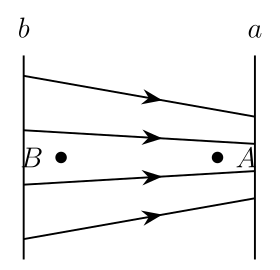 (A) 4×10⁻⁴ Vm−1
(B) 8×10⁻⁴ Vm−1
(C) 16×10−4 Vm−1
(D) 1×10⁻⁴ Vm−1
(A) 4×10⁻⁴ Vm−1
(B) 8×10⁻⁴ Vm−1
(C) 16×10−4 Vm−1
(D) 1×10⁻⁴ Vm−1›Reveal solutionSolution
Line spacing doubles ⇒ field halves; then use F=qE.
Step 1 — The concept: line density measures field strength. In a field-line diagram, the magnitude of E is proportional to the number of lines crossing unit area, i.e. inversely proportional to the separation between adjacent lines:
E ∝ (separation)1.
Where lines crowd together the field is strong; where they spread out the field is weak.
Step 2 — Compare A and B. From the figure, the separation on the left (at B) is twice that on the right (at A):
dB=2dA⟹EAEB=dBdA=21.
With EA=40 V m−1,
EB=240=20 V m−1.
Step 3 — Force on the charge at B. The force on a charge q in a field E is
F=qEB.
Convert the charge: q=20 μC=20×10−6 C. Hence …
- KCET 2020Set A-11 markMCQQ.An infinitely long thin straight wire has uniform charge density of 41×10−2 cm−1. What is the magnitude of electric field at a distance 20 cm from the axis of the wire? (A) 1.12×10⁸ NC−1 (B) 4.5×10⁸ NC−1 (C) 2.25×10⁸ NC−1 (D) 9×10⁸ NC−1
›Reveal solutionSolution
E≈2.25×10⁸ N C−1 — option (C).
For an infinitely long straight wire with linear charge density λ, the field at distance r is
E=2πε0rλ=r2kλ,k=9×10⁹ N m2C−2. …
- KCET 2018Set A-11 markMCQQ.The magnetic flux linked with a coil varies as ϕ=3t2+4t+9. The magnitude of the emf induced at t=2 seconds is (A) 8 V (B) 16 V (C) 32 V (D) 64 V
›Reveal solutionSolution
Differentiate the flux with respect to time (Faraday's law) and substitute t=2 s.
Step 1 — The concept.
Faraday's law of electromagnetic induction states that the emf induced in a coil equals the negative time-rate of change of the magnetic flux linked with it:
ε=−dtdϕ
The minus sign is Lenz's law (it fixes the direction); the question asks only for the magnitude, so we take ∣dϕ/dt∣. Notice that the constant term 9 in ϕ contributes nothing — only changing flux induces an emf.
Step 2 — Differentiate.
ϕ=3t2+4t+9 …
🎓Unlock everything free for 14 days
- ✓Full step-by-step solutions
- ✓Concept-first explanations
- ✓Methods, shortcuts & mistakes
- ✓PYQ mapping + timed mock tests
Full access for 14 days. No credit card required.