Q.Suppose while sitting in a parked car, you notice a jogger approaching towards you in the side view mirror of R=2 m. If the jogger is running at a speed of 5 m s−1, how fast the image of the jogger appear to move when the jogger is
🔒You're viewing a preview — the full solution, concept, methods & PYQ mapping are locked.
🔒 Start your 14-day free trial to unlock the full solution →Concept understanding — Spherical Mirror Equation
The Spherical Mirror Equation: From Intuition to Formula
Imagine you're standing in front of a concave mirror — the kind that makes your face look bigger when you're close, but flips everything upside down when you step far back. That change isn't magic; it's geometry. The spherical mirror equation is the single relationship that predicts exactly where an image will form, and whether it's real or virtual, for any spherical mirror.
The Core Idea
Every point on an object sends out light rays in all directions. A mirror redirects those rays. The mirror equation tells you: given the mirror's curvature and the object's distance, where will those rays meet again (or appear to meet)?
There are only three quantities you need:
- u — object distance (from the mirror's pole)
- v — image distance (from the mirror's pole)
- f — focal length (a property of the mirror's curvature)
The equation is:
v1+u1=f1
The power is in the sign convention, because every distance can point in one of two directions.
The Sign Convention (New Cartesian Sign Convention)
This is where most students slip. The equation works for all spherical mirrors — concave and convex — only if you follow the convention used throughout NCERT and CBSE:
- All distances are measured from the mirror's pole.
- The incident light is taken to travel left to right, so distances measured in that same direction (to the right) are positive, and distances measured against it (to the left) are negative.
- Heights above the principal axis are positive; heights below are negative.
Because a real object is always placed in front of the mirror (to the left, where the incident light originates), its distance u is always negative.
Under this convention, the focal length of a concave mirror is negative (its focus F sits in front of the mirror, on the same side as the object), and the focal length of a convex mirror is positive (its focus lies behind the mirror). This is one of the most frequently tested facts in CBSE board exams.
A very common mistake is writing f as positive for a concave mirror because "it converges light." Convergence tells you the type of mirror, not the sign — the sign comes purely from where the focus physically sits relative to the pole, under the convention above.
Where Does the Formula Come From?
For a concave mirror, parallel rays from a distant object converge at the focus, a point at (signed) distance f from the mirror. The derivation uses similar triangles from a ray diagram.
›Proof
Consider an object of height ho in front of a concave mirror. Draw the ray parallel to the axis: it reflects through the focus F. Draw the ray through the centre of curvature C: it strikes the mirror normally and reflects straight back on itself. These two reflected rays cross to form the image, of height hi.
From similar triangles formed by the ray through C:
hiho=R−vu−R
where R=2f is the radius of curvature (with the same sign convention as f).
From similar triangles formed by the ray through F:
hiho=fu−f
Equating the two ratios and simplifying (using R=2f) gives:
v1+u1=f1
What the Equation Tells You
Rearranging for v:
v=u−fuf
Because u is negative for a real object, and v takes the sign the geometry dictates:
- v negative → the image forms in front of the mirror → real image (can be projected on a screen).
- v positive → the image forms behind the mirror → virtual image.
For a concave mirror (f negative), using the magnitude of the object distance ∣u∣ measured from the pole:
- ∣u∣>2∣f∣ → real, inverted, diminished image between f and 2f
- ∣u∣=2∣f∣ → real, inverted, same-size image at 2f
- ∣f∣<∣u∣<2∣f∣ → real, inverted, magnified image beyond 2f
- ∣u∣=∣f∣ → image at infinity …
Why this formula?
Spherical Mirror Equation: Why the Formula Holds
The spherical mirror equation — also called the mirror formula — relates the object distance (u), image distance (v), and focal length (f) of a spherical mirror. Let's build the reasoning step by step.
1. The Key Formula
For a spherical mirror (concave or convex):
f1=u1+v1
Where:
- f = focal length (positive for concave, negative for convex)
- u = object distance from pole (always negative by sign convention)
- v = image distance from pole (sign depends on image location)
2. Why This Formula Holds — The Derivation
Step 1: Start with a ray diagram
Consider a concave mirror with:
- Pole P
- Centre of curvature C (radius R)
- Focus F (midpoint of PC, so f=R/2)
Take an object placed beyond C. Draw two rays from the object's tip:
- A ray parallel to the principal axis → reflects through F
- A ray through C → reflects back along itself
These rays meet at the image point.
Step 2: Use similar triangles
Let the object height be ho and image height be hi.
From the geometry of the ray through C:
- Triangle formed by object, C, and axis is similar to triangle formed by image, C, and axis.
This gives:
hiho=R−vu−R
(Here u and v are distances from P, with sign conventions applied later.)
Step 3: Use the parallel ray
From the ray parallel to the axis:
- Triangle formed by object, F, and axis is similar to triangle formed by image, F, and axis.
This gives:
hiho=fu−f
Step 4: Equate the two ratios
Since both ratios equal ho/hi:
R−vu−R=fu−f
Step 5: Substitute R=2f
For a spherical mirror, the focal length is half the radius of curvature:
R=2f
Substitute:
2f−vu−2f=fu−f
Step 6: Cross-multiply and simplify
Cross-multiply:
f(u−2f)=(u−f)(2f−v)
Expand:
fu−2f2=2fu−uv−2f2+fv
Cancel −2f2 on both sides:
fu=2fu−uv+fv
Bring all terms to one side:
0=fu−uv+fv
Rearrange:
uv=fu+fv
Step 7: Divide by uvf
Divide both sides by uvf:
f1=v1+u1
This is the mirror formula.
3. Why the Sign Convention Matters
The derivation above used distances as positive magnitudes. In actual problem-solving, we use the Cartesian sign convention:
- Distances measured against incident light are negative
- Distances measured along incident light are positive
For a concave mirror:
- u is negative (object in front)
- f is negative (focus in front)
- v is negative for real images (in front) …
The side mirror is convex, R=2 m⇒f=+1 m. With object distance u=−d and the jogger approaching, d decreases so u increases: dtdu=+5 m s−1.
Differentiating v1+u1=f1 gives dtdv=(u−ff)2dtdu=(d+1)25 m s−1.
- (a) d=39 m: 16005=0.003125 m s−1
- (b) d=29 m: 9005≈0.00556 m s−1 …
A car's side-view mirror is convex with f=R/2=+1 m. Differentiating the mirror equation with respect to time gives image speed =(u−ff)2vobject. For a jogger approaching at 5 m s−1, the image speeds are (a) 3201 m s−1≈3.1×10⁻³ m s−1,
(b) 1801 m s−1≈5.6×10⁻³ m s−1,
(c) 801 m s−1=1.25×10⁻² m s−1,
(d) 201 m s−1=5.0×10⁻² m s−1 — the image speeds up sharply as the jogger gets closer.
Setting up
A side-view mirror is convex, R=2 m, so f=R/2=+1 m (positive by the sign convention, since a convex mirror's focus lies behind it).
Using the Cartesian sign convention, an object a distance d in front of the mirror has u=−d. As the jogger approaches, d decreases, so u (which is negative) is becoming less negative — i.e. u is increasing with time:
dtdu=+5 m s−1
(The jogger's own speed is 5 m s−1 toward the mirror, which is exactly a rate of increase of u.)
Differentiating the mirror equation
Start from
v1+u1=f1
Differentiate with respect to time (with f constant):
−v21dtdv−u21dtdu=0⇒dtdv=−u2v2dtdu
Since v=u−ffu, we have uv=u−ff, so
dtdv=(u−ff)2dtdu
Evaluating at each distance
With f=1 m and u=−d, u−f=−(d+1), so (u−ff)2=(d+1)21, and the image speed is (d+1)25 m s−1.
| Distance d | v=u−ffu | Image speed |
|---|---|---|
| 39 m | 0.975 m | 16005=3201≈3.1×10⁻³ m s−1 |
| 29 m | 0.967 m | 9005=1801≈5.6×10⁻³ m s−1 |
Method: Differentiation of the Spherical Mirror Equation
We use the mirror equation and differentiate it with respect to time to relate object velocity and image velocity.
Step 1: Identify mirror type and sign conventions
- Side view mirror of a car is convex.
- Radius of curvature R=+2 m (convex mirror → R positive).
- Focal length:
f=2R=22=1 m
- Sign convention:
- Object distance u is negative (object in front of mirror).
- Image distance v is positive (virtual image behind mirror).
Step 2: Write the mirror equation
v1+u1=f1
With u negative, let u=−x where x is the positive distance of jogger from mirror.
v1−x1=f1
Step 3: Solve for v in terms of x
v1=f1+x1=fxx+f
⇒v=x+ffx
Here f=1 m, so:
v=x+1x
Step 4: Differentiate with respect to time
We need dtdv (speed of image). Given dtdx=−5 m/s (jogger approaching → x decreasing).
Using quotient rule:
dtdv=(x+1)2(x+1)(1)−x(1)⋅dtdx
dtdv=(x+1)21⋅dtdx
Substitute dtdx=−5:
dtdv=−(x+1)25 m/s
The negative sign means the image moves towards the mirror (virtual image gets smaller). …
Common Mistakes with the Spherical Mirror Equation (and How to Avoid Them)
This problem is a classic application of the mirror formula combined with differentiation (rate of change). Here are the most frequent errors students make:
1. Confusing Sign Convention for Convex Mirrors
The Mistake:
Students treat the side-view mirror as a concave mirror or forget that for a convex mirror, the focal length (f) is negative.
Why it happens:
The formula f1=u1+v1 is the same for both, but the sign of f changes. A side-view mirror is convex (diverging).
How to avoid:
- Always identify the mirror type first.
- For a convex mirror:
- R is positive in magnitude, but f=−2R (by Cartesian sign convention).
- Here, R=2 m, so f=−1 m.
- Write the sign explicitly before substituting.
2. Forgetting that Object Distance (u) is Negative
The Mistake:
Plugging u=+39 m directly into the formula.
Why it happens:
In the Cartesian sign convention, distances measured against the incident light direction are negative. The object is in front of the mirror, so u is negative.
How to avoid:
- Always set u=−d where d is the actual distance.
- For this problem: u=−39, −29, −19, −9 m.
3. Using the Wrong Formula for Image Velocity
The Mistake:
Directly differentiating v=u−fuf without considering the sign of f or using v=u−ffu incorrectly.
Why it happens:
Students often memorise v=u−fuf but forget that this form assumes f is positive (concave). For convex mirrors, the correct derived relation is:
v=u−fuf
but with f negative, the denominator becomes u−(−∣f∣)=u+∣f∣, which changes the sign of the result.
How to avoid:
- Derive from the mirror formula each time:
v1=f1−u1
Then solve for v after substituting signed values.
- Then differentiate:
dtdv=−u2v2⋅dtdu
(This formula is sign-sensitive — use it carefully.)
4. Ignoring the Sign of dtdu
The Mistake:
Taking dtdu=+5 m/s when the jogger is approaching.
Why it happens:
If the jogger is moving toward the mirror, the distance ∣u∣ decreases, but u itself (which is negative) becomes less negative — so dtdu is positive.
How to avoid:
- Define u=−x, where x is the positive distance.
- Then dtdu=−dtdx.
- If the jogger approaches, dtdx=−5 m/s (since x decreases), so dtdu=−(−5)=+5 m/s.
- Key: dtdu=+5 m/s.
5. Forgetting That Image Velocity is Also Negative
The Mistake:
Reporting the speed as a positive number without realising the image moves toward the mirror (opposite direction to the object's approach).
Why it happens:
Students compute dtdv and get a negative value, then panic or drop the sign.
How to avoid: …
- COMEDK 2026Set 2026-M1 markMCQQ.An object is placed 25 cm in front of a fully silvered concave mirror of focal length 15 cm . A plane mirror is placed 35 cm behind the concave mirror on the side opposite to the object. The final image after reflection first from the concave mirror and then from the plane mirror is formed at: (A) 37.5 cm in front of the plane mirror (B) 72.5 cm behind the concave mirror (C) 107.5 cm behind the concave mirror (D) 37.5 cm in front of the concave mirror
›Reveal solutionSolution
The key idea is to treat the fully silvered concave mirror as a mirror (not a lens) and then use the plane mirror to fold the path. After two reflections, the final image lies 107.5 cm behind the concave mirror, which corresponds to option (C).
Concept & Intuition
A fully silvered concave mirror is just a concave mirror — it reflects light. The plane mirror is placed behind it, so after the first reflection from the concave mirror, the light travels toward the plane mirror, reflects again, and the final image location is found by applying the mirror formula twice, carefully tracking sign conventions. The trick: the plane mirror simply creates a virtual image at the same distance behind it as the object is in front of it. We must keep distances measured from the concave mirror consistent.
Step-by-step solution
- First reflection from the concave mirror
- Object distance from concave mirror: u1=−25 cm (negative because object is in front, per Cartesian sign convention).
- Focal length: f=−15 cm (concave mirror, negative focal length).
- Mirror formula: v11+u11=f1.
v11+−251=−151
v11=−151+251=75−5+3=−752
So $v_1 = -37.5$ cm.- The negative sign means the image is in front of the concave mirror (real image), 37.5 cm from it.
-
Position of this image relative to the plane mirror
- The plane mirror is 35 cm behind the concave mirror. So the distance from the concave mirror to the plane mirror is +35 cm (taking direction from concave toward plane as positive).
- The first image is at −37.5 cm from the concave mirror (i.e., 37.5 cm in front).
- Distance from this image to the plane mirror = 35−(−37.5)=72.5 cm.
- So the image is 72.5 cm in front of the plane mirror.
-
Second reflection from the plane mirror …
- First reflection from the concave mirror
- KCET 2026Set C21 markMCQQ.The direction of a ray of light incident on a concave mirror is shown by PQ, while direction in which the ray would travel after reflection is shown by four rays marked as A, B, C and D as shown in the figure. Which of the four rays correctly shows the direction of the reflected ray?
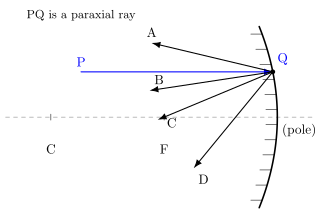 PQ is a paraxial ray.
(A) D
(B) C
(C) B
(D) A
PQ is a paraxial ray.
(A) D
(B) C
(C) B
(D) A›Reveal solutionSolution
A basic property of a concave (converging) mirror: any paraxial ray travelling parallel to the principal axis, after reflection, passes through the mirror's principal focus F.
Step 1 — Recall the reflection rule for a ray parallel to the axis
For a concave mirror, a ray parallel to the principal axis strikes the mirror and is reflected such that the reflected ray passes through the focus F, which lies midway between the pole and the centre of curvature C on the principal axis. This follows directly from the law of reflection applied to the mirror's curved surface at the point of incidence Q.
Step 2 — Identify the correct ray among the four options …
- KCET 2025Set D-41 markMCQQ.A ray of light passes from vacuum into a medium of refractive index n. If the angle of incidence is twice the angle of refraction, then the angle of incidence in terms of refractive index is (A) sin−1(2n) (B) 2cos−1(2n) (C) 2sin−1(2n) (D) cos−1(2n)
›Reveal solutionSolution
Put i=2r into Snell's law, expand sin2r with the double-angle identity, cancel sinr, and solve for r.
Step 1 — Write Snell's law for the vacuum → medium refraction.
Light goes from vacuum (n1=1) into a medium of refractive index n:
n1sini=n2sinr⟹sini=nsinr
Step 2 — Impose the given condition.
We are told the angle of incidence is twice the angle of refraction:
i=2r
Substituting:
sin(2r)=nsinr
Step 3 — Use the double-angle identity.
sin2r=2sinrcosr
so
2sinrcosr=nsinr
Step 4 — Cancel sinr.
Since the ray actually refracts, r=0, so sinr=0 and we may divide both sides by it:
2cosr=n⟹cosr=2n
r=cos−1(2n)
Step 5 — Return to the angle of incidence.
The question asks for i, not r:
i=2r=2cos−1(2n) …
- KCET 2025Set D-41 markMCQQ.A convex lens has power P. It is cut into two halves along its principal axis. Further one piece (out of two halves) is cut into two halves perpendicular to the principal axis as shown in figure. Choose the incorrect option for the reported lens pieces (A) Power of L2 is 2P (B) Power of L3 is 2P (C) Power of L1 is P (D) Power of L1 is 2P
›Reveal solutionSolution
A cut along the principal axis does not change the power (L1=P); a cut perpendicular to it halves the power (L2=L3=P/2), so the incorrect statement is the one claiming L1 has power P/2.
Step 1 — The lens-maker's formula is the concept.
f1=(μ−1)(R11−R21),P=f1
The power depends only on the refractive index and the two radii of curvature — not on the aperture (the size/height of the lens).
Step 2 — Cut ALONG the principal axis.
This cut is made in a plane containing the principal axis, so each half still has both curved surfaces with the same R1 and R2; only the aperture is halved. Therefore
Phalf=(μ−1)(R11−R21)=P
The piece L1 (the half that is not cut again) has power P. (Only its light-gathering area, and hence image brightness, is halved.)
Step 3 — Cut PERPENDICULAR to the principal axis.
The second half is now sliced through the middle perpendicular to the axis. Each resulting piece is plano-convex: one surface keeps its curvature, the other becomes flat (R→∞).
For the original biconvex lens with R1=+R, R2=−R: …
- COMEDK 2025Set 2025-M1 markMCQQ.A convex lens forms a real image of an object with magnification m1. The lens is moved towards the object to obtain another real image of magnification m2. The image distance is increased by x. The focal length of the lens is (A) (m1m2)x (B) (m2m1)x (C) m2−m1x (D) x(m2−m1)
›Reveal solutionSolution
The key is to relate the change in image distance to the two magnifications using the lens formula. The focal length turns out to be f=m2−m1x, so the correct option is (C).
Concept and intuition
When a convex lens forms a real image, both object distance u and image distance v are positive (using the real-is-positive sign convention). The magnification for a real image is m=v/u. If we move the lens toward the object, u decreases, so v must increase to keep the lens equation 1/f=1/u+1/v satisfied. The problem tells us that the image distance increases by x, and gives two magnifications m1 and m2. The trick is to express u and v in terms of m and f, then use the change in v to solve for f.
Step-by-step solution
- Relate magnification to object and image distances For a real image formed by a convex lens,
m=uv.
So we can write v=mu.
- Use the lens formula The lens equation is
f1=u1+v1.
Substitute v=mu:
f1=u1+mu1=u1(1+m1)=mum+1.
Hence
u=mm+1f.
Then the image distance is
v=mu=m⋅mm+1f=(m+1)f.
- Apply to the two positions For the first position: v1=(m1+1)f. …
- COMEDK 2024Set 2024-M1 markMCQQ.When a particular wave length of light is used the focal length of a convex mirror is found to be 10 cm. If the wave length of the incident light is doubled keeping the area of the mirror constant, the focal length of the mirror will be: (A) 5 cm (B) 20 cm (C) 15 cm (D) 10 cm
›Reveal solutionSolution
The focal length of a convex mirror depends only on its geometry (radius of curvature), not on the wavelength of light. Therefore, changing the wavelength does not change the focal length. The answer is 10 cm.
Concept and Intuition
The key idea here is to recall what determines the focal length of a mirror. For any spherical mirror — concave or convex — the focal length f is given by f=2R, where R is the radius of curvature of the mirror. This radius is a purely geometric property: it is the radius of the sphere from which the mirror’s surface is cut. It does not depend on the color, wavelength, or frequency of the light used.
A common confusion arises because lenses do have wavelength-dependent focal lengths (chromatic aberration), but mirrors work by reflection, not refraction. Reflection obeys the law of reflection for all wavelengths equally — there is no dispersion. So, no matter what light you shine on a mirror, its focal length stays fixed.
Let’s walk through the reasoning step by step.
- Recall the mirror formula for focal length For any spherical mirror (concave or convex), the focal length is
f=2R
where R is the radius of curvature. This is derived from geometry and the law of reflection, and it contains no term involving wavelength.
-
Identify what changes when wavelength is doubled
The problem states that the wavelength of incident light is doubled, but the mirror’s area (and therefore its shape and radius) is kept constant. Changing the wavelength does not alter the physical shape of the mirror — the mirror remains the same piece of glass with the same silvered surface.
-
Check for any possible effect of wavelength on reflection …
🎓Unlock everything free for 14 days
- ✓Full step-by-step solutions
- ✓Concept-first explanations
- ✓Methods, shortcuts & mistakes
- ✓PYQ mapping + timed mock tests
Full access for 14 days. No credit card required.