Q.(a) To construct an electronic circuit, you want to select a 470 KΩ resistor with 5% tolerance. Draw a schematic diagram indicating the colour combinations that you will select.
You're viewing a preview — the full solution, concept, methods & PYQ mapping are locked.
Start your 14-day free trial to unlock the full solution →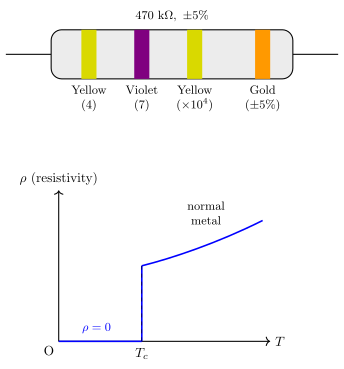
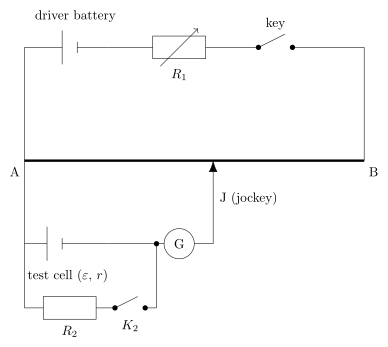
(a) 470 kΩ, 5% = Yellow-Violet-Yellow-Gold. (b) ρσ=1 always, so it stays constant. (c) A superconductor's resistivity drops to exactly zero at Tc. (d) Kirchhoff's junction and loop rules follow from charge and energy conservation. (e) The potentiometer internal-resistance formula gives r ≈ 3.45 Ω.
(a) Colour code for 470 kΩ, 5% tolerance
.
- 1st digit 4 → Yellow
- 2nd digit 7 → Violet
- Multiplier → Yellow
- Tolerance 5% → Gold
Band sequence: Yellow – Violet – Yellow – Gold.
(b) Effect of temperature on resistivity × conductivity
Conductivity is defined as the reciprocal of resistivity, , at every temperature. So the product always, regardless of how itself changes with temperature. Answer: (iii) Remains constant.
(c) Resistivity vs temperature for a superconductor
As temperature is lowered, resistivity decreases gradually like a normal metal, but at a sharply defined critical temperature it drops discontinuously to exactly zero and stays zero for all . The graph is a normal-metal-like curve down to , followed by a vertical drop to the T-axis.
(d) Kirchhoff's rules
- Junction (current) rule: The algebraic sum of currents meeting at any junction in a circuit is zero, (current entering a junction = current leaving it). This follows from conservation of charge — charge cannot accumulate at a junction.
- Loop (voltage) rule: The algebraic sum of potential differences (including emfs) around any closed loop in a circuit is zero, . This follows from conservation of energy — the net change in potential energy of a charge taken around a closed loop is zero.
(e) Internal resistance from the potentiometer
…
Unlock everything free for 14 days
- Full step-by-step solutions
- Concept-first explanations
- Methods, shortcuts & mistakes
- PYQ mapping + timed mock tests
Full access for 14 days. No credit card required.