Biology · Ch 9 — Control and Co-ordination
Generation and Conduction of the Nerve Impulse
Generation and Conduction of the Nerve Impulse
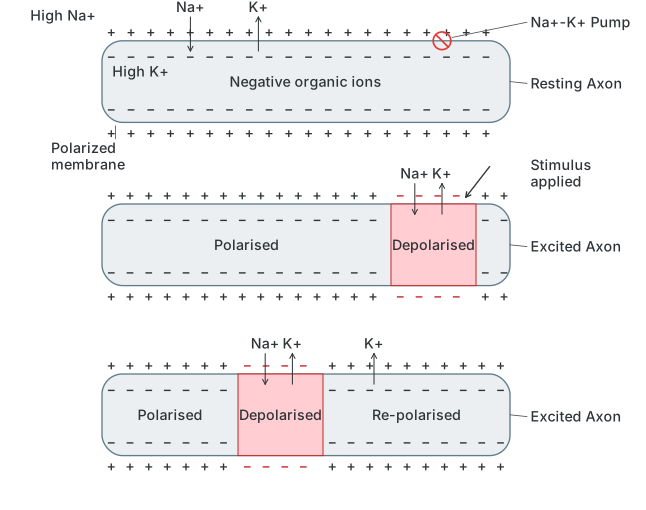
Generation of nerve impulse : 1. Depolarization : Generating a nerve impulse begins with depolarisation. Any disturbance to the resting membrane lets Na+ begin entering, lowering the potential difference below -70 mV; because the nerve membrane's Na+ permeability rises sharply once this starts, more Na+ rushes in, a self-reinforcing property unique to nerve membranes. The voltage-gated Na+/K+ channels are special in two ways: they change the membrane's potential difference in direct response to the stimulus received, and each gate opens and closes independently and automatically (self-closing). At rest both gate types are closed; during depolarisation, only the Na+ gates open (the K+ gates stay shut), so Na+ rushes into the axon, flipping the polarity -- the extracellular fluid becomes relatively electronegative and the axon interior becomes electropositive, reaching an action-potential peak of about +30 to +60 millivolts. This local depolarisation immediately triggers depolarisation in the next patch of membrane just ahead, while the patch behind begins repolarising -- so the wave is self-propagating along the whole length of the axon.
Drawn by us to help you understand the concept clearly, and verified to make sure it's accurate. For exams, practice from your textbook's own diagram.
What this figure shows. A sequence of cross-sections along an axon showing the resting, fully polarised membrane with high Na+ outside and high K+ plus negative organic ions inside (maintained by the Na+-K+ pump); then, after a stimulus is applied, a travelling wave in which the stimulated patch becomes depolarised (Na+ rushing in) while the region just behind it is already repolarising, illustrating how excitation and recovery move together …
2. Re-polarization : Repolarisation restores the resting state after a short refractory period. As Na+ accumulates inside, the membrane's Na+ permeability drops while its K+ permeability rises (K+ voltage gates open as Na+ gates slowly close), so K+ now rushes out rapidly (faster than Na+ had entered), and the Na+-K+ pump becomes active again, restoring the original ion distribution. This cycle of depolarisation followed by repolarisation, run as a self-propagating wave, repeats continuously all the way to the axon terminal.
Chart 9.7 Steps in generation and conduction of nerve impulse
- A stimulus is applied to a resting nerve.
- The membrane's permeability changes: it becomes more permeable to Na+.
- Na+ ions diffuse into the neuron from the ECF; the number of positive ions inside the axon rises.
- The axoplasm becomes positive and the ECF negative: the polarity is reversed, which is depolarisation.
- The membrane potential swings from -70 mV to about +30 mV; this change is the action potential.
- Repolarisation: at the peak (+30 mV) the Na+ channels close, the K+ gates open and the membrane becomes more permeable to K+.
- K+ ions diffuse out of the axon; the inside becomes less and less positive.
- The inside of the membrane becomes negative once again. …