Biology · Ch 9 — Control and Co-ordination
Properties and Mechanism of Hormone Action
Properties and Mechanism of Hormone Action
Properties of Hormones : Hormones share several defining properties: they act as chemical messengers effective at very low concentration; they function as regulators that can inhibit, stimulate or modify specific processes; some interact with receptors on the target cell's plasma membrane while others enter the nucleus to interact directly with genes; both hyper- and hyposecretion produce disorders; hormones are metabolised (broken down) after they act and so cannot be reused; and their secretion is itself regulated by positive or negative feedback mechanisms. A hormone produces its effect on a target organ/cell by first binding a hormone receptor -- which may sit on the cell membrane or lie intracellularly -- forming a hormone-receptor complex that triggers biochemical change in the target tissue.
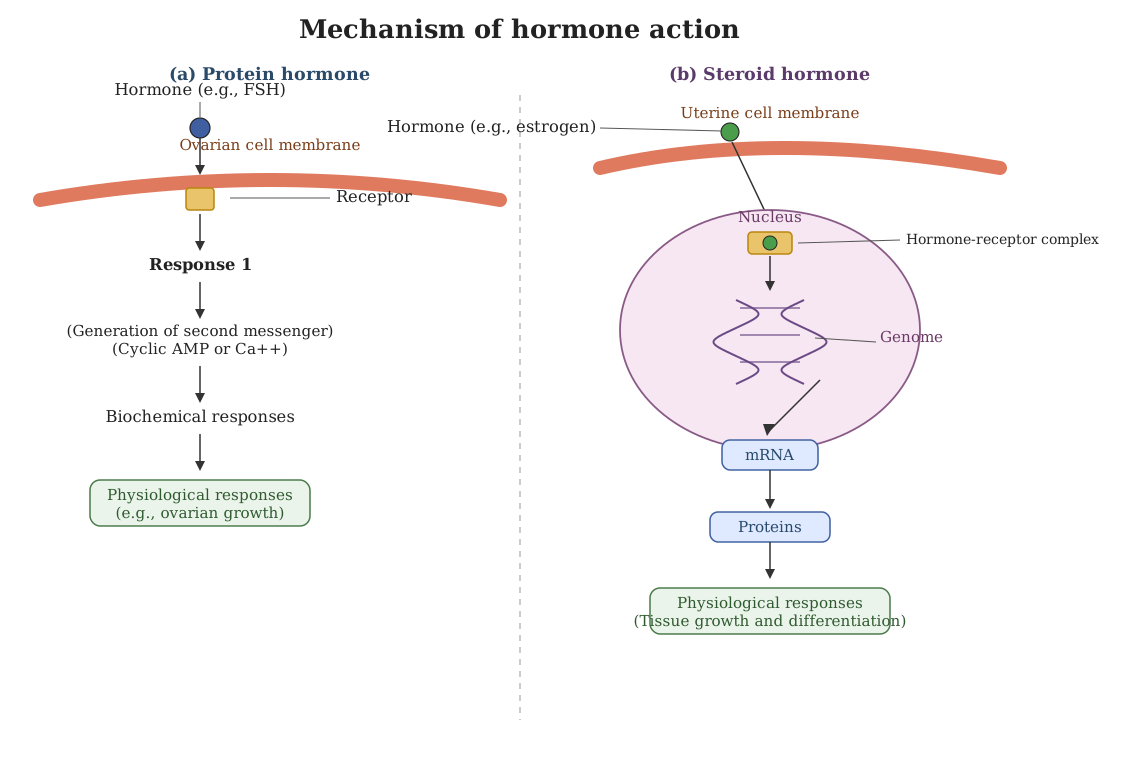
Mechanism of hormone action - A. Mode of hormone action through membrane receptors : Catecholamines, and peptide and polypeptide hormones, are not lipid-soluble, so they cannot cross the target cell's plasma membrane; instead they bind specific receptor molecules on the membrane surface, and this hormone-receptor complex triggers release of the enzyme adenylate cyclase, which converts cellular ATP into cyclic AMP. Here the hormone itself is the 'first messenger' and cAMP is the 'second messenger' (other second messengers used in different pathways include Ca2+, cGMP and IP3/inositol triphosphate), and it is this second messenger that actually activates the downstream enzymatic, biochemical and physiological response.
Drawn by us to help you understand the concept clearly, and verified to make sure it's accurate. For exams, practice from your textbook's own diagram.
What this figure shows. A flow diagram showing a water-soluble hormone such as FSH binding to a receptor on the outer surface of an ovarian target cell's membrane, without crossing into the cell, which triggers generation of a second messenger (cyclic AMP or Ca2+) inside the cell, setting off a chain of biochemical responses that culminate in a physiological response such as ovarian growth.
9.23: Mechanism of hormone action through membrane receptor. …
…
Drawn by us to help you understand the concept clearly, and verified to make sure it's accurate. For exams, practice from your textbook's own diagram.
What this figure shows. A flow diagram showing a lipid-soluble hormone such as oestrogen passing straight through a uterine target cell's membrane and binding, in the cytoplasm, to an intracellular receptor to form a hormone-receptor complex, which then enters the nucleus and acts on the genome to direct synthesis of specific mRNA and, from it, proteins, producing physiological responses such as tissue growth and differentiation.
9.24: Mechanism of hormone action through intracellular receptor.
Panel (b) of this drawing is the book's Fig. 9.24 (intracellular receptor); panel (a) is Fig. 9.23. …