Biology · Ch 5 — Origin and Evolution of Life
Geological Time Scale
Geological Time Scale
The Earth's biodiversity today looks nothing like it did when the planet was first formed, and the fossil record makes clear that the life forms present millions of years ago (mya) were very different from those alive now. The geological time scale is the framework biologists use to organise the sequence of events that unfolded on Earth across these different ages, arranging Earth's history into six major eras. Each era came to an end with a major environmental change that drove the extinction of some species while allowing new ones to emerge, and each era is further subdivided into periods and epochs, marked out by smaller but still significant landmark events (summarised in Table 5.15).
Table 5.15: Geological Time Scale (MYA = Million Years Ago; rows listed most recent to oldest, matching the source's own print order)
| Era | Period | Epoch | Time (MYA) | Plant life | Animal life |
|---|---|---|---|---|---|
| Cenozoic | Quaternary | Recent (Holocene) | 0.1-0.6 | Angiosperms, Dicots, Monocots; spread of agriculture | Age of mammals: development of modern man, birds, fishes and insects; development of human culture |
| Cenozoic | Quaternary | Pleistocene | 0.6-2.0 | Increase in herbs | Extinction of great mammals. Appearance of primitive man |
| Cenozoic | Tertiary | Pliocene | 2-13 | Hard woody plants, conifers, bryophytes, monocots; grasslands dominated | Emergence or origin of man. Evolution of ruminants - horse, camel, elephant |
| Cenozoic | Tertiary | Miocene | 13-26 | Abundance of deciduous trees, origin of grasses | Formation of first man-like apes. Adaptive radiation/spread of mammals |
| Cenozoic | Tertiary | Oligocene | 26-38 | Rise of monocots and flowering plants | Extinction of archaic mammals. Appearance of apes and monkeys. Turtles and crocodiles attained development |
| Cenozoic | Tertiary | Eocene | 38-54 | Development of angiosperms | Diversification of placental mammals and modern birds |
| Cenozoic | Tertiary | Palaeocene | 54-65 | Advancement of flowering plants | Arrival of early/first primates, rise of placental mammals |
| Mesozoic | Cretaceous | - | 65-135 | Decline of ferns - sphenopsids (horsetails) and Bennetitales. Ginkgos, Gnetales; 1st appearance of flowering plants | Extinction of dinosaurs and toothed birds. Appearance of placental mammals and first modern birds |
| Mesozoic | Jurassic | - | 135-165 | Origin of angiosperms. Dominance of herbaceous lycopods, ferns, conifers, cycads | Age of reptiles. Dinosaurs dominant. Appearance of toothed birds (Archaeopteryx). Rise of marsupials |
| Mesozoic | Triassic | - | 165-225 | Dominance of Bennetitales, gymnosperms; extinction of seed ferns | Appearance and rise of dinosaurs. Extinction of primitive amphibians. Diversification of reptiles. Rise of oviparous mammals, therapsids. Diversification of flies |
| Palaeozoic | Permian | - | 225-280 | Origin of conifers. Decline of arborescent lycopods. Abundance of ferns, cycads and advanced conifers | Rise of modern insects. Disappearance of trilobites. Appearance of mammal-like reptiles (Pelycosaurs). Decline of amphibians |
| Palaeozoic | Carboniferous | - | 280-345 | Development of diverse, arborescent lycopods, mosses, seed ferns and primitive conifers; age of ferns and coal forests; different fungal groups | Abundance of amphibians (age of amphibians). Appearance of reptiles and winged insects |
| Palaeozoic | Devonian | - | 345-400 | Appearance of first pro-gymnosperms. Formation of forests, wood-decaying fungi, chytrids and origin of bryophytes | Diversification of fishes. Evolution of amphibians. Appearance of ammonites |
| Palaeozoic | Silurian | - | 400-440 | Appearance of lycopods and ferns. Dominance of algae, ascomycetean fungi | Appearance of first terrestrial animals, wingless insects and jawed fish |
| Palaeozoic | Ordovician | - | 440-500 | Appearance of first seedless vascular land plants, abundant algae | Abundance of diverse invertebrates. Appearance of first vertebrates (jawless fishes). Appearance of corals, giant cephalopods like Nautilus |
| Palaeozoic | Cambrian | - | 500-590 | Rhynia-like plants. All types of marine algae | Abundance/age of trilobites. Diversification of invertebrate phyla |
| Proterozoic | - | - | 600-1600 | Tracheophyte ancestors, chlorophyte ancestors, bacterial single-celled protista, blue-green algae | Primitive flatworms, annelids, sponges, coelenterates, primitive metazoans; scanty fossils of prokaryotes |
The very first life is thought to have appeared on Earth roughly 2000 million years ago; the transition from simple protenoid aggregates all the way to genuine first cells took place over billions of years and remains, even today, something of a mystery. Once life had appeared, living forms went on to diversify into a wide range of groups. Life itself began in the sea, and plants were the very first living beings to make the transition to a terrestrial existence. Fishes then evolved and diversified in turn, and among them the lobefin group of fishes diversified further still, with some members developing stout, strong fins that let them venture onto land and return to water as needed. The coelacanth — a member of this lobefin group — was for a long time believed to be entirely extinct and was regarded as a 'living fossil' only in the sense of a well-studied fossil record, until a living specimen was actually caught off South Africa in 1938, making it a true living fossil in the more familiar sense of the phrase.
Reptiles evolved from amphibians and were the first truly land-adapted vertebrates, since — unlike amphibians — they do not need to return to water in order to reproduce. Even so, around 200 million years ago some reptile lineages moved back into an aquatic way of life and re-evolved a fish-like body form, as seen in the Ichthyosaurs. The giant reptiles known as dinosaurs dominated the Earth for a long period but ultimately went extinct roughly 65 million years ago, at around the same time that the giant ferns which had flourished alongside them also died out and were converted, over time, into today's fossil fuels. …
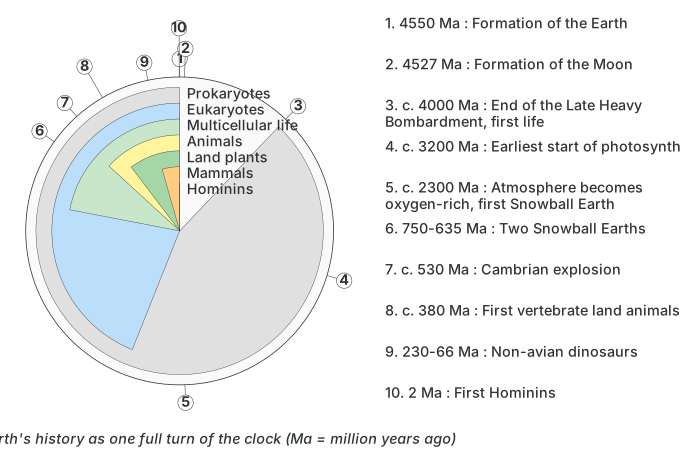
Drawn by us to help you understand the concept clearly, and verified to make sure it's accurate. For exams, practice from your textbook's own diagram.
What this figure shows. A circular (pie-chart style) timeline of Earth's history from its formation about 4550 million years ago to the present, marked with concentric labelled bands for prokaryotes, eukaryotes, multicellular life, animals, land plants, mammals and hominins appearing in turn, and annotated with specific dated milestones around its rim — the Moon's formation, the end of the Late Heavy Bombardment and first life, the start of photosynthesis, the atmosphere becoming oxygen-rich, two 'Snowball Earth' glaciation episodes, the Cambrian explosion of animal diversity, the first vertebrates on land, the age of non-avian din …