Biology · Ch 5 — Origin and Evolution of Life
Human Evolution
Human Evolution
Use your brain power
Since your earlier school days you have been solving mysteries and puzzles labelled 'use your brain power'. Did you ever wonder why the human brain has such a capacity? Why and how did we evolve along these lines? What is the extent of similarity between humans, chimpanzees and monkeys?
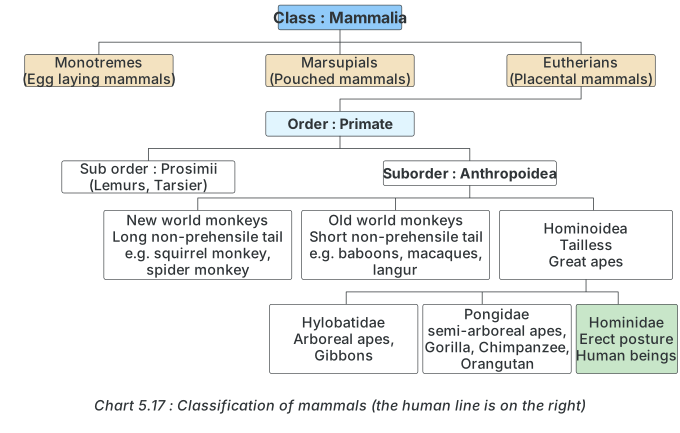
The evolutionary history of human beings has been traced back to a tree-dwelling, shrew-like ancestral animal, with the process beginning during the Palaeocene epoch, when shrinking forests forced arboreal mammals to begin adapting to a life spent on the ground — a shift in habitat that is thought to have been an important driving force behind the descent to land. In the following chart (Chart 5.17) it can be seen that we are most closely related to the gibbons, chimpanzees and gorillas.
Drawn by us to help you understand the concept clearly, and verified to make sure it's accurate. For exams, practice from your textbook's own diagram.
A branching classification chart of the mammals, starting from Class Mammalia and splitting first into Monotremes (egg-laying mammals), Marsupials (pouched mammals) and Eutherians (placental mammals); the eutherian branch continues down through Order Primate into Suborder Prosimii (lemurs, tarsiers) and Suborder Anthropoidea, which itself splits into New World monkeys (long non-prehensile tails, e.g. squirrel and spider monkeys), Old World monkeys (short non-prehensile tails, e.g. baboons, macaques, langurs) and the tailless Hominoidea, which finally divides into the arboreal gibbons (Hylobatidae), the semi-arboreal great apes — gorilla, chimpanzee, …
Do you know?
There is a difference of only 2.5 % between the DNA of the chimpanzee and man, while between monkey and man it is 10 %.
Several major evolutionary trends mark the transition from ape to man: an increase in the size and complexity of the brain, accompanied by markedly enhanced intelligence; a corresponding increase in cranial capacity; the adoption of bipedal locomotion; the development of an opposable thumb; an erect (upright) posture; a shortening of the forelimbs together with a lengthening of the hind limbs; the development of a distinct chin; a broadening of the pelvic girdle; the development of the lumbar curvature of the spine; and, ultimately, social and cultural development — including articulate speech, art and the deliberate making of tools.
The fossil record traces this transition through a sequence of ancestral and related forms (summarised in Table 5.18). Dryopithecus (Miocene epoch, roughly 20-25 million years ago; fossil sites include Lake Victoria in Africa and Haritalyangar in Himachal Pradesh) was distinctly ape-like in appearance and showed a close resemblance to the living chimpanzee, with a comparatively small cranial capacity. Ramapithecus (late Miocene to early Pliocene, roughly 14-12 million years ago; found in the Shivalik Hills of India and also in Kenya) was already more man-like in its features. Australopithecus (late Pliocene to early Pleistocene, roughly 4-1.8 million years ago; found at Taung in South Africa and also in Ethiopia and Tanzania) is regarded as the connecting link between ape and man, and is often described as having had 'a man's body with an ape's brain' — an upright, bipedal gait combined with a comparatively small, ape-sized brain (roughly 900 cc). Homo habilis (late Pliocene to early Pleistocene, roughly 2.5-1.4 million years ago; found at Olduvai Gorge in Tanzania) was nicknamed the 'handy man' because it is credited with making the first tools out of stone, and probably did not eat meat. Homo erectus (middle Pleistocene, roughly 1.5 million years ago; found in Java and near Peking) was more clearly an 'ape-man' in build, is thought to have been omnivorous and to have probably eaten meat, and may have used fire. Neanderthal man (late Pleistocene, roughly 100,000 to 40,000 years ago; found in the Neanderthal valley in Germany) was a heavily built, advanced prehistoric human who used animal hide, buried the dead, and constructed flint tools, with a skull marked by prominent brow ridges and a cranial capacity of roughly 1400 cc. Homo sapiens, modern man, is found across Africa (and subsequently the whole world), developed distinct races over time, and produced cave art as far back as roughly 18,000 years ago.
Table 5.18: Human Evolution (Comparative Table)
| Criterion | Dryopithecus | Ramapithecus | Australopithecus | Homo habilis | Homo erectus | Neanderthal man | Homo sapiens |
|---|---|---|---|---|---|---|---|
| Appearance | Ape like | Man like | Connecting link between ape and man | Handy man like | Ape man | Advanced prehistoric man | Modern man |
| Site of fossil record | Lake Victoria of Africa, Haritalyngar of Himachal Pradesh | Shivalik Hills in India and even in Kenya | Toung in South Africa, Ethiopia, Tanzania | Olduvai Gorge, Tanzania in Africa | Java and Peking | Neanderthal valley, Germany | Africa |
| Period | Miocene epoch, 20-25 mya | Miocene and early Pliocene epoch, 14-12 mya | Late Pliocene or early Pleistocene epoch, about 4-1.8 mya | Late Pliocene or early Pleistocene, 2.5-1.4 mya | Middle of Pleistocene epoch, 1.5 mya ago | Late Pleistocene epoch, 100000 to 40000 years ago | [NOTE: illegible in source] |
| Skeletal features | [NOTE: illegible in source] | Lower jaw, lightly built, dentition more like modern man, smaller molars | Not taller than 4 feet, jaws larger, prognathous face, chin absent, lumbar curvature present | [NOTE: illegible in source] | 5 feet in height, prognathous face, massive jaws, huge teeth, chin absent, bony eye brow ridges present | Heavy built, short, prominent brow ridges, low forehead, deep jaws, chin absent, outwardly curved thigh bones | [NOTE: illegible in source] |
| Posture | Semi-erect | Erect | Upright | Erect | Erect | Erect | Erect |
| Cranial capacity | [NOTE: illegible in source] | [NOTE: illegible in source] | 450-600 cc | 650-800 cc | 900 cc | 1400 cc | 1450 cc |
| Special features | Close similarity to chimpanzee | [NOTE: illegible in source] | [NOTE: illegible in source] | Man with ape brain, probably did not eat meat, made tools from stones, nicknamed 'handy man' | Probably ate meat, omnivorous, might have used fire | Used hide, buried their dead, constructed flint tools | Developed distinct races. Developed cave art about 18000 years ago |
Use your brain power
Even though the cranium of the elephant is larger than that of humans, why are humans considered more intelligent than elephants?
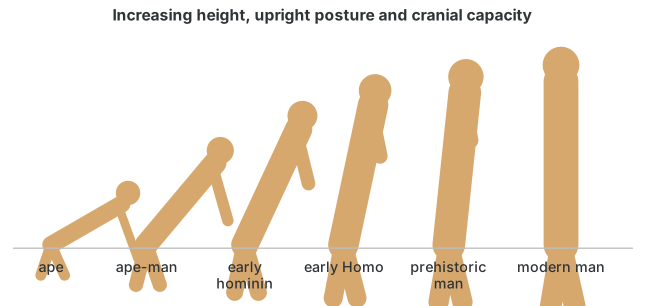
Over this same evolutionary sequence, cranial capacity increased steadily and the enlargement of the frontal lobe allowed a high forehead to develop; the growth in intelligence made a corresponding physical development necessary, so that body and brain could be used together effectively and productively. Freedom of the forelimbs from any locomotory role, combined with an opposable thumb, allowed much better use of the hands for holding objects and for the development of fine motor skills. Bipedal locomotion and an upright posture, together with stereoscopic vision, together let early humans move about safely on land. Table 5.18 clearly shows this gradual increase in cranial capacity, together with the accompanying changes in skull shape and dentition, across the ancestral human lineage right up to the present day — a journey of evolution that, as the chapter notes, still continues.
Drawn by us to help you understand the concept clearly, and verified to make sure it's accurate. For exams, practice from your textbook's own diagram.
What this figure shows. A left-to-right sequence of increasingly upright, larger-brained hominin silhouettes running from an ape-like early ancestor through the intermediate fossil stages to modern Homo sapiens, visually reinforcing the progressive change in posture, skull shape and body proportions summarised in the accompanying …
Internet my friend
- Recently a fossil park has been established in Gadchiroli district of Maharashtra state. Find more information about the Wadadham fossil park. …