Biology · Ch 5 — Origin and Evolution of Life
Origin of Life (Protobiogenesis)
Origin of Life (Protobiogenesis)
Can you recall?
- What is evolution?
- Where was first life formed?
- Why are many species of plants and animals becoming extinct?
- Lamarck's theory of inheritance of acquired characters.
- What is speciation?
Living matter can be recognised by a set of shared attributes — responsiveness, growth, metabolism, energy transformation and reproduction — that non-living matter does not show. Yet exactly where and how the very first living matter arose has remained a genuine puzzle for thinkers across the ages, and even today's advances in biochemistry, astrobiology, geology and molecular biology have not settled the question with certainty. Over time, several different theories have been put forward:
a. Theory of Special Creation. The oldest of these ideas rests on religious belief rather than scientific proof, holding that every living organism was individually created by a super-natural power.
b. Cosmozoic Theory / Theory of Panspermia. This theory argues that life did not originate on Earth at all, but instead arrived here from other planets, carried as spores or micro-organisms (called cosmozoa or panspermia). Interest in the idea was renewed when NASA reported bacteria-like fossil structures on a piece of Martian rock recovered from Antarctica — but because the theory simply relocates the problem (it cannot explain how life began on those other planets either), it is not accepted as an explanation of origin.
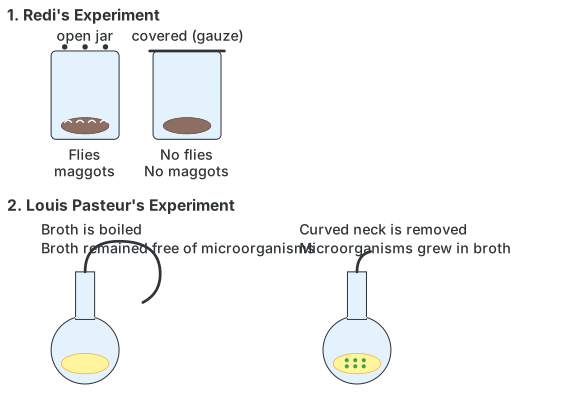
c. Theory of Spontaneous Generation (Abiogenesis). According to this once-popular idea, living organisms could arise spontaneously from non-living (inanimate) matter. It was decisively disproved by Louis Pasteur's swan-necked flask experiments, which followed earlier work such as Redi's experiment showing that maggots appear in meat only when flies can reach it, not from the meat itself.
Observe and Discuss
- Redi's Experiment
- Louis Pasteur's Experiment
Study the two illustrations: in Redi's experiment the open jar of meat is visited by flies and develops maggots, while the covered jar gets no flies and no maggots; in Pasteur's experiment the broth boiled in a swan-necked flask stays free of microorganisms, but when the curved neck is removed microorganisms grow in the broth.
Drawn by us to help you understand the concept clearly, and verified to make sure it's accurate. For exams, practice from your textbook's own diagram.
Observe and Discuss: Redi's jars (open and covered) and Pasteur's swan-necked flask before and after the neck is removed.
d. Theory of Biogenesis. This theory instead holds that living organisms are always produced from pre-existing living forms, through the process of reproduction — 'life from life'. While this correctly explains how life continues once it exists, it cannot, on its own, explain how the very first form of life on Earth came to be — which is exactly the gap the chemical-evolution theory below sets out to fill.