Chemistry · Ch 13 — Amines
Electrophilic aromatic substitution in aromatic amines
Electrophilic aromatic substitution in aromatic amines
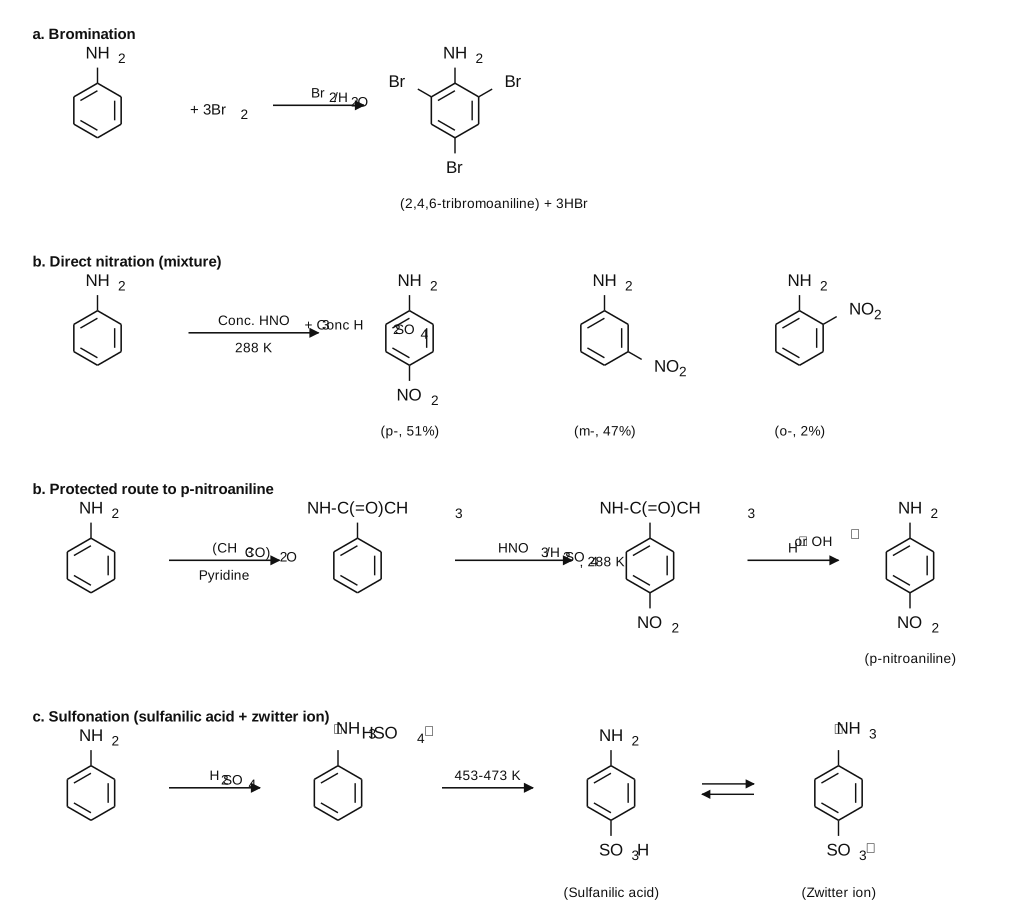
The amino group (-NH2), whether on a primary, secondary or tertiary aromatic amine, is both an ORTHO/PARA-DIRECTING group and a genuinely POWERFUL RING-ACTIVATING group -- because the nitrogen's lone pair of electrons is donated into the aromatic ring by resonance, increasing electron density (and so reactivity toward electrophiles) specifically at the ring's ortho and para positions. As a direct consequence, aromatic amines undergo electrophilic aromatic substitution reactions considerably more READILY than benzene itself does. (a) Bromination: aniline reacts with bromine water at ordinary room temperature to give a white precipitate of 2,4,6-tribromoaniline directly -- note that this is a TRIsubstituted product straightaway, precisely BECAUSE the -NH2 group activates the ring so powerfully that bromination cannot easily be stopped after only one substitution; all three of the positions ortho/para to -NH2 (two ortho, one para) end up substituted. (b) Nitration: DIRECT nitration of aniline, using concentrated HNO3 together with concentrated H2SO4, in fact yields a MIXTURE of all three possible ortho-, meta- and para-nitroaniline isomers (51% para, 47% meta, 2% ortho) -- a genuinely surprising result at first glance, given that -NH2 is meant to be an ortho/para director, until it is recognised that in this strongly ACIDIC reaction medium the -NH2 group itself gets PROTONATED to -N(+)H3, and -N(+)H3 (now carrying a full positive charge, with no lone pair left to donate into the ring by resonance) is instead a META-directing and RING-DEACTIVATING group -- so a substantial share of the aniline present in this acidic medium is, in effect, reacting as its protonated form, routing considerable substitution product to the meta position that plain -NH2 alone would never favour. To obtain p-nitroaniline CLEANLY, as the clear major product rather than as only one component of a three-way mixture, the -NH2 group must first be PROTECTED, by acetylation (with acetic anhydride, pyridine present) to acetanilide -- in acetanilide, the nitrogen lone pair is now partly delocalised into the acetyl carbonyl group instead of only into the ring, so the ring is still activated (and still ortho/para-directing, since the amido nitrogen's lone pair is still, in part, available to the ring) but far less powerfully and far less vulnerable to unwanted protonation under the strongly acidic nitrating conditions. Acetanilide, nitrated under the same conditions (concentrated HNO3 + concentrated H2SO4, 288 K), gives p-nitroacetanilide as the clean major product; acid- or base-catalysed hydrolysis of this product then removes the acetyl protecting group, regenerating the free -NH2 group and delivering p-nitroaniline as the final product. This same overall protect-substitute-deprotect strategy, worked through in the text's own Problem 13.1 using bromination instead of nitration (acetanilide, brominated in acetic acid solvent, gives p-bromoacetanilide, then hydrolysed to p-bromoaniline), is exactly how a clean MONO-substituted product is obtained from aniline whenever direct reaction on the free amine would otherwise over-react or give an unwanted isomer mixture, as bromination and nitration both do. (c) Sulfonation: aniline reacts with concentrated sulfuric acid to form anilinium hydrogen sulfate (a simple acid-base salt, the -NH2 group protonated by the strongly acidic H2SO4); this salt, on further heating with sulfuric aci …
Direct nitration of aniline with concentrated HNO3 + concentrated H2SO4 at 288 K gives a mixture of all three nitroaniline isomers: p-nitroaniline 51%, m-nitroaniline 47%, o-nitroaniline 2%. The unusually large share of the meta isomer (which the plain -NH2 group, being ortho/para-directing, would not on its own predict) arises because in this strongly acidic medium the -NH2 group is itself protonated to -N(+)H3, and -N(+)H3 is a meta-directing, ring-deactivating group -- so a substantial fraction of the aniline pres …
Drawn by us to help you understand the concept clearly, and verified to make sure it's accurate. For exams, practice from your textbook's own diagram.
Worked out. Worked problem: prepare p-bromoaniline from aniline, and justify the route. Solution: -NH2 is such a strongly ring-activating, ortho/para-directing group (its nitrogen lone pair delocalised into the ring by resonance) that direct bromination of aniline over-reacts, giving 2,4,6-tribromoaniline rather than a clean monobromo product. To get a single monobromo product, the ring-activating power of -NH2 must first be reduced -- done by acetylating aniline (with acetyl chloride, base present) to acetanilide, in which the nitrogen lone pair is now partly delocalised into the acetyl carbonyl instead of only into the ring, so ring activation drops. Acetanilide, brominated in acetic acid solvent, then gives the single monobromo product p-bromoacetanilide (bromination still goes para, since the acetamido group is still weakly activating and ortho/para-directing, but no longer activating enough for a second or third substitution). Acid-catalysed hydrolysis of p-bromoacetanilide then removes the acetyl protecting group, regenerating the free -NH2 and giving p-bromoaniline as the final product. The very same protect-brominate/nitrate-deprotect strategy, substituting Br2/acetic acid for conc. HNO3+H2SO4 at 288 K, is how p-nitro …