Chemistry · Ch 13 — Amines
Reaction with arenesulfonyl chloride (Hinsberg's test)
Reaction with arenesulfonyl chloride (Hinsberg's test)
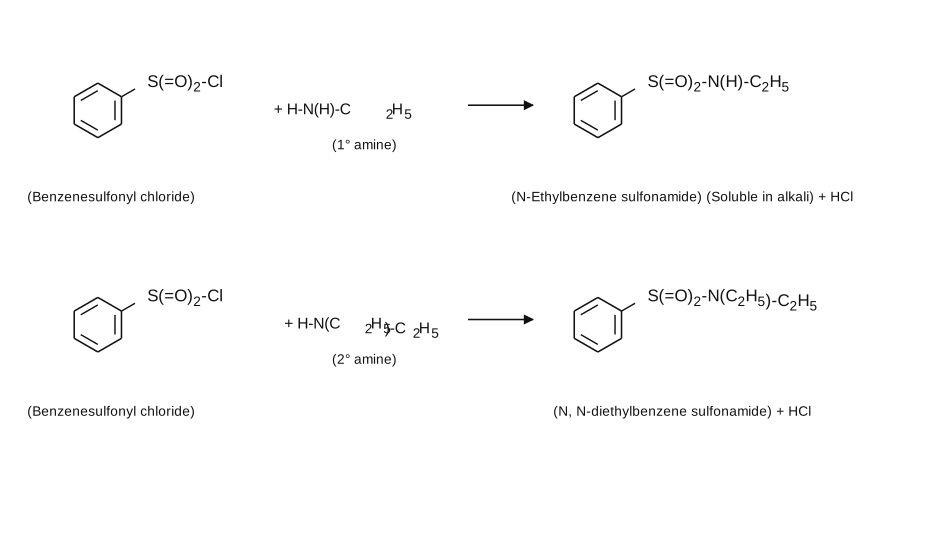
Benzenesulfonyl chloride (C6H5SO2Cl) is given its own specific name in the context of distinguishing amines: Hinsberg's reagent, used in what is correspondingly called the Hinsberg test. (a) A PRIMARY amine -- worked here with ethylamine as the specific example -- reacts with benzenesulfonyl chloride to form N-ethylbenzenesulfonyl amide (more simply, N-ethylbenzenesulfonamide). The single hydrogen atom still attached to nitrogen in this sulfonamide product turns out to be STRONGLY acidic (its acidity considerably enhanced by the strongly electron-withdrawing adjacent sulfonyl, -SO2-, group) -- and precisely because this remaining N-H is genuinely acidic, this sulfonamide product is SOLUBLE in aqueous alkali (it is deprotonated by, and dissolves into, the alkali as its own sodium/potassium salt). (b) A SECONDARY amine -- worked here with diethylamine as the specific example -- instead reacts with benzenesulfonyl chloride to give N,N-diethylbenzenesulfonamide. This particular sulfonamide product, unlike the primary-amine case, does NOT contain ANY hydrogen atom still attached to its nitrogen at all (both of nitrogen's original hydrogens have been replaced -- one by the sulfonyl group, one by the second ethyl group already present in the starting secondary amine) -- so, having no acidic N-H left to deprotonate, this product is NOT acidic, and consequently does NOT dissolve in alkali at all. TERTIARY amines, having no N-H hydrogen on nitrogen to begin with (all three original hydrogens of ammonia already replaced by alkyl groups before the reaction even starts), simply do NOT react with benzenesulfonyl chloride under these conditions in the first place -- there is no acidic proton for the reagent's mechanism to act on. Taken together, these three genuinely different outc …
Drawn by us to help you understand the concept clearly, and verified to make sure it's accurate. For exams, practice from your textbook's own diagram.
Worked out. (a) Ethylamine (a primary amine) reacts with benzenesulfonyl chloride to give N-ethylbenzenesulfonamide plus HCl; the remaining hydrogen on nitrogen in this sulfonamide is strongly acidic (its acidity boosted by the adjacent electron-withdrawing -SO2- group), so this sulfonamide dissolves in aqueous alkali. (b) Diethylamine (a secondary amine) reacts with benzenesulfonyl chloride to give N,N-diethylbenzenesulfonamide plus HCl; since both of nitrogen's original hydrogens have now been replaced (one by the sulfonyl group, one by the second ethyl), this sulfonamide has no N-H left at all, so it is not acidic and does not dissolve in alkali. Tertiary amines, having no N-H to begin with, simply do not react with benzenesulfonyl chloride under these conditions -- so the three classes are told apart by wheth …