Chemistry · Ch 14 — Biomolecules
Nucleotides
Nucleotides
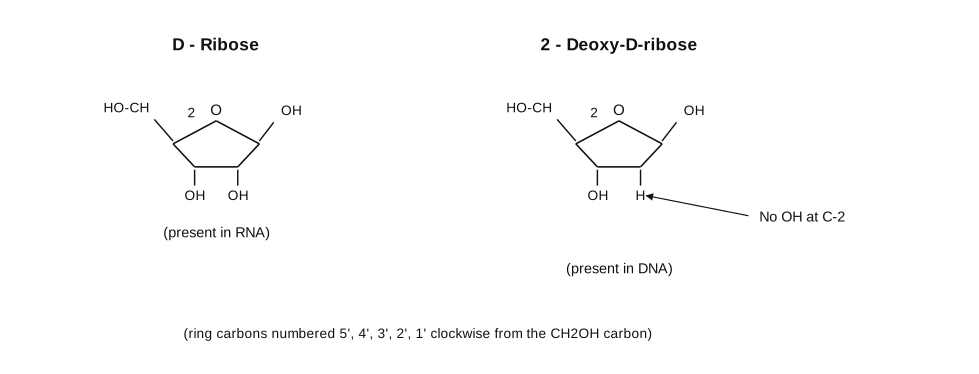
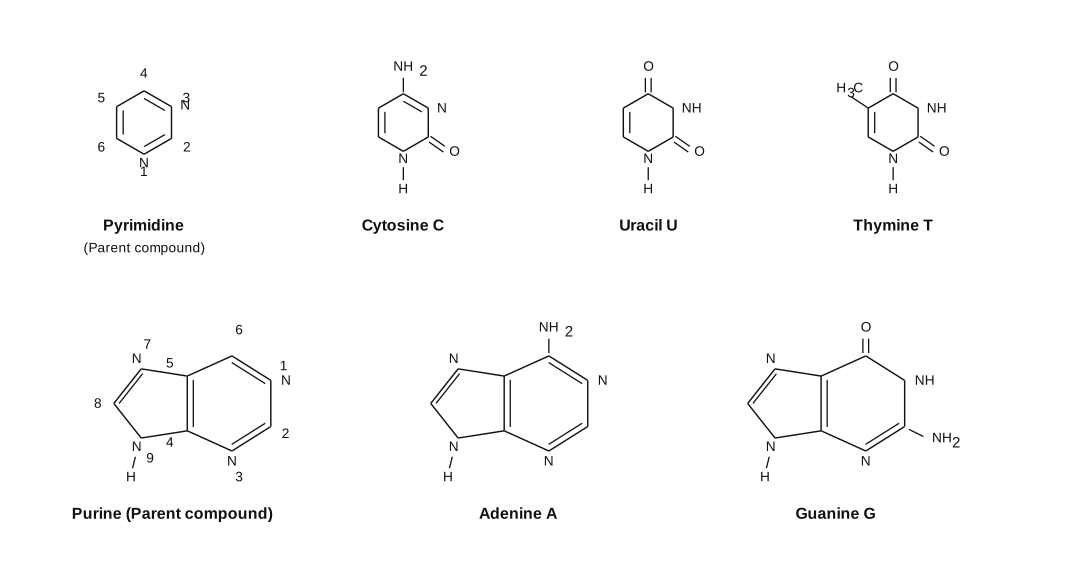
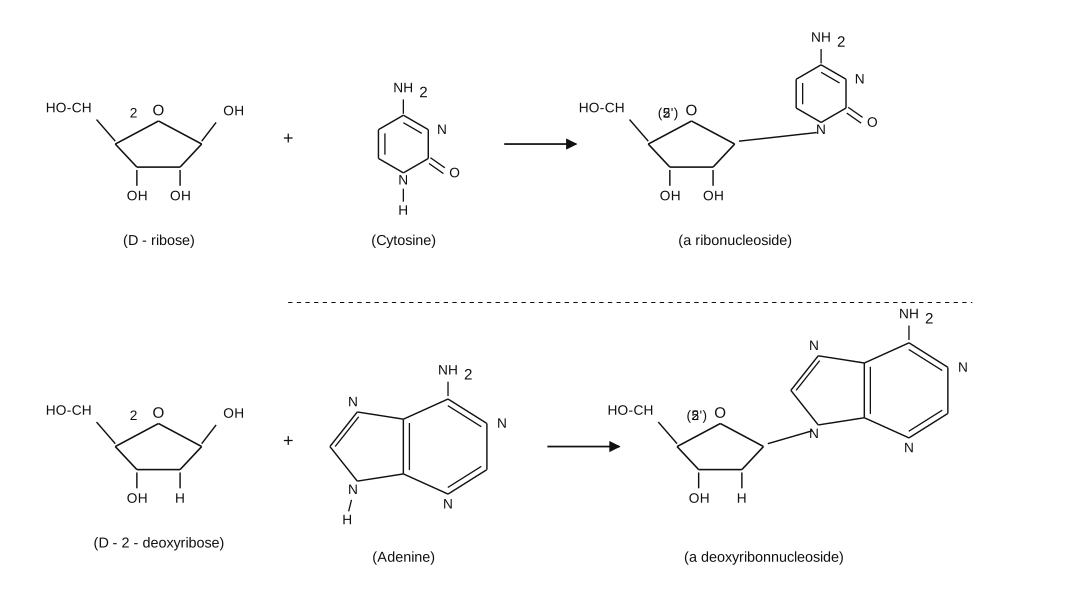
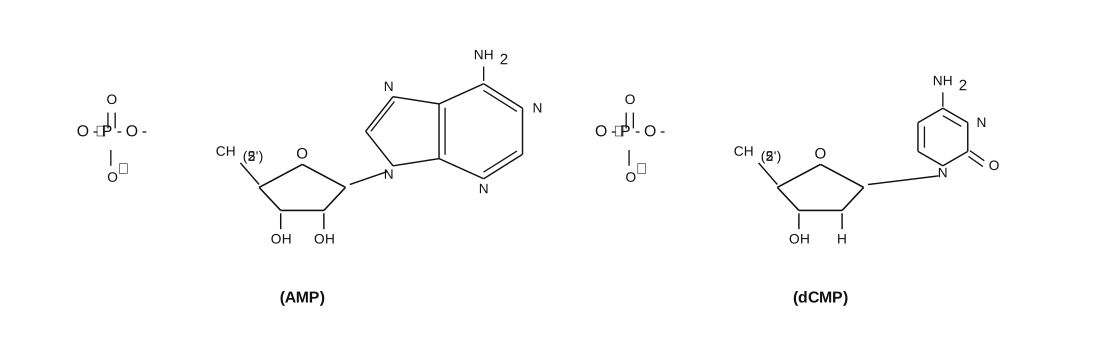
Nucleic acids -- both DNA and RNA -- are unbranched polymers built from repeating monomer units called nucleotides; because of this, nucleic acids are said to have a polynucleotide structure. The scale of this polymerisation is enormous: a single DNA molecule can contain several MILLION nucleotide units, while an RNA molecule typically contains a few THOUSAND. Each individual nucleotide monomer is itself built from exactly three distinct chemical components joined together: a five-membered-ring monosaccharide (a furanose sugar, often just called 'the sugar' component of the nucleotide), a nitrogen-containing base, and a phosphate group. The sugar component differs between the two nucleic acids: in RNA nucleotides the sugar is D-ribose (carrying -OH groups at both its C-2' and C-3' ring positions), while in DNA nucleotides the sugar is 2-deoxy-D-ribose (carrying an -OH only at C-3', with a plain hydrogen instead of an -OH at C-2' -- this single missing oxygen atom is the entire chemical difference between the two sugars, and is exactly what the 'deoxy' in DNA's full name, deoxyribonucleic acid, refers to). Five different nitrogen-containing bases occur across DNA and RNA nucleotides, falling into two structural families: three are single-ring bases derived from the parent heterocycle pyrimidine -- cytosine (C), uracil (U) and thymine (T) -- and two are double-ring (fused bicyclic) bases derived from the parent heterocycle purine -- adenine (A) and guanine (G). Uracil occurs ONLY in RNA nucleotides, and thymine occurs ONLY in DNA nucleotides (this single base substitution -- U in RNA where DNA instead uses T -- is, together with the sugar difference above, one of the two defining chemical differences between the two nucleic acids; see the Remember box: RNA contains D-ribose, A, G, C, U, while DNA contains D-2-deoxyribose, A, G, C, T). A nucleoside is the two-component unit formed by joining just the sugar and the base together: specifically, by joining the sugar's own anomeric carbon (C-1') to a nitrogen atom of the base, with loss of a water molecule. Because sugar-ring positions and base-ring positions both use plain numbers, sugar-ring atom numbers in a nucleoside are conventionally written with a prime symbol (') to keep them clearly distinguished from the base's own (unprimed) numbering. The precise nitrogen atom of the base used in this bond depends on which family the base belongs to: a pyrimidine base (cytosine, uracil or thymine) bonds through the nitrogen at its own ring-position 1 (N-1); a purine base (adenine or guanine) bonds instead through the nitrogen at its own ring-position 9 (N-9) -- in both cases, always to the sugar's C-1'. Finally, a nucleotide is formed from a nucleoside by adding one further component, a phosphate group, esterified onto the sugar's 5'-OH position; because of this, nucleotides are, chemically, simply the 5'-monophosphate esters of the corresponding nucleosides. This full three-p …
Drawn by us to help you understand the concept clearly, and verified to make sure it's accurate. For exams, practice from your textbook's own diagram.
What this figure shows. Two five-membered furanose ring structures drawn side by side, each ring numbered C-1 through C-5 with the exocyclic -CH2OH (C-5') group and ring oxygen shown. D-ribose (present in RNA) carries an -OH group at BOTH C-2 and C-3 of the ring. 2-Deoxy-D-ribose (present in DNA) carries an -OH only at C-3 -- the C-2 position instead carries a plain -H (labelled 'No OH at C-2' in the figure) -- this single missing oxygen at C-2 is the entire chemical difference between the RNA and DNA sugar, …
Drawn by us to help you understand the concept clearly, and verified to make sure it's accurate. For exams, practice from your textbook's own diagram.
What this figure shows. Two parent heterocycles with their derived bases. Pyrimidine (the parent, a single six-membered ring with two ring nitrogens at positions 1 and 3) gives rise to three bases: cytosine (C), with an -NH2 group at C-4 and a ring C=O at C-2; thymine (T), with ring C=O groups at C-2 and C-4 and a -CH3 group at C-5; and uracil (U), identical to thymine but WITHOUT the C-5 methyl group. Purine (the parent, a fused six-membered + five-membered bicyclic ring with four ring nitrogens, numbered 1-9) gives rise to two bases: adenine (A), with an -NH2 group at C-6; and guanine (G), with a ring C=O at C-6 and an -NH2 group at C-2. A 'Remember' box alongside states plainly: R …
Drawn by us to help you understand the concept clearly, and verified to make sure it's accurate. For exams, practice from your textbook's own diagram.
What this figure shows. Two worked examples of nucleoside formation, each showing a furanose sugar reacting with a base by loss of water to join the sugar's anomeric C-1' directly to a ring nitrogen of the base. Example 1: D-ribose + cytosine (joined through cytosine's ring N-1, the pyrimidine numbering convention) gives a ribonucleoside, with the sugar ring positions relabelled 1' through 5' to distinguish them from the base's own unprimed numbering. Example 2: 2-deoxy-D-ribose + adenine (joined through adenine's ring N-9, the purine numbering convention) gives a deoxyribonucleoside. The general rule illustrated: pyrimidine bases bond through their N- …
Drawn by us to help you understand the concept clearly, and verified to make sure it's accurate. For exams, practice from your textbook's own diagram.
What this figure shows. Two complete nucleotide structures. AMP (adenosine monophosphate): a D-ribose ring (with free -OH at C-2' and C-3') carrying adenine at C-1' (via N-9) and a single phosphate group esterified onto the C-5' -OH, drawn as O-P(=O)(OH)-O-CH2- leading into the ring. dCMP (deoxycytidine monophosphate): a 2-deoxy-D-ribose ring (only C-3' -OH free, no C-2' -OH) carrying cytosine at C-1' (via N-1) and likewise a single phosphate group esterified onto the C-5' -OH. Comparing the two side by side shows exactly how the 'd' prefix (deoxyribose sugar) and the base identity are the only two structural variables distinguishing one nucleotide from anoth …