Chemistry · Ch 14 — Biomolecules
Nucleic acids
Nucleic acids
Nucleic acids are the third and final class of biomolecule studied in this chapter, and are distinguished from carbohydrates and proteins by their unique biological role: they are the molecules responsible for storing and transmitting an organism's GENETIC information. One of the most remarkable properties any living cell has is its ability to produce faithful replicas of itself across thousands of successive generations -- and this is possible only because a certain kind of information, the genetic information specifying how to build and run the organism, is copied and passed on essentially unchanged from each generation of cells to the next; nucleic acids are precisely the molecules that accomplish this transfer. There are two distinct types of nucleic acid: ribonucleic acid (RNA), found predominantly in the fluid interior (cytoplasm) of living cells, and deoxyribonucleic acid (DNA), found predominantly within the nucleus of living cells. Understanding the detailed chemical STRUCTURE of these two nucleic acids -- the goal of the rest of this section -- is the essential …
Worked out. Explains the chain of genetic organisation: synthesis of protein, the body's fundamental structural material, is the process by which genetic information is put to use, and DNA governs this process. DNA resides in the chromosomes of the cell nucleus; each chromosome carries a different, specific type of DNA; an individual chromosome is made up of many genes; and a gene is defined as the portion of a DNA molecule responsible for the synthesis of one single protein. In short: DNA stores the genetic information, while RNA translates that stored information into the actual synthesis of the proteins the cell needs to function and develop -- summarised …
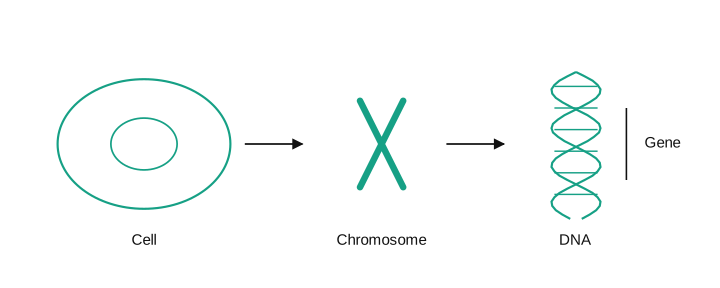
Drawn by us to help you understand the concept clearly, and verified to make sure it's accurate. For exams, practice from your textbook's own diagram.
Where DNA lives. Inside every cell's nucleus sit the chromosomes; each is a tightly-packed DNA double helix. A gene is a stretch of that DNA carrying the instructions for a single protein — the chapter's storage-and-transfer of gen …