Chemistry · Ch 14 — Biomolecules
Structure of nucleic acids
Structure of nucleic acids
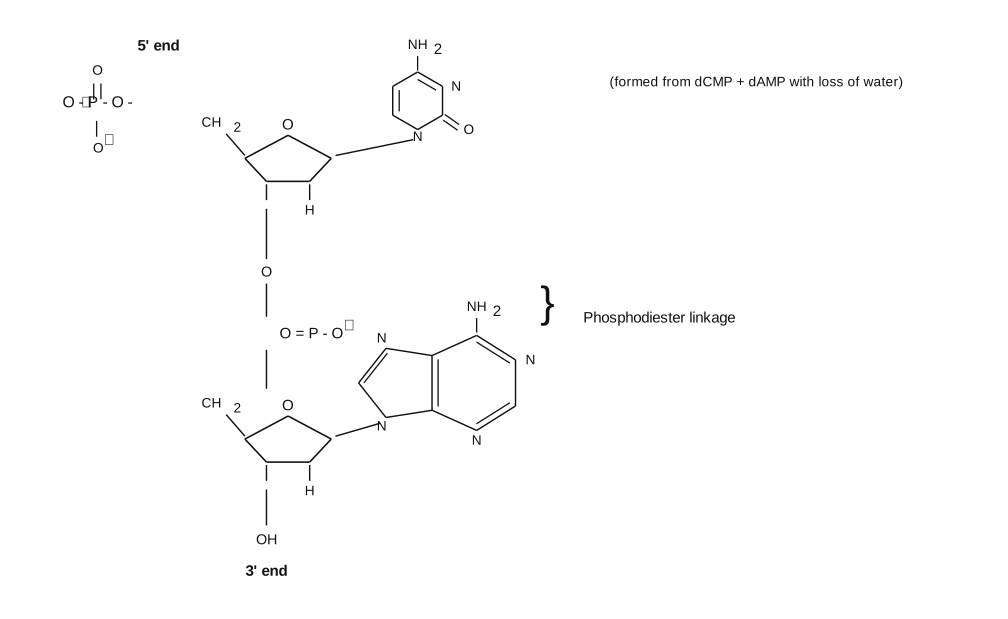
Both DNA and RNA are true polymers of their nucleotide monomer units, built by repeatedly joining the free 3'-OH group on one nucleotide's sugar to the free 5'-phosphate group of the NEXT nucleotide in the chain -- this specific type of ester-to-ester linking bond, bridging through the shared phosphate group, is called a phosphodiester linkage, and its repetition, over and over, is what builds up the long sugar-phosphate 'backbone' running the length of every nucleic acid strand. Because this joining reaction has a clear direction (always 3'-of-one to 5'-of-the-next), the two ends of any finished polynucleotide chain are chemically DISTINCT from one another, exactly as the two ends of a polypeptide chain are (section 14.3.2): the end of the chain where a phosphate group remains completely free (not linked onward to a further nucleotide) is called the chain's 5' end, while the opposite end, where a sugar's -OH group remains free at the 3' position, is called the chain's 3' end. The primary structure of any given nucleic acid molecule is, exactly analogous to a protein's primary structure, simply the SEQUENCE in which its nucleotide units occur along the chain -- and because every nucleotide in a given nucleic acid shares an identical sugar-phosphate backbone unit, this sequence is entirely and only determined by the sequence of BASES carried by the successive nucleotides; different nucleic acid molecules are consequently distinguished from one another purely by their distinct base sequences. Polynucleotide chains are conventionally named and written out by listing the one-letter symbols of their bases in order, always starting …
Drawn by us to help you understand the concept clearly, and verified to make sure it's accurate. For exams, practice from your textbook's own diagram.
What this figure shows. Shows dCMP (deoxycytidine monophosphate: 2-deoxyribose + cytosine + 5'-phosphate) and dAMP (deoxyadenosine monophosphate: 2-deoxyribose + adenine + 5'-phosphate) condensing together: the free 3'-OH of the dCMP sugar attacks the 5'-phosphate group of dAMP, losing a water molecule and forming a new phosphate-diester bridge directly connecting the two sugar rings -- labelled the 'phosphodiester linkage'. The resulting dinucleotide has one free phosphate remaining at its 5' end (from the dCMP side) and one free -OH remaining at its 3' end (from the dAMP side), matching the general 5 …
Drawn by us to help you understand the concept clearly, and verified to make sure it's accurate. For exams, practice from your textbook's own diagram.
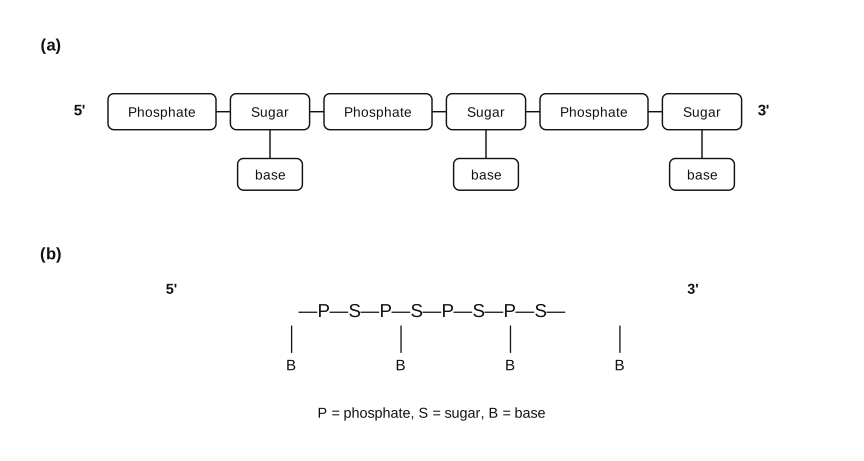
What this figure shows. Two increasingly abstracted schematics of the same repeating polynucleotide chain. (a) A more pictorial version: alternating 'Phosphate' and 'Sugar' blocks forming the 'sugar-phosphate backbone' running vertically, with a 'base' block hanging off each sugar, the chain explicitly labelled with its 5' end at the bottom and 3' end at the top. (b) A fully abstracted version: the same chain reduced to a repeating P-S-P-S-P-S backbone (P = phosphate, S = sugar) with a base (B) hanging off each S, again labelled 5' and 3' at the two ends -- this P-S-P-S shorthand is exactly what MCQ vi (section 14.4.3-adjacent exercises) tests as a featur …
Worked out. Worked problem: draw a schematic representation of the trinucleotide segment 'ACT' of a DNA molecule. Solution: in DNA the sugar is always deoxyribose; reading the segment name from its 5' end, base A (adenine) sits at the 5' end and base T (thymine) sits at the 3' end, with C (cytosine) in the middle. The schematic is drawn as three deoxyribose-sugar units in a row, each carrying its base (A, then C, then T, left to right) and linked by phosphate groups via phosphodiester bonds, with the free 5' end (phosphate) on the A side and the free 3' end (-OH) on the T side -- directly applying the P-S-P-S-with-bases schematic of Fig …
Worked out. Five summary facts about nucleic-acid structure: a nucleic acid's backbone consists of alternating sugar and phosphate groups; the backbone of every DNA molecule contains the sugar 2-deoxy-D-ribose, while every RNA molecule's backbone contains D-ribose; it is specifically the identity and sequence of the BASES (not the identical backbone) that distinguishes one polynucleotide from another; every polynucleotide has one free phosphate group at its 5' end; and every polynucleotide has a free …