Chemistry · Ch 6 — Chemical Kinetics
Graphical description of effect of temperature
Graphical description of effect of temperature
It has been realized that the average kinetic energy of molecules is proportional to temperature. The collision theory suggests a bimolecular reaction occurs only if the reacting molecules have sufficient kinetic energies (at least ) and proper orientation when they collide.
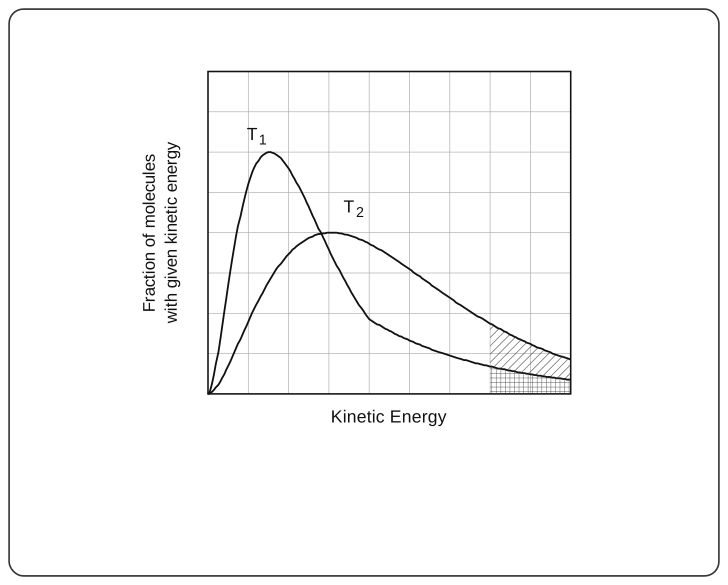
At a given temperature, the fraction of molecules with their kinetic energy equal to or greater than may lead to the product. With an increase of temperature, the fraction of molecules having their energies equal to or greater than increases, and the rate of the reaction thus increases. This is depicted by plotting the fraction of molecules with a given kinetic energy versus kinetic energy for two different temperatures and ( being ) in Fig. 6.9.
Drawn by us to help you understand the concept clearly, and verified to make sure it's accurate. For exams, practice from your textbook's own diagram.
What this figure shows. Each curve gives the fraction of molecules having a particular kinetic energy: at the lower temperature T₁ the curve peaks high and early; at the higher temperature T₂ () it is flatter and shifted toward higher energies. The total area under each curve — the total number of molecules — is the same. The two hatched areas under the far right tail are the fractions of molecules whose kinetic energy exceeds at the two temperatures: the **T₂ area is …
…