Chemistry · Ch 6 — Chemical Kinetics
Instantaneous rate of reaction
Instantaneous rate of reaction
The book's own printed heading for this subsection reads "6.2.2 Instantaneous rate of :" — the word "reaction" is missing in the print. The title above completes it the way the subsection's own first sentence does.
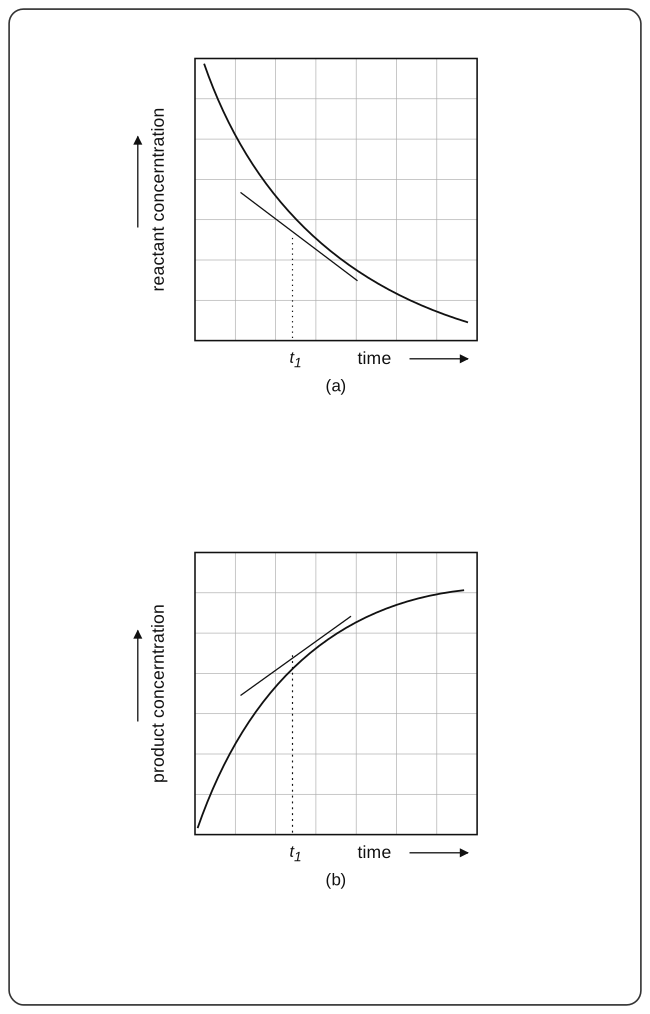
To determine the instantaneous rate of a reaction, the progress of the reaction is followed by measuring the concentrations of a reactant or product at different time intervals. The changes in concentration are relatively fast in the beginning and later become slow. The concentration of a reactant or a product plotted against time is shown in Fig. 6.1 (a) and 6.1 (b).
Drawn by us to help you understand the concept clearly, and verified to make sure it's accurate. For exams, practice from your textbook's own diagram.
What this figure shows. Panel (a) plots reactant concentration against time: the curve falls steeply at first and then flattens — the changes in concentration are fast in the beginning and slow later. Panel (b) plots product concentration, rising and then saturating. In each panel a dotted vertical line marks the instant , and the short straight line crossing the curve there is the tangent — its slope is the instantaneous rate of the reaction at . *(The book's own rotated axis labels print the word as "concerntration" i …
A tangent drawn to the curve at time gives the rate of the reaction at that instant: its slope is the instantaneous rate at . The instantaneous rate is represented by replacing of the average rate by the derivative . In chemical kinetics we are concerned with instantaneous rates.
For the reaction ,
In the second line the book itself prints the mixed form — a derivative numerator over a finite-difference denominator. It is reproduced above exactly as printed; the intended quantity is , as the book's own third line confirms.
For a reaction involving one mole of A and B each, the rate of consumption of A equals the rate of formation of B. This is not true for reactions involving different stoichiometries. Consider, for example, a reaction:
When one mole of A and three moles of B are consumed, two moles of C are formed. The stoichiometric coefficients of the three species are different: the rate of consumption of B is three times the rate of consumption of A, and the rate of formation of C is twice the rate of consumption of A. We write
With this,
…