Chemistry · Ch 9 — Coordination Compounds
Stereoisomers
Stereoisomers
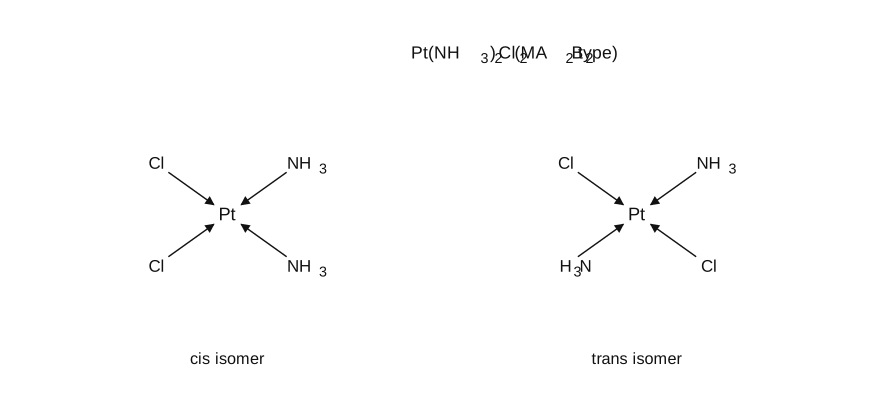
Stereoisomers share identical bonding connectivity but differ in spatial arrangement, and coordination chemistry recognises two kinds. (a) Geometric isomers (diastereoisomers) occur specifically in HETEROLEPTIC complexes (more than one type of ligand present) and are described using the cis/trans convention: in the cis isomer, identical ligands occupy positions adjacent to each other, while in the trans isomer, identical ligands occupy positions directly opposite each other. This cis-trans distinction shows up in both square planar and octahedral geometries. Square planar complexes of the general types MA2B2 (e.g. Pt(NH3)2Cl2, whose cis form is the anticancer drug cisplatin) and MA2BC (e.g. [Pt(NH3)(H2O)Cl2]) both exist as cis and trans isomers; four-coordinate TETRAHEDRAL complexes, by contrast, never show cis-trans isomerism at all, because all four positions around a tetrahedron are geometrically equivalent to each other. Octahedral complexes of types MA4B2 (e.g. [Co(NH3)4Cl2]+), MA4BC (e.g. [Pt(NH3)4ClBr]2+) and M(AA)2B2, where (AA) denotes a bidentate ligand (e.g. [Co(en)2Cl2]+), likewise all show cis and trans forms. The cis and trans isomers of a given complex can have genuinely different physical and chemical properties -- cisplatin's cis form is more water-soluble than its trans form, is the biologically active anticancer drug, and, because its two Pt-NH3 and two Pt-Cl bond dipoles do NOT cancel in the adjacent cis geometry, is polar (non-zero net dipole moment); the trans form is physiologically inactive, and because its two Pt-Cl bond dipoles point in exactly opposite directions (and likewise its two Pt-NH3 dipoles), those dipoles cancel exactly, giving the trans isomer a net dipole moment of zero. (b) Optical isomers (enantiomers) are complex ions or molecules that are non-superimposable mirror images of one another -- 'chiral', in the same sense that a person's left and right hands are non-superimposable mirror images. Enantiomers share identical chemical and physical properties EXCEPT for how they interact with plane-polarised light: the isomer that rotates the plane of polarised light clockwise (to the right) is called the dextro or 'd' isomer, and the one that rotates it anticlockwise (to the left) is called the laevo or 'l' isomer. Chirality in octahedral complexes shows up for tris-chelate complexes like [Co(en)3]3+ and [Cr(ox)3]3- (homoleptic, all three bidentate ligands wound the same way, like a propeller), and for the CIS form specifically of M(AA)2B2-type complexes like [Co(en)2Cl2]+ and [PtC …
Drawn by us to help you understand the concept clearly, and verified to make sure it's accurate. For exams, practice from your textbook's own diagram.
What this figure shows. Two square planar arrangements around Pt(II). Cis isomer: the two NH3 ligands occupy adjacent corners of the square (90 degrees apart) and the two Cl ligands occupy the other two adjacent corners. Trans isomer: the two NH3 ligands sit diagonally opposite each other (180 degrees apart, across the metal), and the two Cl ligands likewise sit diagonally opposite each other. …
![Fig. 9.7.1c — Cis and trans isomers of octahedral [Co(NH3)4Cl2]+ (MA4B2 type): the two chlorides at 90 degrees in the cis isomer and at 180 degrees in the trans isomer.](/figures/mh-chem-coordination-compounds/cis-trans-isomers-co-nh3-4-cl2-octahedral-uncaptioned-p198.svg)
Drawn by us to help you understand the concept clearly, and verified to make sure it's accurate. For exams, practice from your textbook's own diagram.
What this figure shows. Two octahedral arrangements around Co(III), with four NH3 and two Cl- ligands. Cis isomer: the two Cl- ligands occupy adjacent octahedral positions, 90 degrees apart. Trans isomer: the two Cl- ligands occupy opposite octahedral positions, 180 degrees apart, with the four NH3 filling the equatorial plane between them. …
![Fig. 9.7.1b — Cis and trans isomers of square planar [Pt(NH3)(H2O)Cl2] (MA2BC type), distinguished by whether the two chlorides sit adjacent or opposite.](/figures/mh-chem-coordination-compounds/cis-trans-isomers-pt-nh3-h2o-cl2-square-planar-uncaptioned-p198.svg)
Drawn by us to help you understand the concept clearly, and verified to make sure it's accurate. For exams, practice from your textbook's own diagram.
What this figure shows. Two square planar arrangements around Pt(II), with two Cl (identical, A), one NH3 (B) and one H2O (C) ligand. Cis isomer: the two Cl ligands occupy adjacent corners of the square. Trans isomer: the two Cl ligands occupy diagonally opposite corners of the square, with NH3 and H2O filling the remaining two adjacent corners. …
![Fig. 9.7.1f — The d and l enantiomers of [Co(en)3]3+ drawn either side of a mirror plane - non-superimposable mirror images built from three en chelate rings.](/figures/mh-chem-coordination-compounds/d-l-enantiomers-co-en-3-octahedral-uncaptioned-p199.svg)
Drawn by us to help you understand the concept clearly, and verified to make sure it's accurate. For exams, practice from your textbook's own diagram.
What this figure shows. An octahedral Co(III) ion bound to three bidentate en ligands, each spanning two adjacent octahedral positions (a homoleptic tris-chelate complex). Because all three chelate rings are arranged with the same 'twist' (like the blades of a propeller), the whole ion is chiral even though every ligand is identical; it exists as two non-superimposable mirror-image forms …
Worked out. Our own two hands are non-superimposable mirror images of each other -- when a left hand is held up to a mirror, its reflection looks exactly like a right hand, yet the real left and right hands can never be placed exactly on top of one another. This is the same relationship that defines a pair of enantiomers in coordination …
![Fig. 9.7.1d — Cis and trans isomers of octahedral [Pt(NH3)4ClBr]2+ (MA4BC type), with chloride and bromide adjacent (cis) or on opposite vertices (trans).](/figures/mh-chem-coordination-compounds/cis-trans-isomers-pt-nh3-4-clbr-octahedral-uncaptioned-p198.svg)
Drawn by us to help you understand the concept clearly, and verified to make sure it's accurate. For exams, practice from your textbook's own diagram.
Cis and trans isomers of octahedral [Pt(NH3)4ClBr]2+ (MA4BC type), with chloride and bromide adjacent (cis) or on opposite vertices (trans). Drawn by us from the textbook's own printed facts and verified elem …
![Fig. 9.7.1e — Cis and trans isomers of octahedral [Co(en)2Cl2]+ (M(AA)2B2 type) drawn with curved en chelate arcs and the two chloride ligands adjacent or trans.](/figures/mh-chem-coordination-compounds/cis-trans-isomers-co-en-2-cl2-octahedral-uncaptioned-p198.svg)
Drawn by us to help you understand the concept clearly, and verified to make sure it's accurate. For exams, practice from your textbook's own diagram.
Cis and trans isomers of octahedral [Co(en)2Cl2]+ (M(AA)2B2 type) drawn with curved en chelate arcs and the two chloride ligands adjacent or trans. Drawn by us from the textbook's own printed facts and verified ele …
![Fig. 9.7.1g — The d and l enantiomers of the cis isomer of [PtCl2(en)2]2+ across a mirror plane; only the cis form is chiral.](/figures/mh-chem-coordination-compounds/d-l-enantiomers-cis-ptcl2-en-2-uncaptioned-p199.svg)
Drawn by us to help you understand the concept clearly, and verified to make sure it's accurate. For exams, practice from your textbook's own diagram.
The d and l enantiomers of the cis isomer of [PtCl2(en)2]2+ across a mirror plane; only the cis form is chiral. Drawn by us from the textbook's own printed facts and verified element- …
![Fig. 9.7.1h — The trans isomer of [PtCl2(en)2]2+ with the two chlorides on the vertical axis and the two en chelate rings equatorial - superimposable on its mirror image, hence optically inactive.](/figures/mh-chem-coordination-compounds/trans-ptcl2-en-2-octahedral-uncaptioned-p199.svg)
Drawn by us to help you understand the concept clearly, and verified to make sure it's accurate. For exams, practice from your textbook's own diagram.
The trans isomer of [PtCl2(en)2]2+ with the two chlorides on the vertical axis and the two en chelate rings equatorial - superimposable on its mirror image, hence optically inactive. Drawn by us from the textbook's own printed facts and verifi …