Chemistry · Ch 5 — Electrochemistry
Electrolysis of molten NaCl
Electrolysis of molten NaCl
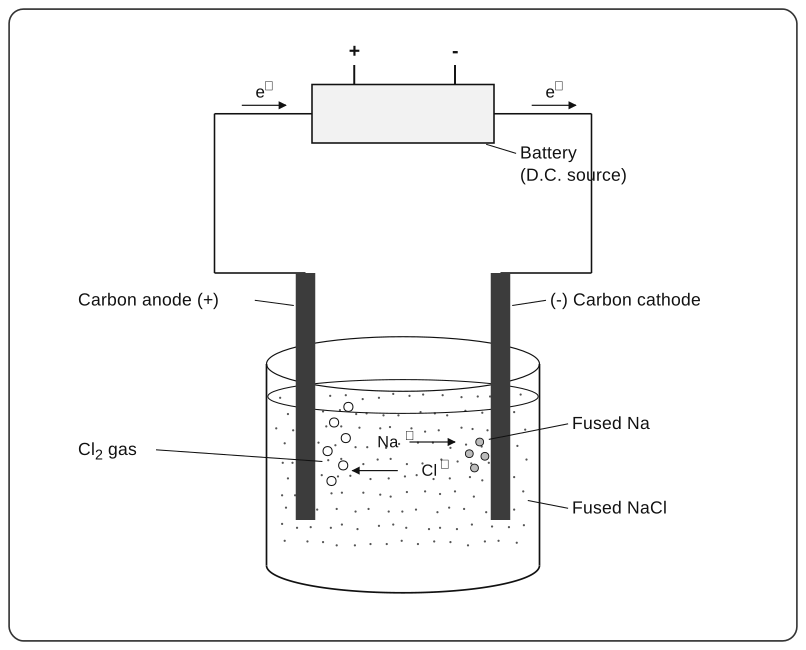
Construction of cell : The electrolytic cell consists of a container in which fused (molten) NaCl is placed. Two graphite electrodes are immersed in it, connected by metallic wires to a source of direct current — a battery. This is shown in Fig. 5.4.
Drawn by us to help you understand the concept clearly, and verified to make sure it's accurate. For exams, practice from your textbook's own diagram.
What this figure shows. The battery (D.C. source) at the top pumps electrons (the e⊖ arrows on both wires) out of the carbon anode (+) and into the (-) carbon cathode. In the fused NaCl melt, the ion-migration arrows show Na⁺ moving toward the cathode (where it is reduced to fused Na) and Cl⊖ moving toward the anode (where Cl₂ gas is evolve …
The carbon electrode connected to the positive terminal of the battery is the anode, and that connected to the negative terminal of the battery is the cathode.
Remember...
In electrolysis the electrodes are usually inert, Pt or graphite.
Reactions occurring in the cell : Fused NaCl contains and ions which are freely mobile. When potential is applied, the cathode attracts ions and the anode attracts ions. As these are charged particles, their migration results in an electric current. When the ions reach the respective electrodes they are discharged according to the following reactions.
Oxidation half reaction at anode : ions migrate to the anode. Each ion that reaches the anode gives one electron to the anode and oxidises to a neutral Cl atom in the primary process; two Cl atoms then combine to form chlorine gas in the secondary process.
The battery sucks the electrons produced at the anode and pushes them to the cathode through a wire in the external circuit — the battery thus serves as an electron pump. The electrons from the battery enter the solution through the cathode and leave the solution through the anode.
Reduction half reaction at cathode : The electrons supplied by the battery are used in the cathodic reduction. Each ion that reaches the cathode accepts an electron from the cathode and reduces to metallic sodium:
Net cell reaction — the net cell reaction is the sum of the two electrode reactions:
Results of electrolysis of molten NaCl …