Chemistry · Ch 5 — Electrochemistry
Hydrogen-oxygen fuel cell
Hydrogen-oxygen fuel cell
In the - fuel cell, the fuel is hydrogen gas and oxygen gas is the oxidising agent. The energy of the combustion of hydrogen is converted into electrical energy.
Drawn by us to help you understand the concept clearly, and verified to make sure it's accurate. For exams, practice from your textbook's own diagram.
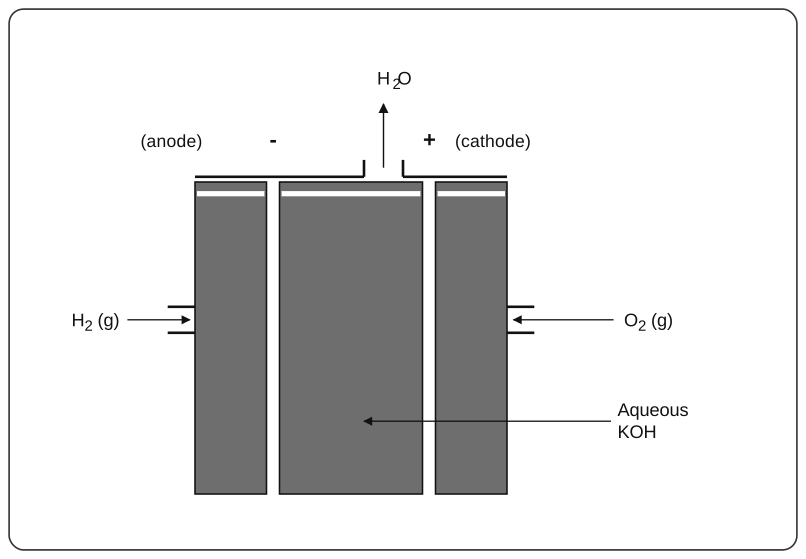
What this figure shows. The flat schematic of the - fuel cell: H₂ (g) enters at the left past the porous-carbon (anode) - bar, O₂ (g) enters at the right past the + (cathode) bar, the central compartment holds the aqueous KOH electrolyte, and the product water H₂O leaves through the top (up-arrow). The reactant …
Construction : The anode and cathode are porous carbon rods containing a small amount of finely divided platinum metal that acts as a catalyst. The electrolyte is a hot aqueous solution of KOH, in which the carbon rods are immersed, as shown in Fig. 5.10. Hydrogen gas is continuously bubbled through the anode, and oxygen gas through the cathode, into the electrolyte.
Cell reactions
i. Oxidation at anode (-) : At the anode, hydrogen gas is oxidised to :
ii. Reduction at cathode (+) : The electrons released at the anode travel through the external circuit to the cathode, where is reduced to :
iii. Net cell reaction : The overall cell reaction is the sum of the electrode reactions (i) and (ii):
The overall cell reaction is the combustion of to form liquid water. Interestingly, the fuel gas and the oxidant do not react directly: the chemical energy released during the formation of the O-H bond is directly converted into electrical energy accompanying the above combustion reaction. The cell continues to operate as long as and gases are supplied to the electrodes.
The cell potential is given by
Advantages of fuel cells
i. The reacting substances are continuously supplied to the electrodes. Unlike conventional galvanic cells, fuel cells do not have to be discarded on consuming of the chemicals.
ii. They are nonpolluting, as the only reaction product is water.
iii. Fuel cells provide electricity with an efficiency of about 70 %, which is twice as large when compared with the efficiency of thermal plants (only 40 %).
Drawbacks of fuel cell
gas is hazardous to handle, and the cost of preparing is high.
Applications of fuel cells …