Chemistry · Ch 5 — Electrochemistry
Standard hydrogen electrode (SHE)
Standard hydrogen electrode (SHE)
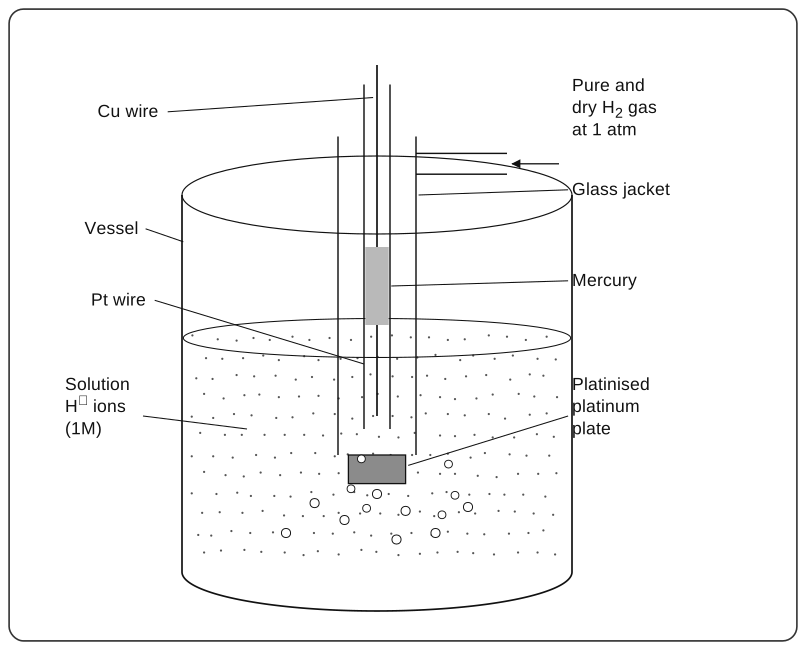
Construction : SHE consists of a platinum plate coated with platinum black, used as the electrode. This plate is connected to the external circuit through a sealed narrow glass tube containing mercury, and is surrounded by an outer glass jacket. The platinum electrode is immersed in a 1 M ion solution, which is kept saturated with dissolved by bubbling hydrogen gas under 1 atm pressure through the side tube of the jacket, as shown in Fig. 5.6. Platinum does not take part in the electrode reaction — it is an inert electrode and serves as the site for electron transfer.
Drawn by us to help you understand the concept clearly, and verified to make sure it's accurate. For exams, practice from your textbook's own diagram.
What this figure shows. The SHE assembly: the platinised platinum plate dips in the solution of H⊕ ions (1M) held in the vessel; pure and dry H₂ gas at 1 atm enters through the side tube of the glass jacket and bubbles over the plate; electrical contact runs from the plate up the Pt wire, through the mercury in the sealed narrow tube, to the external Cu wire. The two printed conditions — 1 M and 1 atm — are exactly the …
Formulation : The standard hydrogen electrode is represented as
Electrode reaction : The platinum black, capable of adsorbing large quantities of gas, allows the change from the gaseous to the ionic form and the reverse process to occur. The reduction half reaction at the electrode is
Application of SHE
SHE is used as a primary reference electrode to determine the standard potentials of other electrodes.
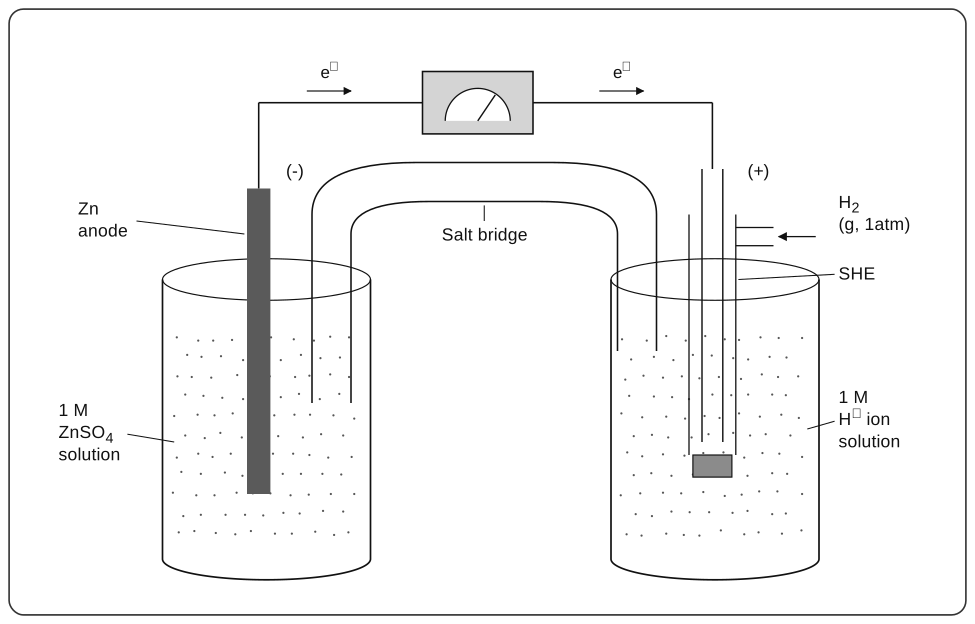
To determine the standard potential of , it is combined with SHE to form the cell
This is shown in Fig. 5.7.
Drawn by us to help you understand the concept clearly, and verified to make sure it's accurate. For exams, practice from your textbook's own diagram.
What this figure shows. The cell : the Zn anode (-) in 1 M ZnSO₄ solution on the left, the SHE (+) with H₂ (g, 1atm) in 1 M H⊕ ion solution on the right, joined by the salt bridge, with the e⊖ arrows showing electron flow through the meter from anode to cathode. The measured emf equals the standard potential of the zinc electrode because the SHE contributes zero. *( …
The standard cell potential is measured. , because is zero. Thus the measured emf of the cell is equal to the standard potential of the electrode (with reversed sign).
Difficulties in setting SHE
i. It is difficult to obtain pure and dry hydrogen gas.
ii. The pressure of hydrogen gas cannot be maintained exactly at 1 atm throughout the measurement.
iii. The concentration of the ion solution cannot be exactly maintained at 1 M. Due to bubbling of gas into the solution, evaporation of water may take place; this results in changing the concentration of the solution.
Hydrogen gas electrode …