Q.Bond dissociation enthalpy of F (158.8 KJ mol) is lower than that of Cl (242.6 KJ mol) Why ?
[!NOTE]
The unit is printed "KJ mol" (capital K) and the stem runs straight into "Why ?" with no punctuation before it -- both the book's own style, transcribed as printed.
The unit is printed "KJ mol" (capital K) and the stem runs straight into "Why ?" with no punctuation before it -- both the book's own style, transcribed as printed.
You're viewing a preview — the full solution, concept, methods & PYQ mapping are locked.
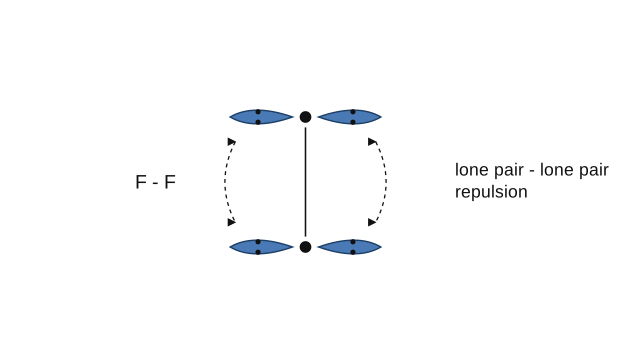
Start your 14-day free trial to unlock the full solution →Fluorine's small atomic size brings the two atoms' lone pairs into strong mutual repulsion, weakening the F - F bond (158.8 kJ mol); in the larger Cl the lone pairs are far apart, so the Cl - Cl bond is stronger (242.6 kJ mol).
Step 1. Fluorine has a smaller atomic size than chlorine, so in the F molecule the two nuclei -- and with them each atom's three lone pairs -- are held very close together.
Step 2. The lone pairs on each F atom are so close that they strongly repel each other; this repulsion works against the bonding attraction and makes the F - F bond weak, so less energy is required to break it. The textbook illustrates this inside the Problem box (its "Fig. 7.1"):
Unlock everything free for 14 days
- Full step-by-step solutions
- Concept-first explanations
- Methods, shortcuts & mistakes
- PYQ mapping + timed mock tests
Full access for 14 days. No credit card required.