Chemistry · Ch 16 — Green Chemistry and Nanochemistry
Reduce Derivatives (Minimization of Steps)
Reduce Derivatives (Minimization of Steps)
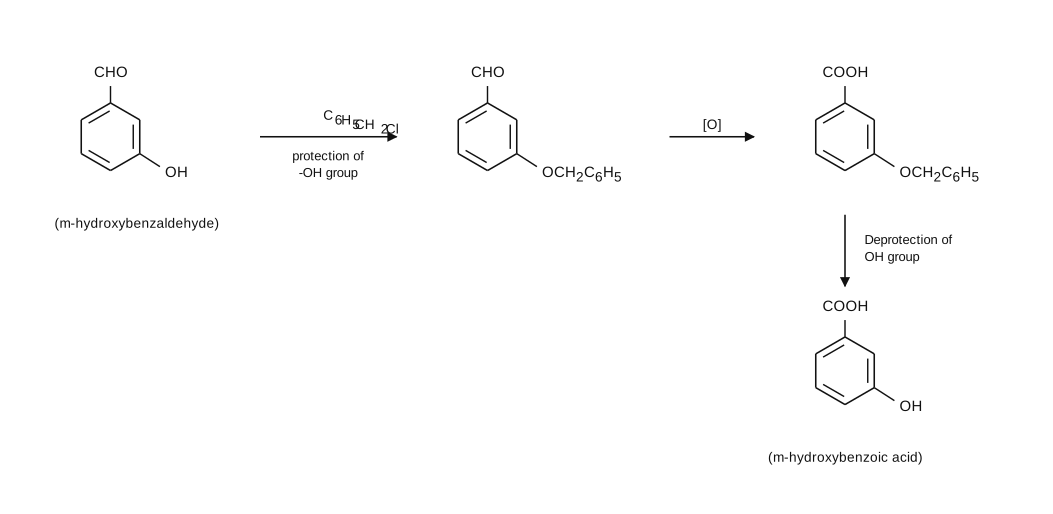
Organic synthesis commonly relies on protecting or blocking groups -- temporarily converting a reactive functional group into an unreactive one so that a different part of the molecule can be modified without side reactions, and then removing (deprotecting) that group again once it is no longer needed. This eighth principle asks chemists to minimise or avoid such unnecessary derivatisation wherever practicable, because every installation and removal of a protecting group is an additional reaction step that itself needs extra reagents and generates additional waste; unsurprisingly, a synthesis route with many such steps also tends to have poorer atom economy overall (Section 16.3.2), since atoms are being consumed by protecting/deprotecting reagents rather than ending up in the final product. The chapter's worked illustration is the synthesis of m-hydroxybenzoic acid from m-hydroxybenzaldehyde: the phenolic -OH group is first protected (by reaction with C6H5CH2Cl), the aldehyde (-CHO) group is then oxidised to a carboxylic acid (-COOH) using an oxidising agent [O], and finally the -OH-protecting group is removed again (deprotection) to reveal the free -OH group in the final product. Green chemistry's aim, wherever biocatalytic (enzy …
Drawn by us to help you understand the concept clearly, and verified to make sure it's accurate. For exams, practice from your textbook's own diagram.
What this figure shows. A three-step reaction scheme drawn to illustrate why unnecessary derivatisation should be minimised. Starting material m-hydroxybenzaldehyde (structure drawn with a -CHO group and a free phenolic -OH group on the benzene ring) is first treated with C6H5CH2Cl, which protects the -OH group by converting it to a -OCH2C6H5 (benzyl ether) group. The -CHO group of this protected intermediate is then oxidised with an oxidising agent, labelled [O], converting -CHO to -COOH while the protected -OCH2C6H5 group is left untouched. In the final step, the protecting group is removed again (deprotection of the OH group), regenerating the free phenolic -OH group alongside the newly formed -COOH group, giving the target product m-hydroxybenzoic acid. The scheme visually emphasises that reaching the target required two extra steps (protection and deprotection) purely to shield the -OH group during the oxidation step, which is exactly …