Chemistry · Ch 16 — Green Chemistry and Nanochemistry
Surface Area
Surface Area
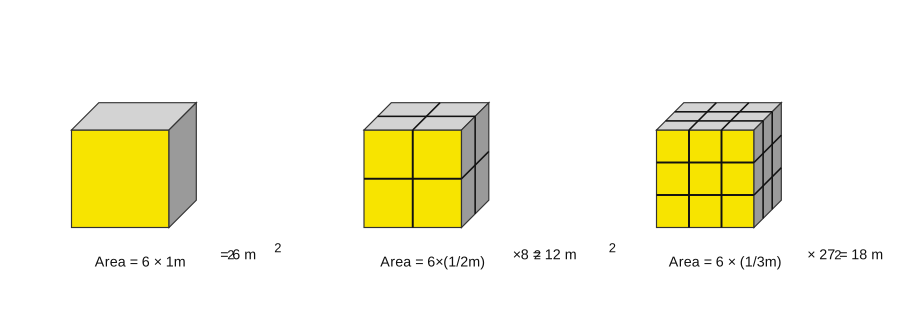
A high surface-area-to-volume ratio is one of the most important characteristics of nanoparticles. If a bulk material is progressively subdivided into a group of smaller and smaller individual particles, the total volume of material stays exactly the same throughout, but the collective surface area of all the pieces together increases enormously as subdivision continues -- because every new cut creates two new exposed surfaces where there had previously been none. With a much larger surface area available for the same total volume, small particles react considerably faster than the equivalent bulk material, because more surface area means more available reaction sites, which directly translates into greater chemical reactivity overall. The chapter illustrates this numerically by progressively cutting a 1 cubic-metre cube into smaller and smaller cubes, down to cubes of 1 cubic-nanometre, and tracking the total surface area at each stage: a single 1 m cube has a surface area of 6 x 1 m^2 = 6 m^2; cut into eight (1/2 m) cubes, the combined surface area rises to 6 x (1/2 m)^2 x 8 = 12 m^2; cut further into twenty-seven (1/3 m) cubes, it rises again to 6 x (1/3 m)^2 x 27 = 18 m^2 -- and this trend continues all the way down to the nanoscale, where the same starting volume of material ends up with an enormously lar …
Drawn by us to help you understand the concept clearly, and verified to make sure it's accurate. For exams, practice from your textbook's own diagram.
What this figure shows. A stepped diagram showing a 1 cubic-metre cube being progressively subdivided into smaller and smaller cubes, with the total surface area recalculated at each stage: the intact 1 m cube shows Area = 6 x 1 m^2 = 6 m^2; once cut into eight (1/2 m)-sided cubes, Area = 6 x (1/2 m)^2 x 8 = 12 m^2; and once cut further into twenty-seven (1/3 m)-sided cubes, Area = 6 x (1/3 m)^2 x 27 = 18 m^2. The diagram visually demonstrates that while the total volume of material stays fixed throughout, the total exposed surface area keeps growing every time the material is subdivided further, illustrating the basis of the high surface-to-volume ratio that …
Drawn by us to help you understand the concept clearly, and verified to make sure it's accurate. For exams, practice from your textbook's own diagram.
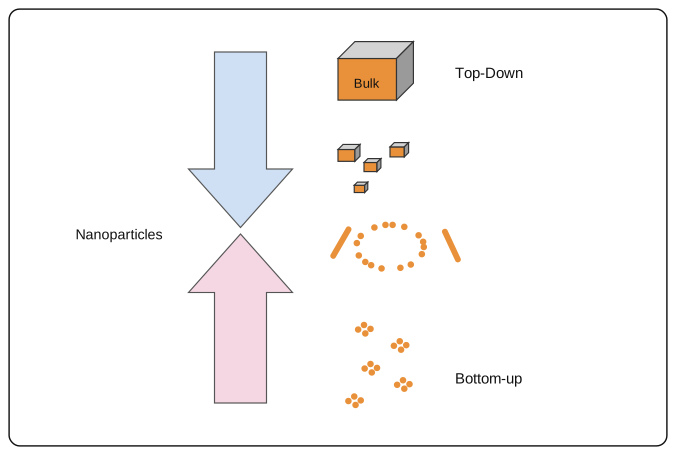
What this figure shows. A schematic diagram contrasting the two general approaches to nanoparticle synthesis discussed in Section 16.7.1. The top-down branch is drawn starting from a large bulk block of material and showing it being progressively broken down into smaller and smaller fragments, ending at nanoscale particles. The bottom-up branch is drawn in the opposite direction, starting from individual atoms or small molecules and showing them progressively assembling together -- atom by atom, molecule by molecule, cluster by cluster -- building up into a nanoscale particle. Placing the two schematics side by side visually emphasises that top-down and bottom-up reach the same nanoscale end point from opposite starting directions -- one by breaking bulk materia …