Chemistry · Ch 16 — Green Chemistry and Nanochemistry
Wet Chemical Synthesis -- Sol-Gel Process
Wet Chemical Synthesis -- Sol-Gel Process
The sol-gel process is a widely used wet-chemical method for synthesising nanomaterials, particularly oxide materials. A sol is a dispersion of colloidal particles (solid particles with diameters of 1-100 nm) in a liquid; a gel is an interconnected, rigid three-dimensional network with pores of sub-micrometre dimensions and polymeric chains whose average length exceeds a micrometre. The sol-gel process itself is based on inorganic polymerisation reactions, is generally carried out at room temperature, and proceeds through four broad steps: hydrolysis, polycondensation, drying, and thermal decomposition. The chapter gives the two key reactions involved. Hydrolysis: a metal alkoxide reacts with water, MOR + H2O -> MOH + ROH, converting the alkoxide group (OR) into a hydroxide group (OH) and releasing the corresponding alcohol (ROH). Condensation (polycondensation): two such hydroxylated metal centres then react together, MOH + ROM -> M-O-M + ROH, forming a metal-oxygen-metal (M-O-M) linkage and releasing more alcohol -- repeated many times over, this polycondensation reaction is what builds up the interconnected oxide/alcohol-bridged network that becomes the gel. The overall process runs through five stages: (1) forming a stable solution of the alkoxide or solvated metal precursor, (2) gelation, where a polycondensation reaction builds an oxide- or alcohol-bridged network (the gel itself), (3) ageing of the gel, during which the gel gradually transforms into a solid mass, (4) drying of the gel, in which water and other volatile liquids are removed from the gel's network, and (5) dehydration, …
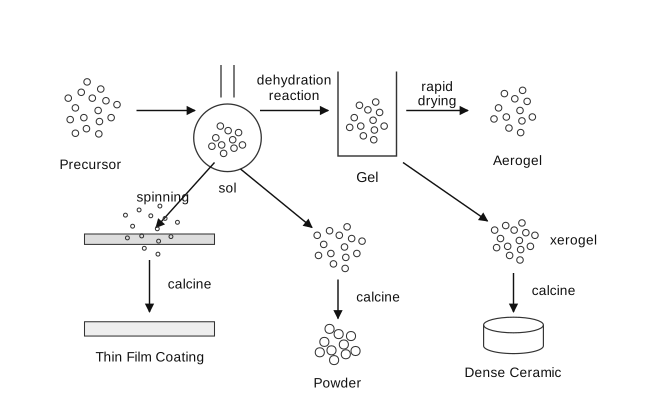
Drawn by us to help you understand the concept clearly, and verified to make sure it's accurate. For exams, practice from your textbook's own diagram.
What this figure shows. A schematic flow diagram tracing the sol-gel process from starting metal alkoxide/precursor solution through to a final nanostructured oxide material, visually laying out the sequence of stages described in the running text: formation of a stable precursor solution, gelation (via the hydrolysis and polycondensation reactions MOR + H2O -> MOH + ROH and MOH + ROM -> M-O-M + ROH), ageing of the gel into a solid mass, drying to remove volatile liquids, and finally thermal dehydration at temperatures up to 800 degrees Celsius to yield the finished …
Worked out. A short applied box noting that sol-gel processes are used in the motor vehicle industry specifically to produce water-repellent coatings for windscreens or exterior mirrors -- a concrete, everyday product application of the sol-gel synthesis method described in the main text of this section, showing the process is not purely a laboratory technique but has real commercial use. …