Chemistry · Ch 3 — Ionic Equilibria
Bronsted - Lowry theory
Bronsted - Lowry theory
J. N. Bronsted and T. M. Lowry (1923) proposed a more general theory known as the Bronsted-Lowry proton transfer theory. According to this theory acids and bases are defined as follows.
Acid : Acid is a substance that donates a proton () to another substance.
Base : Base is a substance that accepts a proton () from another substance.
For example :
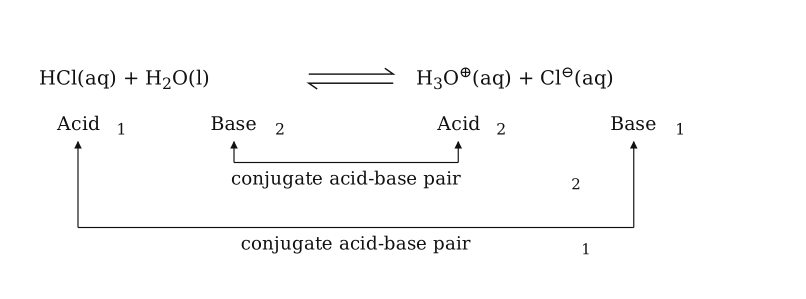
In the above reaction HCl and are proton donors and act as acids. The and are proton acceptors and act as bases. Further it follows that the products of the Bronsted-Lowry acid-base reactions are acids and bases. …
Drawn by us to help you understand the concept clearly, and verified to make sure it's accurate. For exams, practice from your textbook's own diagram.
What this diagram shows. The reaction with every species labelled by its Bronsted-Lowry role -- Acid under HCl, Base under HO, Acid under HO and Base under Cl. The inner connector joins Base and Acid as conjugate acid-base pair (water gains a proton to become hydronium); the longer outer connector joins Acid and Base as conjugate acid-base pair (HCl loses a proton to become Cl). Each pair dif …