Chemistry · Ch 3 — Ionic Equilibria
Lewis theory
Lewis theory
A more generalized acid-base concept was put forward by G. N. Lewis in 1923. According to this theory acids and bases are defined as follows.
Acid : Any species that accepts a share in an electron pair is called Lewis acid.
Base : Any species that donates a share in an electron pair is called Lewis base.
For example :
Drawn by us to help you understand the concept clearly, and verified to make sure it's accurate. For exams, practice from your textbook's own diagram.
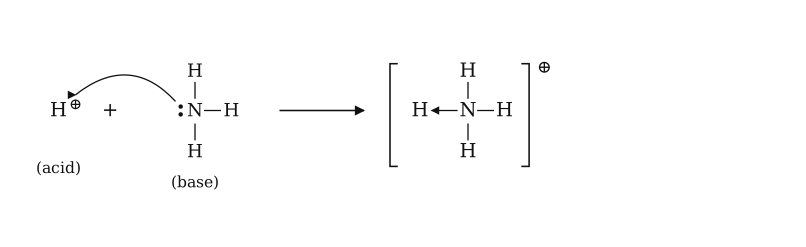
What this structural equation shows. (labelled acid) accepts a share in the lone pair of electrons on the nitrogen of (labelled base, drawn with explicit lone-pair dots). The curved arrow shows the electron pair moving from nitrogen to the proton; the product is drawn in square brackets with a left-pointing arrow () marking the new coordinate bond from N to H. This is the Lewis picture of an …
Drawn by us to help you understand the concept clearly, and verified to make sure it's accurate. For exams, practice from your textbook's own diagram.
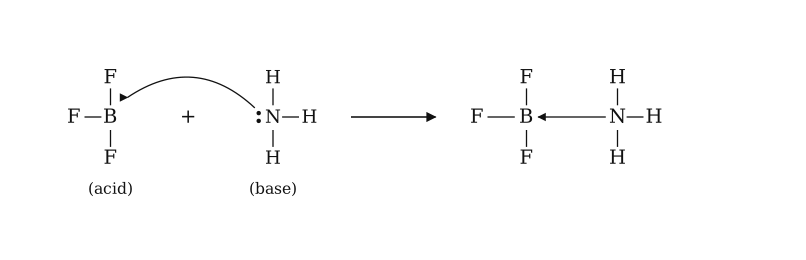
What this structural equation shows. (labelled acid) is electron-deficient -- its boron carries only six valence electrons -- so it accepts a share in the lone pair of (labelled base). The curved arrow shows the nitrogen lone pair attacking boron; the product adduct is drawn with a left-pointing arrow for the new coordinate (dative) bond from N to B. A Lewis acid need not contain hydrogen …
Amphoteric nature of water : Water has the ability to act as an acid as well as a base. Such behaviour is known as amphoteric nature of water. For example :
…