Chemistry · Ch 1 — Solid State
Crystalline solids
Crystalline solids
Crystalline solids possess three characteristic properties that set them apart. First, there is regularity and periodicity in the arrangement of their constituent particles, with this ordered arrangement extending over a long range throughout the solid. Second, crystalline solids have sharp melting points -- they melt at one definite, characteristic temperature rather than over a range. Third, with the exception of substances having a cubic structure, crystalline solids are anisotropic: properties such as refractive index and thermal or electrical conductivity have different values when measured along different directions of the same crystal, because the arrangement of particles itself differs from direction to direction.
Do you know? …
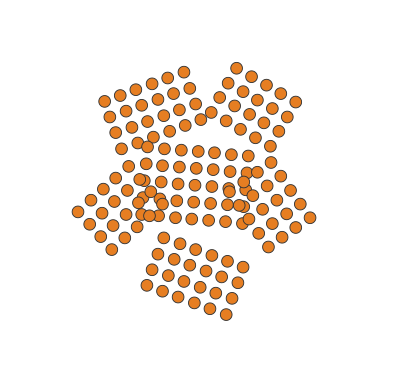
Drawn by us to help you understand the concept clearly, and verified to make sure it's accurate. For exams, practice from your textbook's own diagram.
What this figure shows. An irregular, blob-shaped granule of a solid made up of several patches ('grains'). Within each patch the particles (drawn as small uniform dots) sit in perfectly ordered rows, but each patch's rows point in a different direction, and the patches meet along irregular boundaries -- illustrating how a polycrystalline solid is an aggregat …