Crystalline and Amorphous Solids
Imagine you are in a school assembly. All students stand in neat rows and columns — every person knows exactly where to stand, and the pattern repeats across the entire ground. That is a crystalline solid. Now imagine a crowded market: people are packed together, but there is no fixed arrangement; everyone is just wherever they happen to be. That is an amorphous solid.
The difference is not about how tightly packed the particles are — both types can be dense. It is about order.
Crystalline Solids: The Ordered World
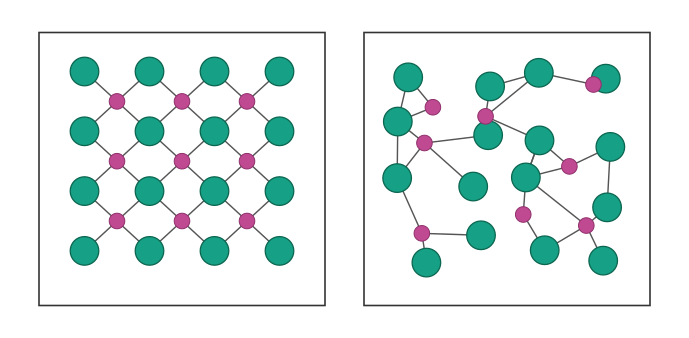
In a crystalline solid, atoms, ions, or molecules are arranged in a regular, repeating three-dimensional pattern that extends throughout the entire material. This pattern is called a crystal lattice. Because of this long-range order, every unit cell is identical to its neighbour, and the arrangement repeats for millions of atomic distances.
This order has two immediate consequences you can observe:
- Sharp melting point. When you heat a crystal, every bond is identical to every other bond. So all bonds break at exactly the same temperature — the solid turns into a liquid at one precise temperature, not over a range.
- Cleavage into smooth planes. If you break a crystal, it tends to split along flat surfaces because the planes of atoms are neatly stacked. Think of how a diamond (crystalline carbon) can be cut into facets.
Examples: sodium chloride (table salt), diamond, quartz, ice, and most metals.
The defining feature of a crystalline solid is long-range order — the arrangement of particles repeats periodically in all three dimensions.
Amorphous Solids: The Disordered World
An amorphous solid has no long-range order. The particles are arranged randomly, much like in a liquid. In fact, you can think of an amorphous solid as a supercooled liquid — a liquid that was cooled so quickly that its molecules did not get a chance to arrange themselves into a crystal before they froze.
Because there is no repeating pattern, the bonds between particles are not all identical. Some are stronger, some weaker. This leads to:
- No sharp melting point. As you heat an amorphous solid, the weaker bonds break first, then the stronger ones later. So the material softens gradually over a range of temperatures — it does not melt at one specific temperature. This is why glass can be blown and shaped while hot; it becomes soft and pliable over a range, not suddenly liquid.
- Irregular fracture. When broken, amorphous solids do not split along flat planes. Instead, they produce curved, shell-like surfaces (conchoidal fracture). Think of how a glass bottle breaks — it shatters into curved, jagged pieces, not flat cubes.
Examples: glass, rubber, plastic, wax, and amorphous silica.
Do not confuse "amorphous" with "weak." Amorphous solids can be very strong — glass is harder than many crystals. The difference is only about arrangement, not strength.
The Precise Statement …