Chemistry · Ch 1 — Solid State
Impurity defect
Impurity defect
An impurity defect arises when foreign atoms -- atoms different from those of the host -- are present in the crystal lattice. There are two kinds.
i. Substitutional impurity defect : The foreign (impurity) atoms occupy regular lattice sites, in place of the host atoms.
For example :
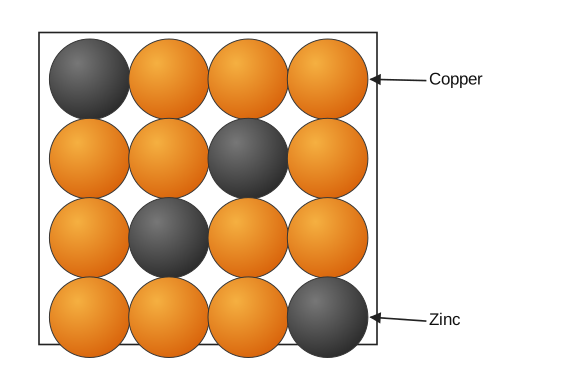
• Solid solutions of metals (alloys) : Brass is a solid solution of copper and zinc. The host lattice is that of copper, and the impurity Zn atoms occupy some of the regular lattice sites that Cu atoms would normally fill (Fig. 1.17).
Drawn by us to help you understand the concept clearly, and verified to make sure it's accurate. For exams, practice from your textbook's own diagram.
What this figure shows. A close-packed 4-by-4 array of large shaded spheres, mostly orange copper atoms (leader arrow labelled 'Copper') with four black zinc atoms (leader arrow labelled 'Zinc') sitting AT regular lattice sites in place of copper -- the substitutional solid solution brass, where the impurity replaces host ato …
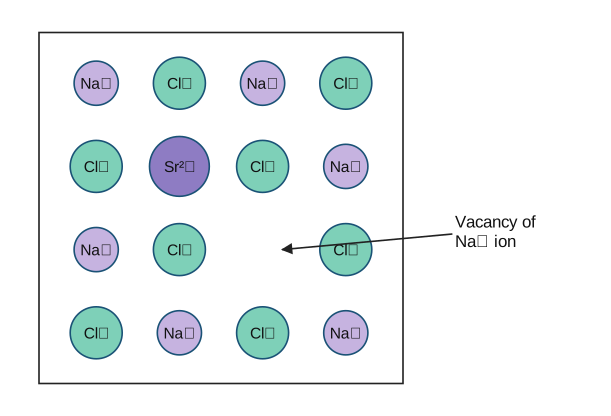
• Vacancy through aliovalent impurity : Vacancies are created when an impurity ion carrying an oxidation state different from that of the host ions is added to an ionic solid. When a small amount of is added to NaCl during its crystallisation, each ion (oxidation state +2) replaces two ions (oxidation state +1), so that the crystal stays electrically neutral. The ion occupies one of the two vacated regular sites of , and the other site remains genuinely vacant (Fig. 1.18).
Drawn by us to help you understand the concept clearly, and verified to make sure it's accurate. For exams, practice from your textbook's own diagram.
What this figure shows. A 4-by-4 grid of labelled ion circles alternating and , with one larger circle labelled occupying a regular cation site and one cation site left empty; an external leader arrow labels the empty site 'Vacancy of ion'. Each doubly charged replaces two ions -- it fills one of the two vacated sites, and the other remains vacant so the crystal stays electrically neutral. (The book prints the ionic c …
…
Drawn by us to help you understand the concept clearly, and verified to make sure it's accurate. For exams, practice from your textbook's own diagram.
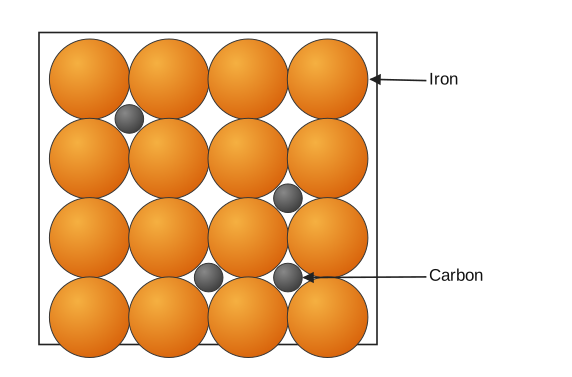
What this figure shows. A 4-by-4 array of large shaded orange iron spheres touching one another, with about five much smaller dark-grey carbon spheres tucked into the interstitial gaps between them; leader arrows label one large sphere 'Iron' and one small sphere 'Carbon'. The size contrast is the content: in steel the Fe atoms keep their regular lattice sites while the small C …