Chemistry · Ch 1 — Solid State
Stoichiometric point defects
Stoichiometric point defects
In a stoichiometric point defect the stoichiometry of the compound -- the ratio of atoms, or of cations to anions, fixed by its chemical formula -- remains unchanged even though the crystal is imperfect. There are four types.
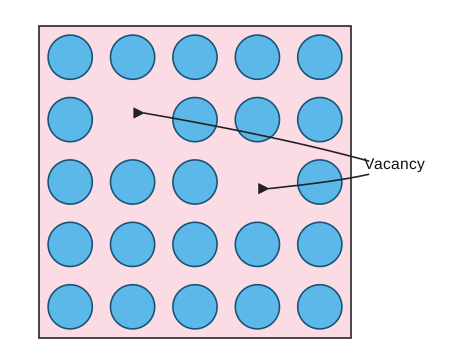
i. Vacancy defect : During crystallisation some regular lattice sites may remain unoccupied, leaving particles missing from their positions (Fig. 1.12); a vacancy defect can also arise when a solid is heated. The mass of the crystal decreases while its volume stays the same, so a vacancy defect lowers the density of the substance.
Drawn by us to help you understand the concept clearly, and verified to make sure it's accurate. For exams, practice from your textbook's own diagram.
What this figure shows. A regular 2-D grid of identical particles (uniform circles) in which two lattice sites are conspicuously empty. A single label 'Vacancy' at the right sends curved leader arrows to both empty sites -- particles missing from their regular positions, which lowers the crystal's mass (and so its density) …
ii. Self interstitial defect in elemental solid : The empty spaces between the regular lattice positions are interstitial spaces, and a self-interstitial defect arises in an elemental solid in two ways.
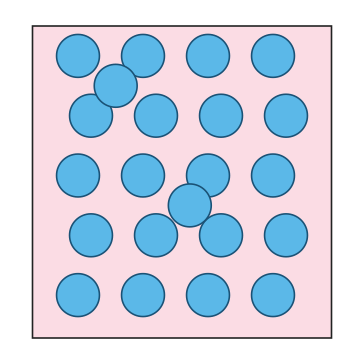
Firstly, an extra particle of the same element as those already present may occupy an interstitial space (Fig. 1.13). The mass of the crystal increases with no change in its volume, so its density increases.
Drawn by us to help you understand the concept clearly, and verified to make sure it's accurate. For exams, practice from your textbook's own diagram.
What this figure shows. A regular 2-D grid of identical particles with two EXTRA particles of the same kind squeezed into interstitial (off-grid) positions between the rows, while every regular site stays occupied. The figure carries no labels -- the point is simply the extra same-element particles in the spaces, which add mass without adding volume a …
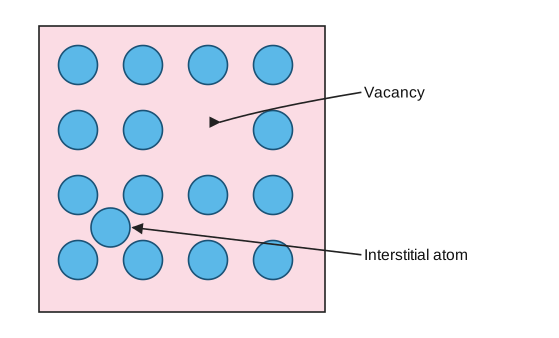
Secondly, a particle may get shifted from its original regular lattice site into an interstitial space (Fig. 1.14). This creates a vacancy defect at the original site and an interstitial defect at the new position at the same time. No particle enters or leaves the crystal, so its density is unchanged.
Drawn by us to help you understand the concept clearly, and verified to make sure it's accurate. For exams, practice from your textbook's own diagram.
What this figure shows. A regular 2-D grid of identical particles in which one regular lattice site is empty -- labelled 'Vacancy' by a leader arrow -- and the displaced particle sits in an interstitial position lower in the grid, labelled 'Interstitial atom'. One particle changing position creates a vacancy and an interstitial defect at the same time, so the density is unchanged. (The book prints the same caption, 'Self interstitial defect', for both Fig. 1.13 and Fig. 1.14 -- the …
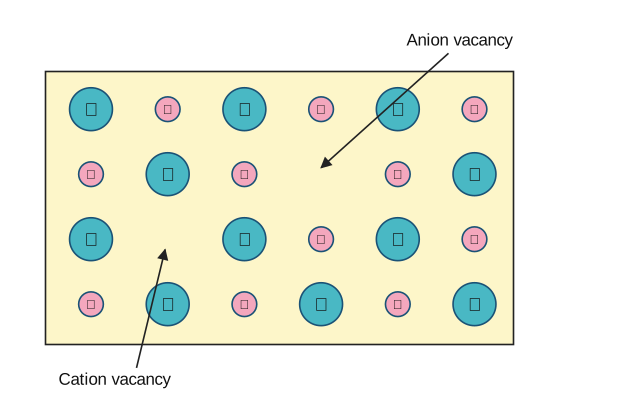
iii. Schottky defect : In an ionic solid, equal numbers of cations and anions go missing from their regular lattice sites, creating paired vacancies of opposite charge (Fig. 1.15).
Drawn by us to help you understand the concept clearly, and verified to make sure it's accurate. For exams, practice from your textbook's own diagram.
What this figure shows. A 2-D ionic lattice of alternating ions -- larger circles marked (anions) and smaller circles marked (cations). One anion site and one cation site are empty: a leader arrow from the label 'Anion vacancy' points to the missing-anion gap and one from 'Cation vacancy' to the missing-cation gap -- a matched pair of oppositely charged vacancies, so the crystal stays elec …
Conditions for the formation of Schottky defect
A Schottky defect forms in ionic compounds having: a high degree of ionic character; a high coordination number; and a small difference between the sizes of the cation and the anion, with the ratio close to unity. NaCl, AgBr and KCl show Schottky defects.
Consequences of Schottky defect
Since particles leave the crystal, its mass decreases while its volume is unchanged, so the density decreases. The number of missing cations equals the number of missing anions, so the crystal remains electrically neutral.
iv. Frenkel defect : An ion -- generally the smaller cation -- is displaced from its regular lattice site into an interstitial space (Fig. 1.16). A Frenkel defect is thus a vacancy defect and a self-interstitial defect combined within the same crystal: the ion never leaves the crystal, it only changes position.
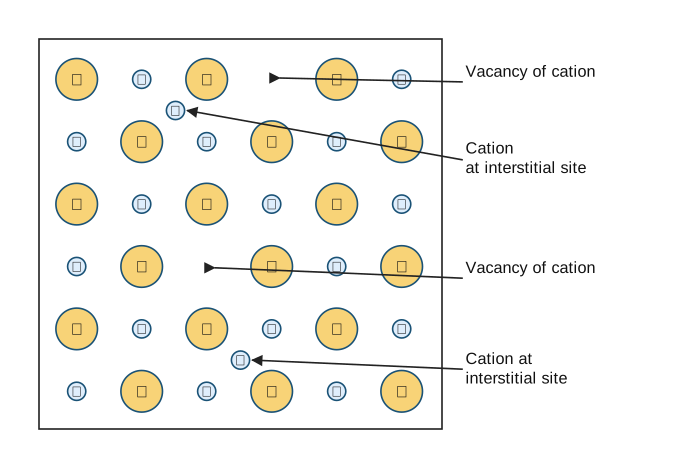
Drawn by us to help you understand the concept clearly, and verified to make sure it's accurate. For exams, practice from your textbook's own diagram.
What this figure shows. A 2-D ionic lattice of larger anions (marked ) and smaller cations (marked ) in which TWO cations are displaced: their empty regular sites are each labelled 'Vacancy of cation', and the displaced ions, sitting in interstitial spaces, are each labelled 'Cation at interstitial site'. No ion has left the crystal -- each displacement pairs a vacancy with an interstitial defect, so density …
Conditions for the formation of Frenkel defect …