Chemistry · Ch 1 — Solid State
Nonstoichiometric defects
Nonstoichiometric defects
In a nonstoichiometric defect the ratio of the atoms -- or of the cations to the anions -- genuinely becomes different from the ratio indicated by the compound's chemical formula, though the overall crystal structure is preserved. There are two types.
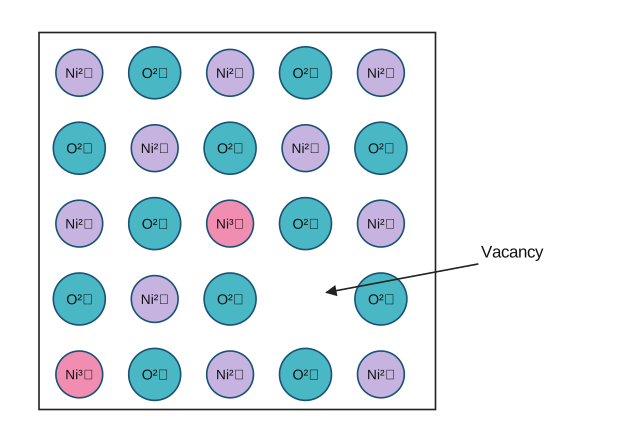
i. Metal deficiency defect : This defect occurs only in compounds of metals that show variable oxidation states. Some cations are missing from their regular lattice sites, and the resulting deficit of positive charge is made up by an equal extra positive charge carried on other cations of the same metal in a higher oxidation state. In nickel oxide, for every missing ion, two other ions are oxidised to , restoring the charge balance -- the crystal then has the nonstoichiometric formula (Fig. 1.20).
Drawn by us to help you understand the concept clearly, and verified to make sure it's accurate. For exams, practice from your textbook's own diagram.
What this figure shows. Five rows of alternating labelled ion circles -- and larger -- with one nickel site empty (external leader arrow labelled 'Vacancy') and two highlighted circles relabelled . The two ions carry exactly the positive charge the missing left behind, giving the electrically neutral but nonstoichiometric crystal $Ni_{0.97}O_{ …
ii. Metal excess defect : A crystal can come to contain excess metal in two ways.
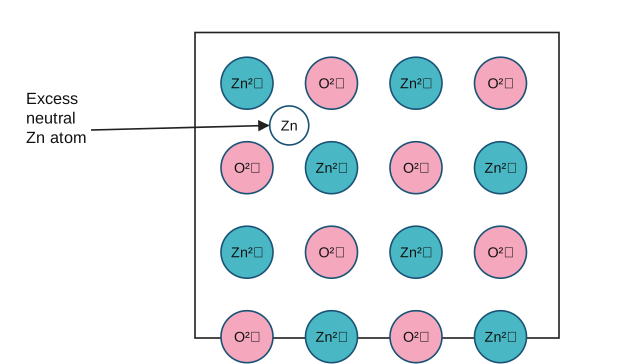
• A neutral atom or an extra positive ion occupies interstitial position : In the first case, an electrically neutral metal atom is present in an interstitial space -- in ZnO, an excess neutral Zn atom occupies an interstitial site (Fig. 1.21a), giving the formula .
Drawn by us to help you understand the concept clearly, and verified to make sure it's accurate. For exams, practice from your textbook's own diagram.
What this figure shows. A ZnO lattice of alternating labelled circles -- and -- with one white circle labelled Zn (a NEUTRAL zinc atom, no charge) sitting at an interstitial position between the rows; a straight leader arrow from the label 'Excess neutral Zn atom' points to it. This is the first route to the metal-excess formula $Zn_{1+x} …
In the second case, ZnO loses oxygen on heating:
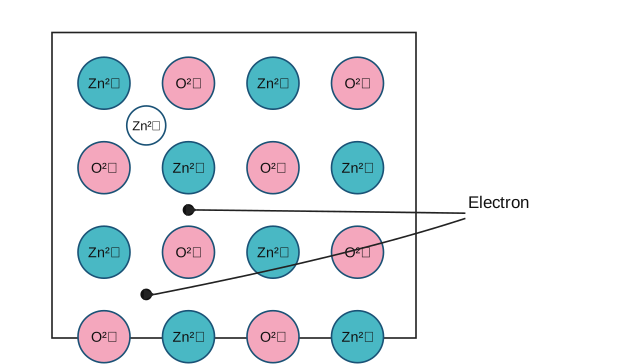
The ions so formed, together with the released electrons, occupy interstitial spaces (Fig. 1.21b); the crystal again has the formula .
Drawn by us to help you understand the concept clearly, and verified to make sure it's accurate. For exams, practice from your textbook's own diagram.
What this figure shows. The same ZnO lattice of labelled and circles, now with an extra circle labelled at an interstitial site and TWO free electrons drawn as small black dots at other interstitial positions; the label 'Electron' sends curved leader arrows to both dots. These are the interstitial ions and electrons trapped when heated ZnO loses oxygen -- the second route to . (The book's caption misprints …
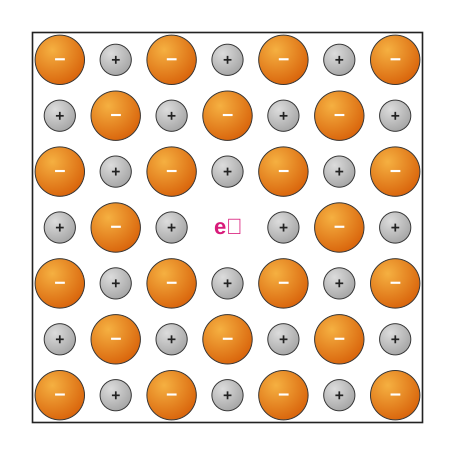
• By anion vacancies (Colour or F-centres) : When NaCl crystals are heated in sodium vapour, Na atoms are deposited on the crystal surface, and ions diffuse out to the surface to combine with them:
…
Drawn by us to help you understand the concept clearly, and verified to make sure it's accurate. For exams, practice from your textbook's own diagram.
What this figure shows. A tightly packed lattice of shaded spheres -- larger ones marked (anions) and smaller ones marked (cations) -- in which one anion position near the centre holds no ion; instead the highlighted symbol sits there, the only coloured element in the drawing. An electron trapped in an anion vacancy is an F-centre (colour centre), the defect that turns NaCl …