Chemistry · Ch 1 — Solid State
Metals
Metals
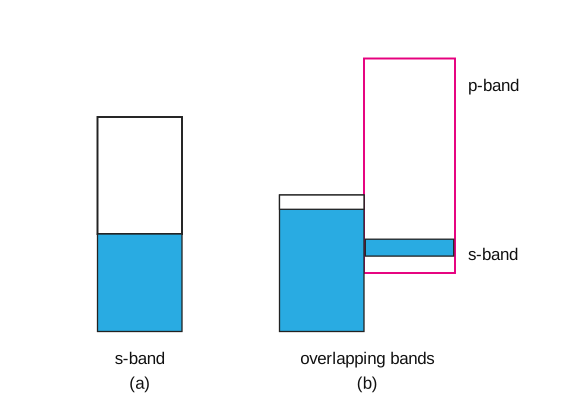
Metals are good conductors of electricity because the outermost electrons of all the atoms in the metallic crystal occupy the conduction band, and the number of electrons in that band is enormous. A metallic conductor shows one of two band patterns: a partially filled conduction band, as in sodium, or a filled band overlapping a vacant band, as in magnesium (Fig. 1.23). Band formation in metallic conductors thus always delocalises the outermost electrons of all the metal atoms, leaving metal ions behind -- the situation described as 'cations of metal immersed in the sea of electrons'.
Drawn by us to help you understand the concept clearly, and verified to make sure it's accurate. For exams, practice from your textbook's own diagram.
What this figure shows. Two flat band diagrams. (a), labelled 's-band': a single rectangle whose lower half is filled (shaded) and upper half empty -- a partially filled band with no gap, the sodium pattern. (b), labelled 'overlapping bands': a mostly filled s-band rectangle overlapping in energy with a tall empty p-band rectangle, the small overlap region marked -- the magnesium pattern, where electrons move from the filled band into the overlapping vacant band. ( …
Do you know?
Metallic sodium is an example of a conductor whose conduction band is partially filled, with no band gap. The electronic configuration of Na is . Interaction of the partially filled atomic orbitals of all the Na atoms gives rise to the same number of closely spaced MOs, which together form a continuous 3s band. The lower half of this band corresponds to the bonding MOs and is filled, while the upper half corresponds to the antibonding MOs and is empty, with no gap between the two halves. This partially filled 3s band is sodium's conduction band; it contains as many electrons as there are sodium atoms, which is responsible for the high conductivity of metallic sodium.
Metallic magnesium is an example of a conductor with overlapping bands. The electronic configuration of Mg is . Interaction of the completely filled AOs of all the Mg atoms forms a completely filled 3s band, and interaction of the vacant AOs forms a vacant 3p band. The filled 3s band and the vacant 3p band overlap each other, so the higher-energy electrons move from the 3s band into the 3p band.
…