Chemistry · Ch 1 — Solid State
Semiconductors
Semiconductors
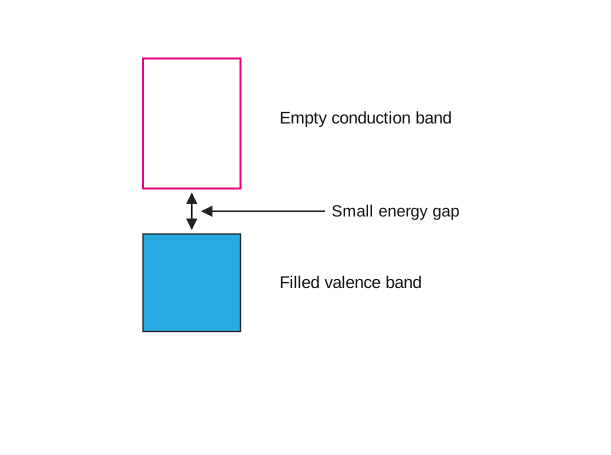
A semiconductor's electrical conductivity is intermediate between that of a metal and that of an insulator; the metalloids silicon and germanium are the classic examples. As in an insulator, the valence band of a semiconductor is completely filled and its conduction band is empty -- but the energy gap between the two bands is much smaller (Fig. 1.25). At any temperature above absolute zero, some electrons of the valence band gain enough thermal energy to jump this small gap into the conduction band: the conduction band becomes partially filled, the valence band becomes partially empty, and the material conducts a small amount of electricity when a potential is applied. A pure semiconductor showing this low but finite conductivity is called an intrinsic semiconductor.
Drawn by us to help you understand the concept clearly, and verified to make sure it's accurate. For exams, practice from your textbook's own diagram.
What this figure shows. The same layout as the insulator diagram -- 'Filled valence band' below, 'Empty conduction band' above -- but with a visibly SMALL separation between the two, marked by a short double-headed arrow labelled 'Small energy gap'. At ordinary temperatures a few valence electrons can gain enough thermal energy to jump this smaller gap, giving the mat …
…