Chemistry · Ch 2 — Solutions
Ideal and Nonideal Solutions
Ideal and Nonideal Solutions
1. Ideal solutions : Solutions with the following properties are called ideal solutions.
i. Ideal solutions obey Raoult's law over the entire range of concentrations.
ii. No heat is evolved or absorbed when two components forming an ideal solution are mixed -- the enthalpy of mixing is zero, .
iii. There is no volume change when two components forming an ideal solution are mixed: the volume of an ideal solution is equal to the sum of the volumes of the two components taken for mixing, .
iv. In an ideal solution, the solvent-solute, solute-solute and solvent-solvent molecular interactions are comparable.
v. The vapour pressure of an ideal solution always lies between the vapour pressures of the pure components, as shown in Fig. 2.2.
It is important to understand that perfectly ideal solutions are uncommon; solutions such as benzene + toluene behave nearly ideally.
2. Nonideal solutions :
i. These solutions do not obey Raoult's law over the entire range of concentrations.
ii. The vapour pressures of these solutions can be higher or lower than those of the pure components.
iii. Deviation from the Raoult's law : These solutions show two types of deviation from the Raoult's law.
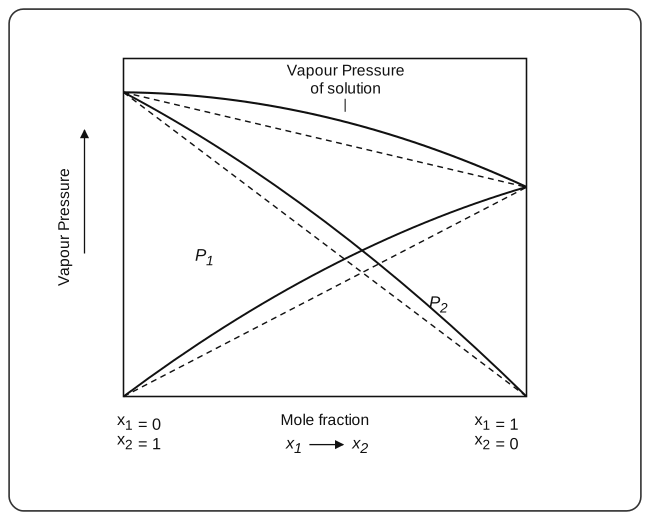
A. Positive deviations from Raoult's law - The solutions in which the solute-solvent intermolecular attractions are weaker than those between solute-solute molecules and solvent-solvent molecules exhibit positive deviations. The vapour pressures of such solutions are higher than those of the pure components, as shown in Fig. 2.3. The solutions of ethanol and acetone, and of carbon disulphide and acetone, show positive deviations from the Raoult's law.
Drawn by us to help you understand the concept clearly, and verified to make sure it's accurate. For exams, practice from your textbook's own diagram.
What this figure shows. Vapour pressure against mole fraction (from at the left edge to at the right). The dashed straight lines are the ideal Raoult's-law references (the two partial-pressure diagonals and the total-pressure line); the solid curves -- , and the topmost 'Vapour Pressure of solution' curve -- all bow above their dashed ideal lines. This happens when solute-solvent attractions are weaker than solute-solute and solvent-solvent attractions, so molecules escape into the vapour more easily than in an ideal mixture. *(The book's printed caption …
…
Drawn by us to help you understand the concept clearly, and verified to make sure it's accurate. For exams, practice from your textbook's own diagram.
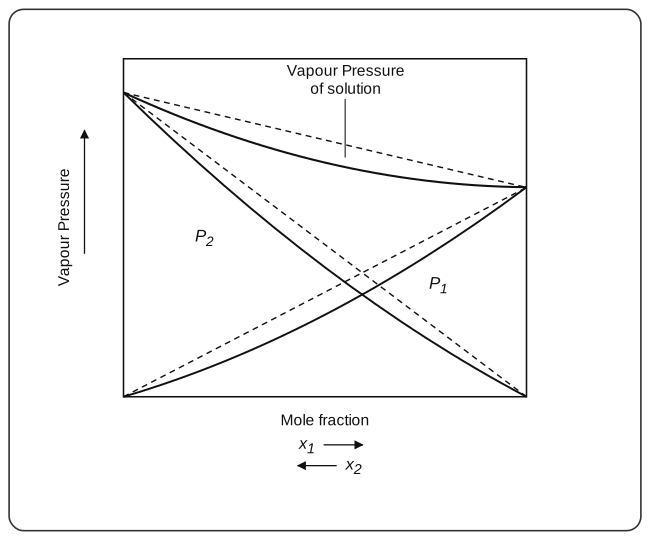
What this figure shows. The mirror image of Fig. 2.3: vapour pressure against mole fraction (same corner conventions), with the solid curves -- , and the topmost 'Vapour Pressure of solution' curve -- all sagging below the dashed ideal Raoult's-law lines. This happens when solvent-solute attractions are stronger than solute-solute or solvent-solvent attractions, so molecules are held back from escaping into the vapour. *(The book's …